Free Executive Resume Template
An executive resume template is built for people judged on scope and results: directors, vice presidents, general managers, CXOs and senior managers stepping up to their first executive role. It opens with a short leadership summary, shows the size of what you ran — teams, budgets, regions, revenue — and keeps the design restrained enough to sit in a board pack. ResumeInk rebuilds your existing resume in this format from a PDF, Word file or photo, then lets you tighten every line in the editor.
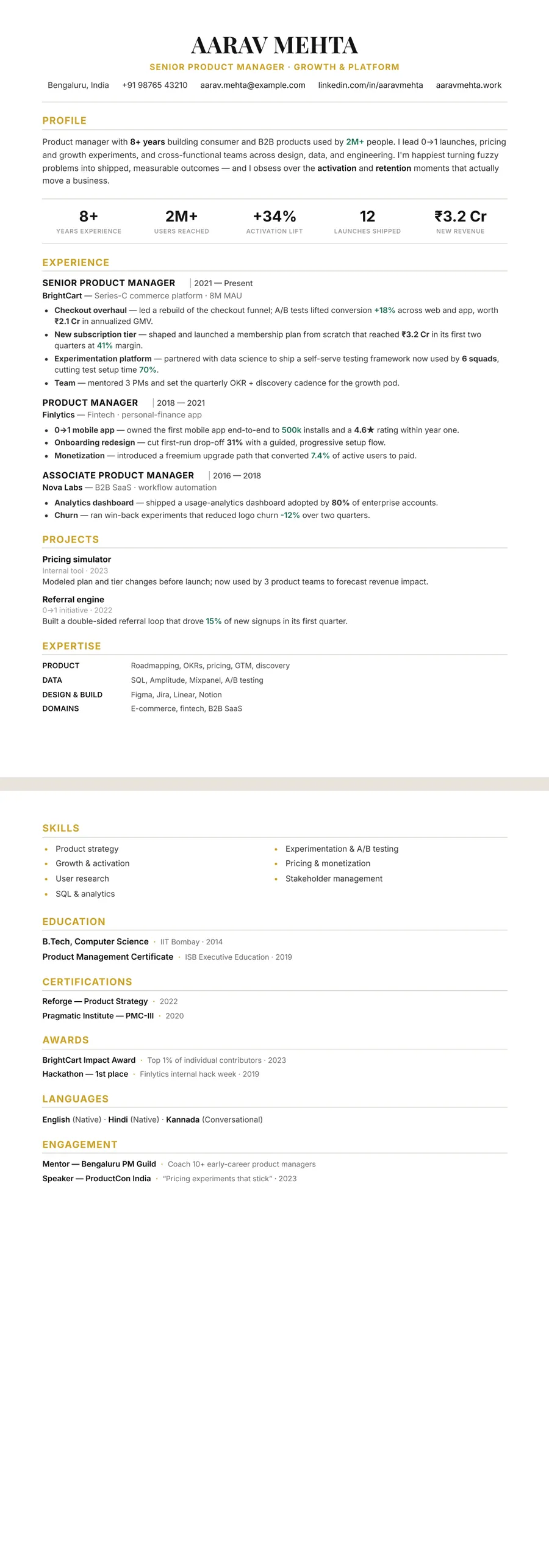
How an executive resume differs
A mid-level resume proves you can do the work. An executive resume proves you can run it. That changes what goes where.
- A leadership summary of three or four lines: your function, your sector, the scale you lead at and the kind of problem you are brought in to solve.
- A row of key numbers near the top, such as years in leadership, team size, budget or revenue owned. Use only figures you can defend in an interview.
- Scope before tasks. Under each role, one line on the remit (people, budget, markets), then three to five outcomes.
- Board and advisory roles in their own short section after experience.
The design should step back. Board members and search consultants read many of these; a calm page with one muted colour, a clear hierarchy and no icons signals the same judgement you claim in the summary. Fewer, stronger lines beat a long list of everything you have touched.
Who it is for, and why two pages is fine
Use this template if you are a director, VP, head of function, country manager, partner or C-level leader, or a senior manager applying one level up. It works across banking and finance, manufacturing, technology, healthcare, consulting and the public sector.
Two pages is normal at this level, and readers of senior resumes are used to it. The test is whether page two still earns its place. Keep the last ten to fifteen years in detail and fold older roles into a single line, such as Earlier roles: Regional Sales Manager at two FMCG companies, 2006 to 2011. Our post on one page vs two pages goes deeper. In India and the UK many senior candidates still call this a CV and send longer ones; trimming to two pages usually makes it stronger, not weaker.
It is not the right template for a first-time team lead with little scope to show yet, or when a recruiter asks for a one-page profile. In those cases, lead with outcomes in a shorter format.
ATS, search firms and the executive resume
Many senior roles are filled through executive search firms or direct approaches, but the formal application often still passes through an applicant tracking system. Your resume has to impress a search partner and parse cleanly for software.
The Formal, Classic and Stacked layouts are single-column, so the text runs top to bottom in the order a person reads it. Figures such as revenue, headcount and budget are ordinary text, so they come through when the text is extracted. Every ResumeInk design is checked for this.
Where executives slip is wording. Use the title the job ad uses, such as Chief Operating Officer rather than only COO, and spell out each acronym once. Name what you led in plain terms: profit and loss ownership, mergers and integration, regulatory change, digital transformation. Our guide to resume keywords for ATS screening shows how to match a job description without stuffing it with buzzwords.
Build an executive resume with ResumeInk
Send in the resume you already use, whether it is a PDF, a Word document or a phone photo of a printed page. The AI rebuilds it in your chosen design and leaves every line open to edit. Three themes fit a board-ready tone:
- Noir executive — sharp black on white, minimal and decisive.
- Platinum slate — understated grey with a premium feel; see the Platinum executive design.
- Midnight gold — navy with gold accents, formal with a little warmth.
For layout, Formal gives a centred, restrained header that suits finance, legal and government roles. Classic sets dates in a narrow column to the left of each role, so tenure is easy to scan. Stacked puts an expertise grid and education above experience, useful when breadth across functions is the point. The optional AI help can tighten wording and tailor the summary to a specific job description, and the ATS score shows how readable the result is. Switch designs in one tap without retyping, hide sections you don't need, and adjust spacing until both pages sit well.
Senior leadership designs you can use


Build your resume in minutes
Upload your current resume, edit anything, then preview and download it free.
Upload your resumeFrequently asked questions
How long should an executive resume be?
Two pages is normal for senior leaders. Keep the top half of page one strong enough to stand on its own, and summarise roles older than about fifteen years in a line or two.
What is the difference between a senior manager resume and an executive resume?
A senior manager resume shows how you delivered results through a team. An executive resume shows the strategy, budget, revenue and organisation you were accountable for, and what changed because of your decisions.
Should an executive resume include a photo?
In the US, UK, Canada and Australia, leave it off. In India, the Middle East and parts of Europe and Asia a photo is common but still optional; if you want one, the Sidebar and Portrait layouts show it in a circle at the top of the side column.
Where do board and advisory roles go on an executive resume?
In a short section after your experience, listing the organisation, your role and the years. In ResumeInk you can add it as its own section and move it to sit right after experience.