Free Professional Resume Template
A professional resume template is the conventional, corporate-safe choice: a clear header, a short profile, experience with the latest role first, then skills and education, in calm colours and readable type. It is the format most recruiters expect, so nothing distracts from your record. It suits finance, consulting, operations, management and most office roles, and it works for a resume in the US as well as a CV in India or the UK. ResumeInk's professional designs keep that structure and are checked to read cleanly in ATS text extraction.
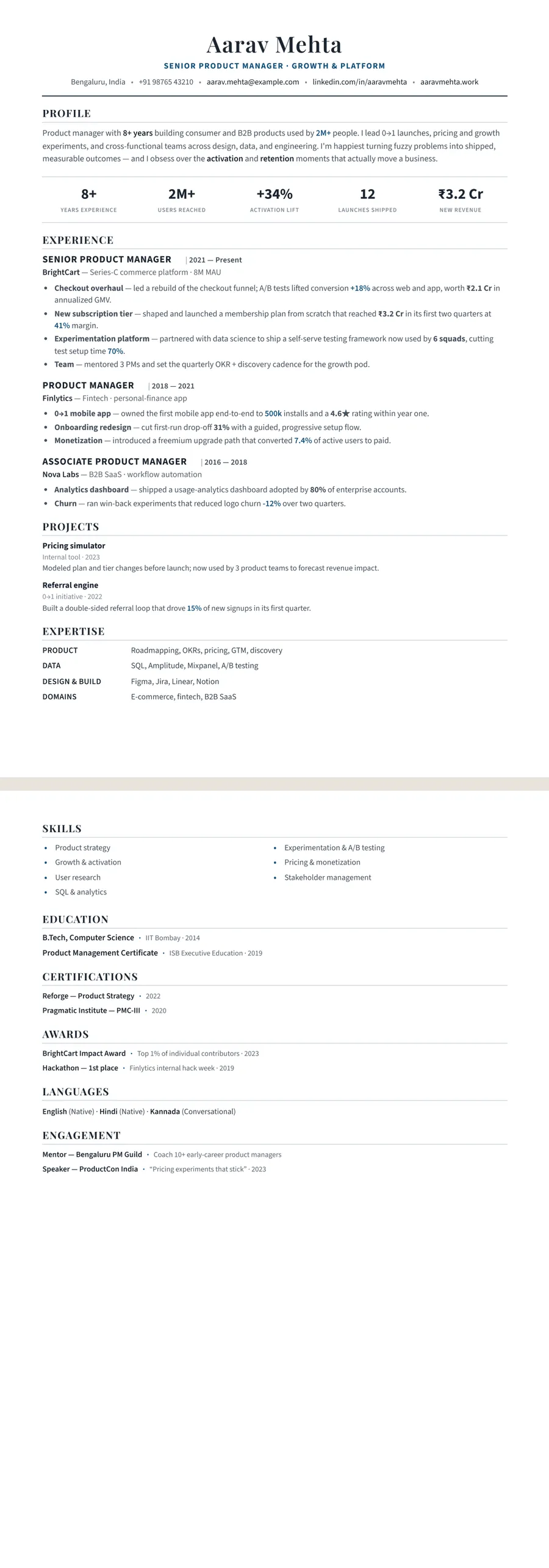
What a professional resume format looks like
The professional resume format is less a design than an agreement between you and the reader. Sections come in the order a recruiter expects:
- Header — name, job title, phone, email, city and a LinkedIn link
- Profile — three or four lines on who you are and what you deliver
- Experience — most recent role first, with results in short bullets
- Skills, education and certifications — grouped and easy to scan
What sets it apart from modern or creative styles is restraint in the details: one muted accent colour, a serif or plain sans-serif typeface, aligned dates and no graphics. A professional template does not try to stand out on looks. It stands out by being easy to read, so a hiring manager can follow your career from top to bottom without hunting for anything.
Who should choose a professional template, and when not
This format suits anyone applying to established organisations, and especially:
- Finance and accounting — banks, audit firms, insurers
- Consulting — where the resume itself is read as a work sample
- Operations and supply chain — roles judged on reliability and results
- Managers and senior leaders — where calm presentation signals judgment
Norms differ by country. In the US, a professional resume usually has no photo or date of birth and runs one or two pages. In the UK the same document is called a CV, also without a photo, and two pages is normal for experienced people. In India a professional CV often runs two pages, and some employers still expect a photo and personal details, so follow what the job posting asks.
If you work in a creative field, or at a startup that values personality, a modern resume template may serve you better.
Why a professional resume reads well in ATS
Conventional structure helps hiring software for the same reason it helps people. Standard headings such as Experience, Education and Skills match what parsers look for. Reverse-chronological order with clear dates lets the system work out your job history. A single column means the reading order is never in doubt.
ResumeInk's professional layouts follow that pattern. Classic gives each role's dates their own slim left-hand column. Formal places a centred, restrained header over a single column. Stacked puts your expertise grid and education above experience, with dates in a left column. All of them use real, selectable text with no words inside images, and every design is checked in ATS text extraction.
The template does half the work; your words do the rest. Use the job titles and skill terms from the posting where they truthfully describe you. The ATS-friendly resume guide walks through the details.
Make a professional resume with ResumeInk
Your existing resume is the starting point. Upload it as a PDF, a DOCX or a PNG or JPG photo, up to 20 MB, and ResumeInk's AI turns it into a designed, editable resume. You can also start from a sample. Professional pairings to try:
- Professional Classic — deep blue accents and a serif name, the safest all-rounder
- Platinum slate on the Formal layout — understated and premium, for senior and finance roles
- Slate tech Stacked — cool blue-grey for operations, analytics and IT
- Noir executive on Classic or Formal — sharp black with a gold accent for leadership roles
Edit any line by clicking it, reorder sections, and let the AI polish your wording or match the resume to a specific job description. Check the ATS score, then download a clean PDF. If one employer wants something plainer, switch designs in one tap; your content stays exactly as you wrote it.
Professional designs you can use


Build your resume in minutes
Upload your current resume, edit anything, then preview and download it free.
Upload your resumeFrequently asked questions
What is the best professional resume format?
For most people, reverse-chronological: a short profile, then experience with the most recent role first, then skills and education. It is what recruiters expect and what hiring software reads most reliably.
Should a professional resume have a photo?
In the US, UK, Canada and Australia, usually not. In India, the Gulf and parts of Asia and Europe a photo is more common, so check what the employer prefers. In ResumeInk the photo is always optional.
Is a resume the same as a CV?
In the US, a resume is a short career summary and a CV is a longer academic record. In the UK, India and much of the world, people say CV for what Americans call a resume. The professional format works for both.
What colours are safe for a professional resume?
Navy, deep blue, grey, dark green or plain black. Use one accent for headings and keep body text dark on white, so the resume prints and copies cleanly.