Free Brand Manager Resume Template & Examples
A brand manager resume should read like a short brand review: the brands you ran, the share and sales you moved, the launches you took to shelf and the budget you were trusted with. This guide is for assistant, associate and senior brand managers in FMCG, the consumer goods world the US calls CPG. It covers format, credentials and rules by country, summary and bullet examples, keywords and common mistakes. Upload your current resume and ResumeInk's AI rebuilds it in a clean, ATS-readable design.
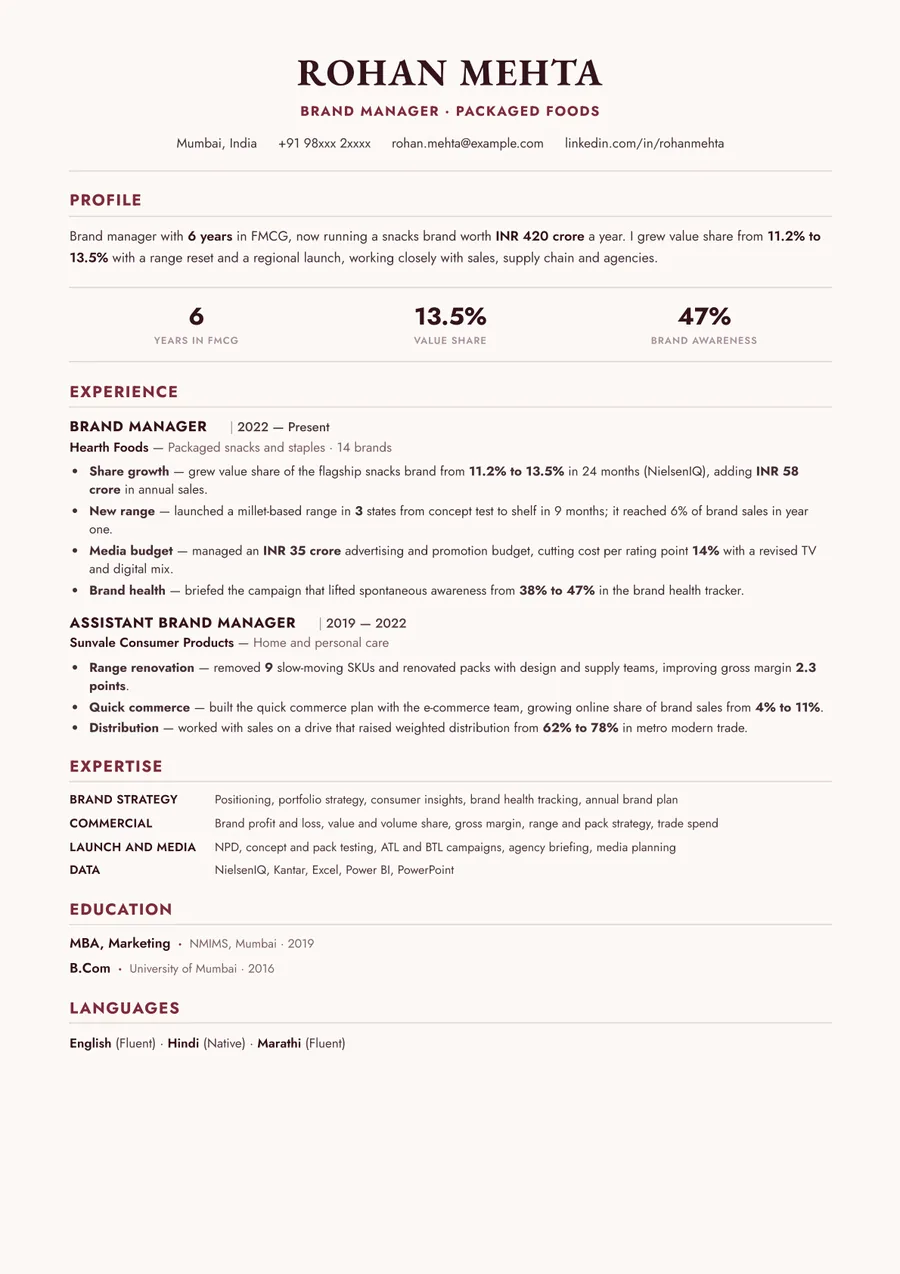
Best resume format for a brand manager
Use reverse-chronological order and keep to one page until senior brand manager or marketing manager level, when two pages are fine if the second page earns its place. Management trainees and assistant brand managers with one or two rotations should stay on one page.
Section order: header, a short summary naming your category (personal care, foods, beverages, home care, OTC health), experience, skills, education. Put your MBA or PGDM at the top of Education with the year. Under each role, add one line of scope before the bullets: the brands, their annual sales and the advertising and promotion budget you managed. List a sales rotation as its own short entry; FMCG employers value it.
Layout tip: a clean single column keeps share figures and brand names in reading order. ResumeInk's Classic centered layout dates each role in a narrow left column, and Formal suits senior roles. Browse professional resume templates for more options.
What to include in a brand manager resume
- Brands and scale: brand names (or a description if confidential), category, annual sales and markets.
- Business results: value and volume share, sales growth, gross margin, penetration and distribution gains, with the data source.
- Launches and renovations: new products, pack changes and relaunches, from consumer insight to shelf, with year-one results.
- Campaigns: TV, digital and in-store work you briefed agencies on, with a brand health or sales result.
- Budget and profit: the advertising and promotion budget you owned, and whether you ran the brand's profit and loss.
- Channels: modern trade, general trade, e-commerce and quick commerce in India; grocery, club and online in the US; supermarkets and discounters in the UK and Australia.
- Cross-functional work: the product development, supply chain, sales and finance teams you led through a launch.
- Awards: effectiveness awards such as an Effie, always with the business result next to them.
If you are moving into a wider marketing role, compare the marketing manager resume guide.
Brand manager certifications and credentials by country
Brand management has no licence. Employers judge your business school, your rotations and the results of the brands you ran. Working knowledge of the rules on claims and packs is a real plus, especially in food and personal care.
- India: an MBA or PGDM in marketing is the usual entry route, often through a management trainee programme. Food roles value knowledge of FSSAI labelling rules, the Legal Metrology rules for packaged goods, and the ASCI code for advertising claims.
- US: many CPG companies hire entry brand roles from MBA programmes. Food labels follow FDA rules, and advertising claims must be substantiated under FTC rules.
- UK: graduate schemes and assistant brand manager roles are the common entry points, and CIM qualifications help. Ads follow the CAP Code, and less healthy food and drink faces extra advertising restrictions.
- Australia: food labels follow the Food Standards Code, ads the AANA Code of Ethics, and the AMI's Certified Practising Marketer status is recognised.
If you have taken a claim or pack change through legal and regulatory review, say so in a bullet; it shows you can launch without costly delays.
Brand manager resume summary examples
Name the category, the size of the brand and a share or growth number. Three examples:
- Entry level: Assistant brand manager with an MBA in marketing and 18 months on a hair care portfolio after a sales rotation. Ran the consumer research and pack testing for a shampoo variant that reached 4% of brand sales in its first year.
- Mid level: Brand manager with 6 years in packaged foods, running a snacks brand worth INR 420 crore a year. Grew value share from 11.2% to 13.5% in two years through a range reset and a regional launch across 3 states.
- Senior: Senior brand manager with 11 years in beverages across the US and Canada, leading 3 brand managers and a USD 38M marketing budget. Relaunched the core range and returned the brand to growth after four years of decline.
More openings by career stage are in the resume summary examples guide.
Brand manager resume bullet point examples
- Grew value share of a snacks brand from 11.2% to 13.5% in 24 months (NielsenIQ), adding INR 58 crore in annual sales.
- Launched a millet-based range in 3 states from concept test to shelf in 9 months; it reached 6% of brand sales in year one.
- Managed an INR 35 crore advertising and promotion budget, cutting cost per rating point 14% with a revised TV and digital mix.
- Briefed the agency on a campaign that lifted spontaneous brand awareness from 38% to 47% in the brand health tracker.
- Removed 9 slow-moving SKUs and renovated packs with design and supply teams, improving gross margin 2.3 points.
- Built the quick commerce plan with the e-commerce team, growing online share of brand sales from 4% to 11%.
- Worked with sales on a distribution drive that raised weighted distribution from 62% to 78% in metro modern trade.
- Ran a sampling programme of 400,000 trial packs in US club stores, lifting household penetration 1.8 points in two quarters.
Each bullet names the brand lever you pulled and the number it moved, with a data source where it matters, such as NielsenIQ, Kantar or your brand health tracker.
Skills & ATS keywords for brand manager resumes
FMCG and CPG job ads repeat the same core terms. Use the ones that match your work:
- Brand strategy: brand positioning, brand architecture, portfolio strategy, consumer insights, brand health tracking, annual brand plan.
- Commercial: profit and loss ownership, market share, volume and value growth, gross margin, pack and range strategy, revenue growth management, trade spend.
- Innovation: new product development (NPD), concept and pack testing, stage-gate, renovation, go-to-market.
- Communication: 360-degree campaigns, ATL and BTL, media planning, agency management, shopper marketing, influencer and digital.
- Retail and channels: modern trade, general trade, e-commerce, quick commerce, retail media, trade marketing.
- Metrics: penetration, numeric and weighted distribution, rate of sale, share of voice, brand funnel, TRPs and GRPs.
- Data and tools: NielsenIQ, Kantar, Circana, Excel, PowerPoint, Power BI or Tableau.
- Soft skills: leading without authority, storytelling, deciding with incomplete data.
Test a draft against a real job ad with the ATS resume checker.
Common brand manager resume mistakes
- Campaigns without business results. An award-winning ad is nice, but hiring managers ask what happened to share, sales or penetration in the months after it ran.
- No data source. Write “value share, NielsenIQ, MAT” or “Kantar household panel” so the number reads as audited rather than estimated.
- Too many brands, too little depth. Rotated through four brands in three years? Give one or two results per brand and put the strongest first.
- Hiding confidential numbers badly. If you cannot share sales, use growth rates, share points or an index, not vague words.
- Ignoring the channel. Say where growth came from: modern trade, e-commerce, quick commerce, export or rural general trade, and what you changed there.
- Claiming agency work. Say what you briefed, approved or changed, not that you “created” the ad.
Premium, ATS-friendly templates


Build your resume in minutes
Upload your current resume, edit anything, then preview and download it free.
Upload your resumeFrequently asked questions
How do I get into brand management with no experience?
Most brand managers start through an MBA or PGDM management trainee programme, a graduate scheme or a sales role at a consumer goods company. On your resume, lead with internships, live projects and any sales or trade marketing work with numbers attached.
Should a brand manager resume include an MBA?
Yes, if you have one. List it at the top of Education with the school, specialisation and year, since many FMCG and CPG employers hire brand teams from MBA programmes. Without an MBA, put strong brand results first and Education last.
How do I show results if my brand's numbers are confidential?
Use share points, growth percentages or an index instead of absolute sales, and name the data source. Hiring managers expect this and will not mark you down for it.
What is the difference between an assistant and an associate brand manager?
Both are entry roles under a brand manager, and companies use the titles differently. Use the title your employer gave you and make the scope clear in the first line of the role.
Can I move from FMCG sales into brand management?
Yes, many FMCG companies value field sales experience in brand teams. Show distribution, trade and customer numbers from your sales roles, and add any consumer research, launch or trade marketing work you supported.