Free Business Analyst Resume Template & Examples
A business analyst resume should read like good requirements: clear, specific and traceable to an outcome. Hiring managers want to know which problems you analysed, how you gathered and documented requirements, who you worked with and what changed once the solution went live. This page covers the format, summary examples from graduate to lead, bullet examples with measurable results, the skills and keywords BA job ads repeat in India, the US, the UK and Australia, and the mistakes that make strong analysts look generic.
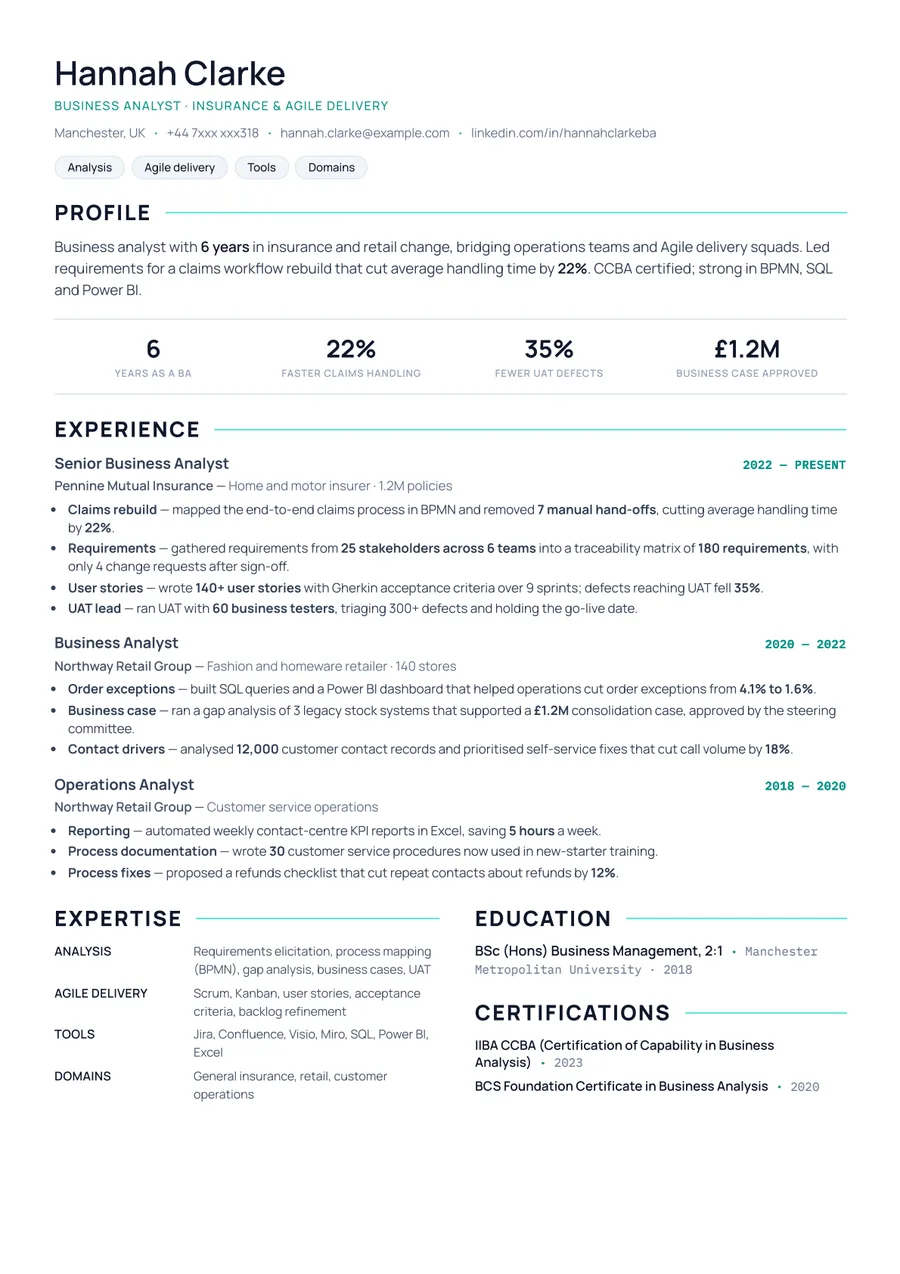
Best resume format for a business analyst
Use one page with under about five years of experience, and two pages as a senior or lead BA with several programmes to describe. Reverse-chronological order suits most people: summary, skills, experience, certifications, education.
If you are moving into business analysis from operations, QA, customer support or finance, a hybrid layout helps. ResumeInk's Skills-first layout puts a shaded Expertise block of grouped skills before your experience, so the transferable work is seen first; see our skills-based resume templates. Otherwise Classic or Timeline keep the focus on your progression.
Contractors in the UK and Australia often have several short engagements. Group them under one contracting heading with each client's sector, the dates and one or two results, rather than a long list of three-month jobs. In India, name the domain you served, such as BFSI, healthcare or retail, because many ads filter on it.
What to include in a business analyst resume
- Domain knowledge: banking, insurance, retail, telecoms, healthcare or public sector, and the systems those teams run on.
- Delivery approach: Agile (Scrum, Kanban, SAFe), waterfall or hybrid, and your part in it.
- What you produce: BRDs and FRDs, user stories with acceptance criteria, use cases, BPMN process maps and a requirements traceability matrix.
- Stakeholders: who you worked with and at what level, from front-line users to steering committees.
- Outcomes: time saved, errors reduced, adoption, cost avoided, defects caught before go-live.
- Certifications: IIBA's ECBA, CCBA and CBAP (from entry to senior), the IIBA-AAC for agile analysis, the BCS Foundation Certificate and International Diploma in Business Analysis (common in the UK), and product owner certificates such as CSPO or PSPO.
Mostly building dashboards and SQL analysis? Compare with our data analyst resume guide.
Business analyst resume summary examples
- Entry level: Business Information Systems graduate with a 12-month placement in a bank's change team. Wrote 60+ user stories with acceptance criteria, mapped as-is processes in Visio and supported UAT for a customer onboarding release. ECBA certified, with working SQL and Jira.
- Mid level: Business analyst with six years in insurance and retail, bridging operations teams and Agile delivery squads. Led requirements for a claims workflow rebuild that cut average handling time by 22%. Strong in BPMN, SQL and Power BI; CCBA certified.
- Senior: Lead business analyst with 11 years on banking transformation programmes. Sets standards for a team of eight BAs, owns requirements for core-platform migrations and turns executive goals into roadmaps delivery teams can build. CBAP.
Use the job title from the ad if it matches your work, such as business systems analyst or functional analyst, and name your domain in the first line.
Business analyst resume bullet point examples
- Gathered requirements from 25 stakeholders across 6 teams for a loan-origination rebuild and kept a traceability matrix of 180 requirements, with only 4 change requests after sign-off.
- Mapped the end-to-end claims process in BPMN and removed 7 manual hand-offs, cutting average handling time by 22%.
- Wrote 140+ user stories with Gherkin acceptance criteria over 9 sprints; defects reaching UAT fell by 35%.
- Built SQL queries and a Power BI dashboard on order exceptions, helping operations cut them from 4.1% to 1.6% of orders.
- Led UAT for a CRM migration with 60 business testers, triaging 300+ defects and holding the go-live date.
- Ran a gap analysis of 3 legacy stock systems that supported a £1.2M consolidation business case, approved by the steering committee.
- Analysed 12,000 customer contact records and prioritised self-service fixes that cut call volume by 18%.
- Wrote a BA playbook and templates adopted by 12 analysts, halving onboarding time for new BAs from 6 weeks to 3.
Each bullet links an analysis activity to a business result. That link is what separates a strong BA resume from a list of documents.
Skills & ATS keywords for business analyst resumes
- Analysis: requirements elicitation, stakeholder analysis, process mapping, gap analysis, root cause analysis, business cases, cost-benefit analysis, data analysis, UAT.
- Documentation: BRD, FRD, user stories, acceptance criteria, use cases, RTM, BPMN, UML, wireframes.
- Methods: Agile, Scrum, Kanban, SAFe, waterfall, BABOK, change management.
- Tools: Jira, Confluence, Azure DevOps, Visio, Lucidchart, Miro, Balsamiq, Excel, SQL, Power BI, Tableau; Salesforce, ServiceNow or SAP where the role is system-specific.
- Domain terms: claims, underwriting, KYC, order management, CRM, core banking or whatever the ad's industry uses.
- Soft skills: workshop facilitation, active listening, negotiation, clear writing, presenting to senior stakeholders.
Write the full term and the abbreviation once, such as business requirements document (BRD), so either version matches a search. Keep the list to skills you could discuss in an interview, and prove the top five in your bullets. More tips in how to make an ATS-friendly resume.
Common business analyst resume mistakes
- Listing documents, not impact. “Wrote BRDs and user stories” describes the job. Add what the change achieved.
- The wrong kind of BA. Some ads want process and stakeholder work, others want SQL and data. Lead with whichever the ad stresses.
- Hiding domain knowledge. Insurance, payments or healthcare experience can matter as much as BA technique. Name it in your summary.
- Rewriting old job titles. If your title was systems analyst or functional consultant, keep it, because background checks compare titles. Explain the BA work in the bullets.
- No numbers. BA work can feel hard to measure, but handling times, defect counts, adoption rates and hours saved usually exist. Ask the product owner or operations lead for the figures.
- A wall of buzzwords. Forty skills with no evidence reads as filler. Keep the relevant ones and prove them in bullets.
Premium, ATS-friendly templates


Build your resume in minutes
Upload your current resume, edit anything, then preview and download it free.
Upload your resumeFrequently asked questions
How do I write a business analyst resume with no experience?
Show analysis work you have done under another title: process improvements, reporting, or requirements gathered in operations, QA or support roles. Add the ECBA or a BCS foundation certificate, and a small portfolio piece such as a process map and user stories for a real app.
Is CBAP worth adding to a business analyst resume?
If you hold it, yes, because some senior roles list it as preferred. CBAP is aimed at experienced analysts, CCBA sits in the middle and ECBA suits newcomers, so list whichever you hold; an ECBA still shows commitment early in your career.
What is the difference between a business analyst and a data analyst resume?
A business analyst resume centres on requirements, processes, stakeholders and delivery. A data analyst resume centres on SQL, statistics, dashboards and insight. Many roles mix both, so lead with whichever the job ad emphasises.
Should I list Agile or Scrum on a business analyst resume?
Yes, if you have worked in Agile teams, but show it rather than just naming it: backlog refinement, user stories with acceptance criteria, sprint reviews. Add CSPO, PSPO or the IIBA-AAC if you hold them.