Free Data Analyst Resume Template & Examples
Hiring teams want proof you can turn messy data into decisions: clean SQL, solid analysis, and clear, quantified results. ResumeInk helps you build a data analyst resume that's ATS-friendly and recruiter-ready — upload your current resume and the AI rebuilds it into a polished, editable design. Preview it and download it free.
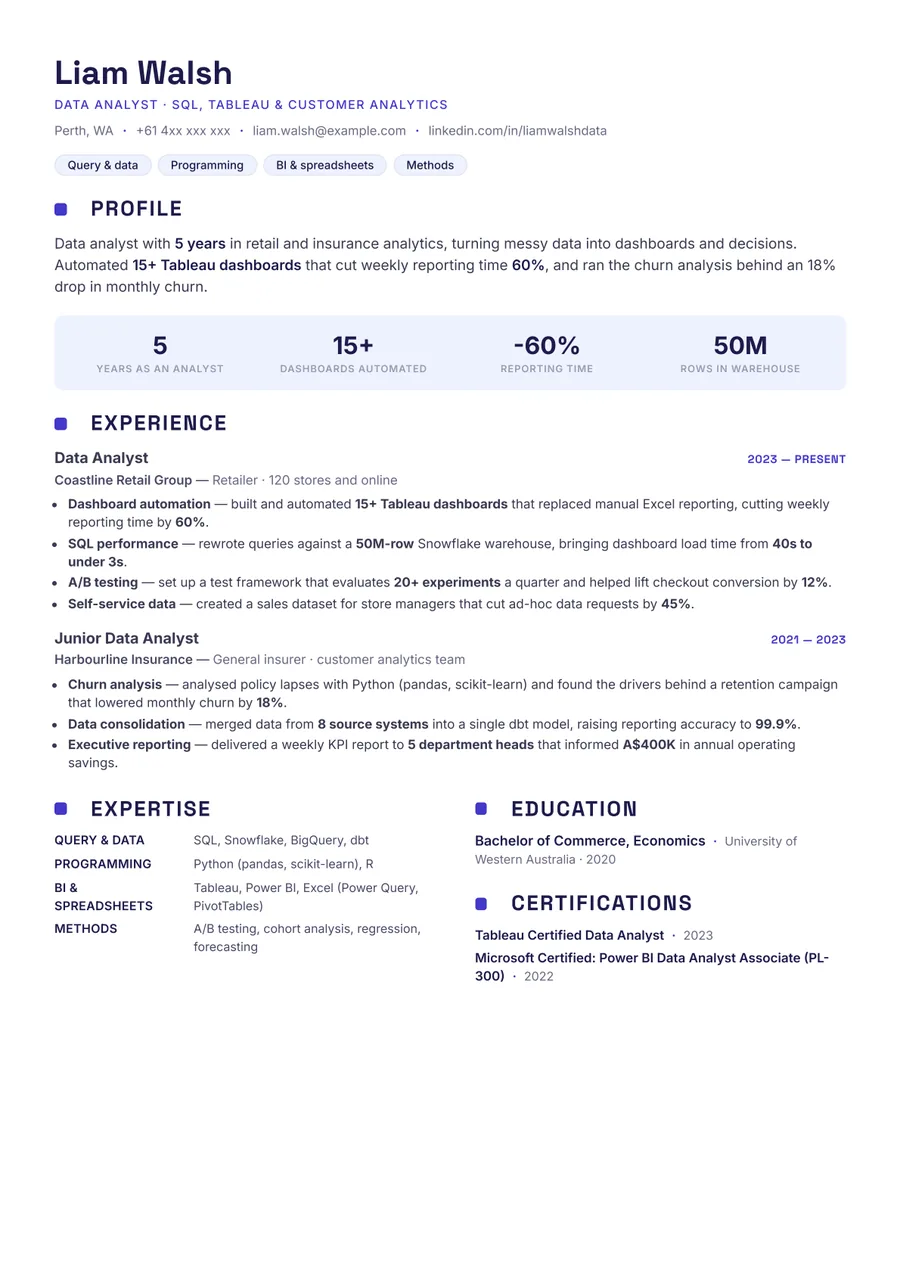
Best resume format for a data analyst
Use a reverse-chronological format and keep it to one page for under ~10 years of experience; two pages only if you have a long, relevant track record. Lead with a 2-3 line summary, then experience, then a dedicated technical skills section, with education and certifications near the end. Recruiters scan for proof you can pull, clean, model, and communicate data, so make tools and measurable outcomes easy to spot at a glance.
Keep the layout single-column and ATS-friendly: real selectable text, standard headings (Experience, Skills, Education), and no charts, logos, or text-in-images. ATS software needs to read your SQL, Python, and BI tools as plain text to match you to the job description.
What to include in a data analyst resume
- Professional summary — 2-3 lines naming your strongest tools (SQL, Python, Tableau/Power BI) and the kind of business impact you drive.
- Technical skills — a clearly labelled section: query languages, programming, BI/visualization, statistics, and data warehouses.
- Work experience — quantified bullets focused on analysis you ran and the decisions or savings it drove, not just task lists.
- Analytics projects or a portfolio — link a GitHub, Tableau Public, or dashboard portfolio, especially if you are early-career or switching fields.
- Domain context — the industries or functions you have analysed (marketing, finance, product, supply chain, healthcare), since domain knowledge is a differentiator.
- Education & certifications — degree plus relevant certs (Google Data Analytics, Microsoft Power BI, Tableau, AWS, or a statistics/CS background).
- Metrics and dashboards owned — KPIs you defined, reports you automated, or stakeholders you served.
Data analyst certifications by country
You do not need a licence to work as a data analyst. Certificates matter most early in your career or when you change fields, because they show tool skills before you have the job title to prove them.
- Everywhere: Microsoft Certified Power BI Data Analyst Associate (PL-300), Tableau Certified Data Analyst, the Google Data Analytics Professional Certificate and Microsoft Office Specialist Excel Expert. Give the exact name and year.
- India: analyst hiring at startups, consultancies and global capability centres usually includes a SQL or Excel test, so name the tools you were tested on. Graduates from B.Com, BBA or B.Sc backgrounds can add a statistics or analytics course to show the switch.
- US: no formal credential is expected; a portfolio and strong SQL count for more. SAS certifications still show up in banking, insurance and pharma ads.
- UK: the Level 4 Data Analyst apprenticeship is a recognised route into the job. If you completed it, list it with your end-point assessment grade.
- Australia: no licence, but many government analyst roles require Australian citizenship and a Baseline security clearance, so state yours if you hold one.
Before you send it, run the file through the ATS resume checker to confirm your tools read as text.
Data analyst resume summary examples
Name your tools, your domain and one decision your analysis drove. Three examples:
- Entry level: Economics graduate with a 3-month analytics internship at a retail chain. Built a Power BI sales dashboard for 40 stores from SQL and Excel extracts, now used in weekly regional reviews. PL-300 certified, with a portfolio of three Tableau Public dashboards.
- Mid level: Data analyst with 4 years in retail and subscription analytics. Automated 15+ Tableau dashboards that cut weekly reporting time 60%, and ran the churn analysis behind a retention campaign that lowered monthly churn 18%. Advanced SQL, Python (pandas) and dbt.
- Senior: Senior analyst with 9 years leading marketing and finance analytics and a team of 3. Built the attribution model that moved a fifth of the paid budget to higher-return channels, and owns the weekly KPI report for 5 department heads.
If your work is closer to requirements and process change, compare the business analyst resume guide.
Data analyst resume examples by industry
An analyst's tools travel between industries, but the questions and vocabulary don't. Use the industry's own terms in your summary and bullets so the recruiter and the ATS both see the fit.
- Finance: emphasise accuracy, controls and reporting cycles: variance analysis, forecasting, month-end close and risk or regulatory reporting, with advanced Excel alongside SQL. Example: "Automated the month-end variance pack for 14 cost centres in SQL and Power BI, cutting close reporting from four days to one." The financial analyst resume guide covers modelling roles.
- Healthcare: emphasise data quality, privacy, clinical or claims data and outcomes for patients or services. Name the rules you worked under, such as HIPAA in the US or UK GDPR and NHS information governance in the UK. Example: "Built a readmissions dashboard from 300,000 discharge records that helped two wards cut 30-day readmissions 11%."
- E-commerce and retail: emphasise conversion funnels, basket size, promotions, stock and customer cohorts. Example: "Analysed 18 months of promotion data, showed a third of offers brought no extra orders, and helped the category team drop 40 of them."
- Marketing: emphasise attribution, campaign measurement, segmentation and test design, with GA4, ad platform and CRM data. Example: "Built a customer segmentation in Python that raised email click-through 23% when used for targeting."
- Operations: emphasise throughput, lead times, forecast accuracy and cost per unit, using ERP and warehouse data. Example: "Rebuilt the weekly demand forecast for 2,400 SKUs, raising accuracy from 68% to 81% and cutting stock-outs by a quarter." See the operations manager and supply chain manager guides for the roles you will support.
Data Analyst resume bullet point examples
- Built and automated 15+ Tableau dashboards that replaced manual Excel reporting, cutting weekly reporting time by 60%.
- Wrote optimized SQL queries against a 50M-row warehouse, reducing average dashboard load time from 40s to under 3s.
- Analyzed customer churn with Python (pandas, scikit-learn) and identified drivers that informed a retention campaign, lowering monthly churn by 18%.
- Designed an A/B test framework that evaluated 20+ experiments per quarter, increasing checkout conversion by 12%.
- Partnered with marketing to build attribution models in Power BI, reallocating $2M in ad spend toward channels with 30% higher ROI.
- Cleaned and consolidated data from 8 source systems into a single dbt model, improving reporting accuracy to 99.9%.
- Delivered a weekly executive KPI report to 5 department heads, enabling decisions that reduced operating costs by $400K annually.
- Created a self-service sales analytics dataset that cut ad-hoc data requests to the analytics team by 45%.
Notice the pattern: strong action verb + what you analyzed or built + a quantified result (a percentage, a dollar figure, or a time saved).
Skills & ATS keywords for data analyst resumes
Applicant tracking systems and recruiters scan for specific tools and competencies. Mirror the language in the job description and only list what you can actually do. Common ATS keywords for data analyst roles include:
- Query & databases: SQL, PostgreSQL, MySQL, BigQuery, Snowflake, Redshift
- Programming: Python (pandas, NumPy, scikit-learn), R
- BI & visualization: Tableau, Power BI, Looker, Google Data Studio / Looker Studio
- Spreadsheets: Advanced Excel (PivotTables, VLOOKUP/XLOOKUP, Power Query), Google Sheets
- Statistics & methods: A/B testing, hypothesis testing, regression, forecasting, segmentation, cohort analysis
- Data pipeline & modeling: ETL/ELT, dbt, data warehousing, data cleaning, data modeling
- Competencies: KPI reporting, dashboarding, data storytelling, stakeholder communication, requirements gathering
- Bonus: Git, cloud platforms (AWS/GCP/Azure), basic exposure to machine learning
Common data analyst resume mistakes
- No numbers. Writing "created reports" instead of quantifying the impact or volume of data you handled.
- Listing tools without context. A skills dump of "SQL, Python, Tableau" with no bullets that show you actually used them on real problems.
- Describing tasks, not outcomes. Focusing on what you were assigned rather than the decisions or savings your analysis drove.
- Burying technical skills. Hiding SQL and BI tools in dense paragraphs where an ATS and a recruiter can miss them.
- Using charts or graphics on the resume itself. Visuals look on-brand but break ATS parsing — keep them in a linked portfolio instead.
- Ignoring the job description. Not mirroring the specific stack (e.g. Power BI vs Tableau, Snowflake vs BigQuery) the employer actually asked for.
Premium, ATS-friendly templates


Build your resume in minutes
Upload your current resume, edit anything, then preview and download it free.
Upload your resumeFrequently asked questions
How long should a data analyst resume be?
One page for most analysts with under about 10 years of experience. Go to two pages only if you have a long, relevant track record that genuinely needs the space; recruiters skim quickly, so keep it tight and outcome-focused.
What skills do I put on a data analyst resume?
Lead with SQL, Python (or R), and a BI tool like Tableau or Power BI, plus advanced Excel, statistics (A/B testing, regression), and data modeling/ETL. List the specific stack the job description names, and only include tools you can actually use.
Do I need a portfolio for a data analyst resume?
It's a strong advantage, especially if you're early-career or changing fields. A GitHub repo, Tableau Public profile, or a couple of dashboards with a short write-up proves you can do the work, not just list the tools.
Is a ResumeInk data analyst resume ATS-friendly?
Yes. ResumeInk rebuilds your resume into a clean, single-flow layout with real selectable text and standard headings, so applicant tracking systems can read your SQL, Python, and BI tools. You can preview it and download it free.
How do I write a data analyst resume with no experience?
Build two or three projects on public data that answer a business question, and present each like a job: the question, the tools (SQL, Excel, Power BI or Tableau) and what you found. Put a skills section near the top, add any certificate you have finished, and link your portfolio in the header.
Which certification is best for a data analyst resume?
The one that matches the tools in the ads you are applying to: Microsoft PL-300 for Power BI roles, Tableau Certified Data Analyst for Tableau teams, and the Google Data Analytics certificate as a broad starting point. A certificate supports your projects; it does not replace them.
How do I tailor a data analyst resume to a new industry?
Keep your tools and methods, then rewrite your summary and top bullets in the new industry's metrics, such as readmissions and claims in healthcare or conversion and basket size in retail. A short project on public data from that industry shows you already speak its language.