Free Machine Learning Engineer Resume Template & Examples
A strong machine learning engineer resume shows models running in production, not just notebooks. Hiring teams want to see what you trained, how you served and monitored it, and what it changed: revenue, latency, cost or hours saved. This page covers format, what to include, credentials by country, summary and bullet examples, keywords and common mistakes, for classic ML and LLM work alike. Upload your current resume as a PDF, Word file or photo, and ResumeInk rebuilds it in a clean, ATS-readable design you can edit and tailor to each job.
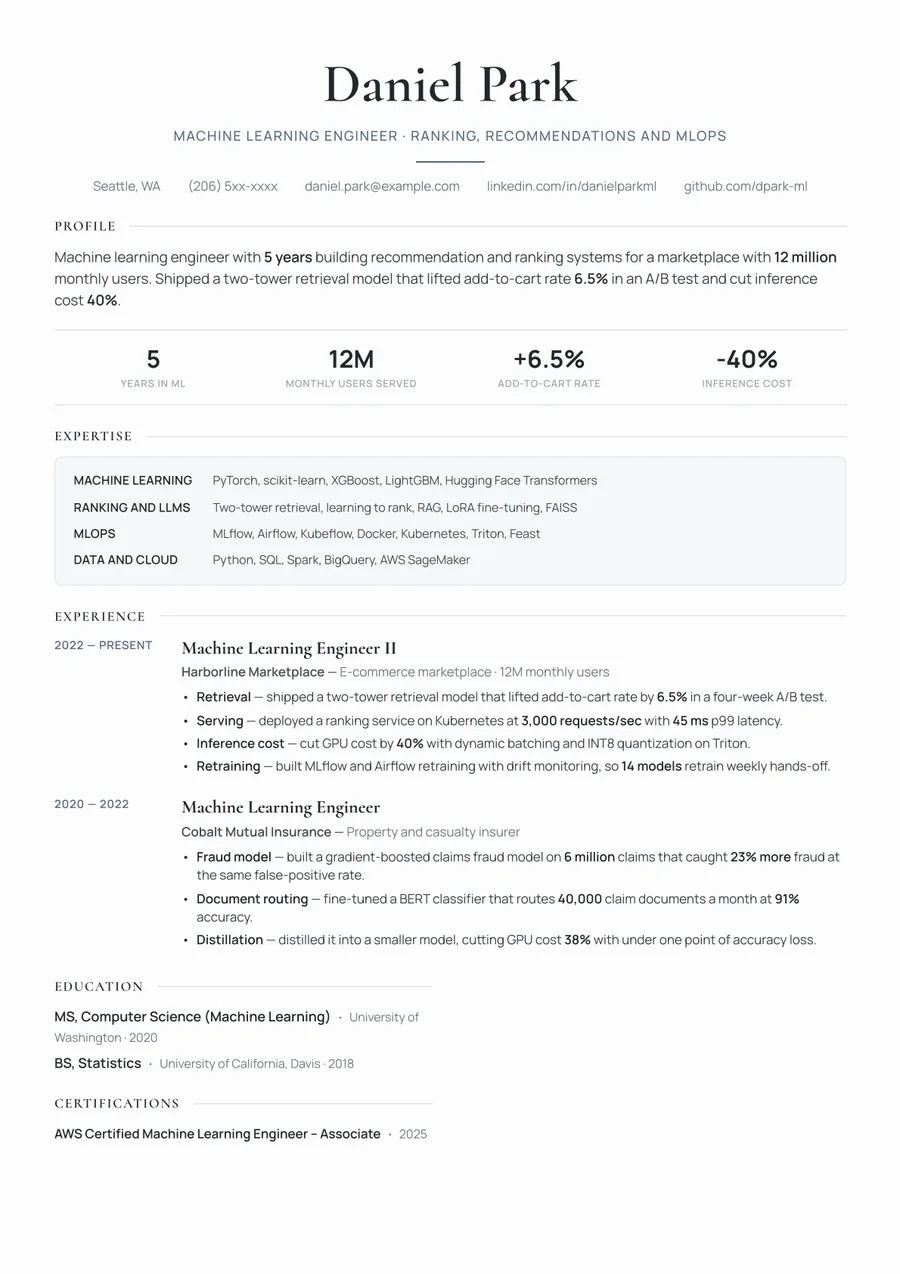
Best resume format for a machine learning engineer
Reverse-chronological order works for most ML engineers. Keep to one page as a graduate or with under five years of experience, and use two pages when production systems, a team or publications need the space. A PhD applying for lab or research scientist roles can use a longer academic CV, but product companies still expect two pages or less.
Suggested order: header with GitHub, a short summary, grouped skills, experience, selected projects or publications, education, then certifications. If your degree is your strongest asset, as with a new master's or PhD, move education up to sit right after the summary.
Layout tip: ResumeInk's Skills-first layout shows your frameworks and MLOps tools in a shaded block before experience, the Developer stack layout gives projects more room, and the Academic layout puts education first. Publications go in a custom section with its own heading. You can switch layouts in one tap and your words stay where they are.
What to include in a machine learning engineer resume
- Header: name, city, email, LinkedIn, GitHub, and a Google Scholar or Hugging Face profile if it holds real work.
- Summary: your domain (ranking, vision, NLP, forecasting, LLM applications), the scale you serve and one production result.
- Skills: languages, frameworks, MLOps and serving tools, cloud, and the model families you have shipped.
- Experience: the problem, your approach, how the model was deployed and monitored, and the metric that moved. Make clear what you owned and what the team did.
- Projects: one or two with a demo, a write-up or a tested repository. A Kaggle medal counts if you explain the approach.
- Publications and patents: peer-reviewed papers with venue and year, in a short custom section.
- Education: degree, institution and year, with the thesis topic for a master's or PhD.
Coming from analytics? The data scientist resume page shows the difference in emphasis: ML engineers lean on deployment and systems. If most of your work is pipelines, compare the data engineer resume page.
Machine learning engineer certifications and credentials by country
No country licenses machine learning engineers, and no certificate is a hiring requirement. Employers judge your degree, production experience, projects and, for research roles, publications. Cloud certifications still help when a job names a platform:
- Google Cloud Professional Machine Learning Engineer.
- AWS Certified Machine Learning Engineer — Associate.
- Microsoft Certified: Azure AI Engineer Associate (AI-102) or Azure Data Scientist Associate (DP-100).
- Databricks Certified Machine Learning Associate or Professional.
US: applied research roles often ask for a master's or PhD, while ML platform and MLOps jobs weigh software engineering more. India: product companies and global capability centres hire from B.Tech, M.Tech and MS programmes; name your institute and any research internship. UK: an MSc in machine learning or AI is a common route in; state your right to work. Australia: state your working rights and any security clearance for government or defence AI work. If your models use personal data, name the rules you worked under, such as GDPR or, for products sold in Europe, the EU AI Act.
Machine learning engineer resume summary examples
Name the domain, the scale and one result that reached users:
- Entry level: MSc Computer Science graduate who fine-tuned a small open-weights language model for support-ticket triage, reaching 0.87 macro F1 on 40,000 labelled tickets and serving it with FastAPI and Docker. Strong in Python, PyTorch, SQL and experiment tracking with MLflow.
- Mid level: Machine learning engineer with five years building recommendation and ranking systems for a marketplace with 12 million monthly users. Shipped a two-tower retrieval model that lifted add-to-cart rate by 6.5% in an A/B test, and cut inference cost by 40% with batching and quantisation.
- Senior: Staff ML engineer with 12 years across search, fraud and LLM applications, leading a platform team of eight that serves 70 models through one feature store and deployment pipeline. Took median model release time from six weeks to four days and set the company's evaluation and monitoring standards.
Machine learning engineer resume bullet point examples
Pair every model metric with what it did in production:
- Built a gradient-boosted claims fraud model on 6 million claims that caught 23% more fraud at the same false-positive rate.
- Deployed a real-time ranking service on Kubernetes handling 3,000 requests per second at a p99 latency of 45 ms.
- Cut GPU inference cost by 38% by distilling a BERT classifier into a smaller model with under one point of accuracy loss.
- Set up an MLflow and Airflow retraining pipeline with drift monitoring, so 14 models retrain weekly without manual steps.
- Built a retrieval-augmented generation assistant over 60,000 internal documents; accuracy on a 500-question evaluation set rose from 61% to 84%.
- Designed an offline evaluation suite that matched the A/B test direction in 9 of 10 launches, so weak experiments were dropped before they reached users.
- Moved feature computation into a shared Feast feature store, removing training-serving skew that had cost four points of live precision.
- Mentored four engineers and ran a weekly model review; incidents caused by model releases fell from five a quarter to one.
Strong verbs help here too: see the list of resume action verbs.
Skills & ATS keywords for machine learning engineer resumes
Use the job ad's spelling, such as PyTorch rather than Torch, and keep each group honest:
- Languages: Python, SQL, plus C++, Scala or Go where the job asks for them.
- ML and deep learning: PyTorch, TensorFlow, scikit-learn, XGBoost, LightGBM, Hugging Face Transformers, computer vision, NLP, recommender systems, time series.
- LLM work: fine-tuning, LoRA, retrieval-augmented generation, vector databases, evaluation, LangChain or LlamaIndex.
- MLOps and serving: MLflow, Kubeflow, SageMaker, Vertex AI, Docker, Kubernetes, Triton, ONNX, feature stores, model monitoring, CI/CD.
- Data: Spark, Airflow, BigQuery, Snowflake, labelling and data versioning.
- Maths and method: statistics, A/B testing, experiment design, optimisation, responsible AI.
- Soft skills: explaining trade-offs to product managers, writing design docs, cross-team work.
Group the list by area so a recruiter finds PyTorch or Kubernetes at a glance, and drop anything you used only in a single tutorial. If Python is your main strength outside ML, the Python developer resume page lists the general engineering keywords.
Common machine learning engineer resume mistakes
- Model metrics with no business link. An AUC of 0.91 means little alone. Pair it with what it produced: fraud caught, clicks, cost or hours saved.
- Notebook-only work. If a model reached production, say how it was served, monitored and retrained. If it did not, call it a prototype.
- Buzzword stacking. Every framework plus GenAI in the skills list, with no bullet that uses them, reads as padding.
- Unclear ownership. On team projects, name your part: the feature pipeline, the serving layer or the evaluation.
- No sense of scale. Say how many rows, images, users or requests your models handled; scale is what separates production work from a class project.
- Tutorial projects as headline work. Titanic and MNIST are fine for learning; replace them with a project on messy, real data before you apply.
- Nothing to check. A repository, paper or demo a reviewer can open backs up your claims. Run the final version through the ATS resume checker before you send it.
Premium, ATS-friendly templates


Build your resume in minutes
Upload your current resume, edit anything, then preview and download it free.
Upload your resumeFrequently asked questions
How do I write a machine learning engineer resume with no experience?
Lead with two or three projects that go beyond a notebook: a model trained on real data, served behind an API, with a short write-up of results and trade-offs. Follow with coursework, research assistantships, internships and competition results, and keep it to one page.
What is the difference between a machine learning engineer and a data scientist resume?
A data scientist resume leans on analysis, experiments and insight for decisions, while a machine learning engineer resume leans on building, deploying and running models in production. If you have done both, order your bullets so the side that matches the job comes first.
Should I put Kaggle competitions on my ML engineer resume?
Yes, if you placed well or can explain what you learned, such as a medal or a top 5% finish with your approach in one line. Without a ranking, treat it as a project and focus on what you built.
Do I need a master's or PhD to become a machine learning engineer?
Not for most applied and MLOps roles, where strong software skills and shipped models count most. Research engineer and research scientist roles more often ask for a postgraduate degree or publications, so list your thesis and papers if you have them.
How do I show LLM and generative AI experience on a resume?
Name what you built and how you measured it: the model, the retrieval setup, the evaluation set and the quality, latency or cost result. Treat LLM work like any other production system rather than listing prompt skills without numbers.