Free Data Scientist Resume Template & Examples
Hiring teams skim a data science resume for one thing first: proof you turned data into measurable impact. ResumeInk helps you build a clean, ATS-friendly data scientist resume that leads with quantified model and business results — upload your current resume and AI rebuilds it into a recruiter-ready design. Preview and download free.
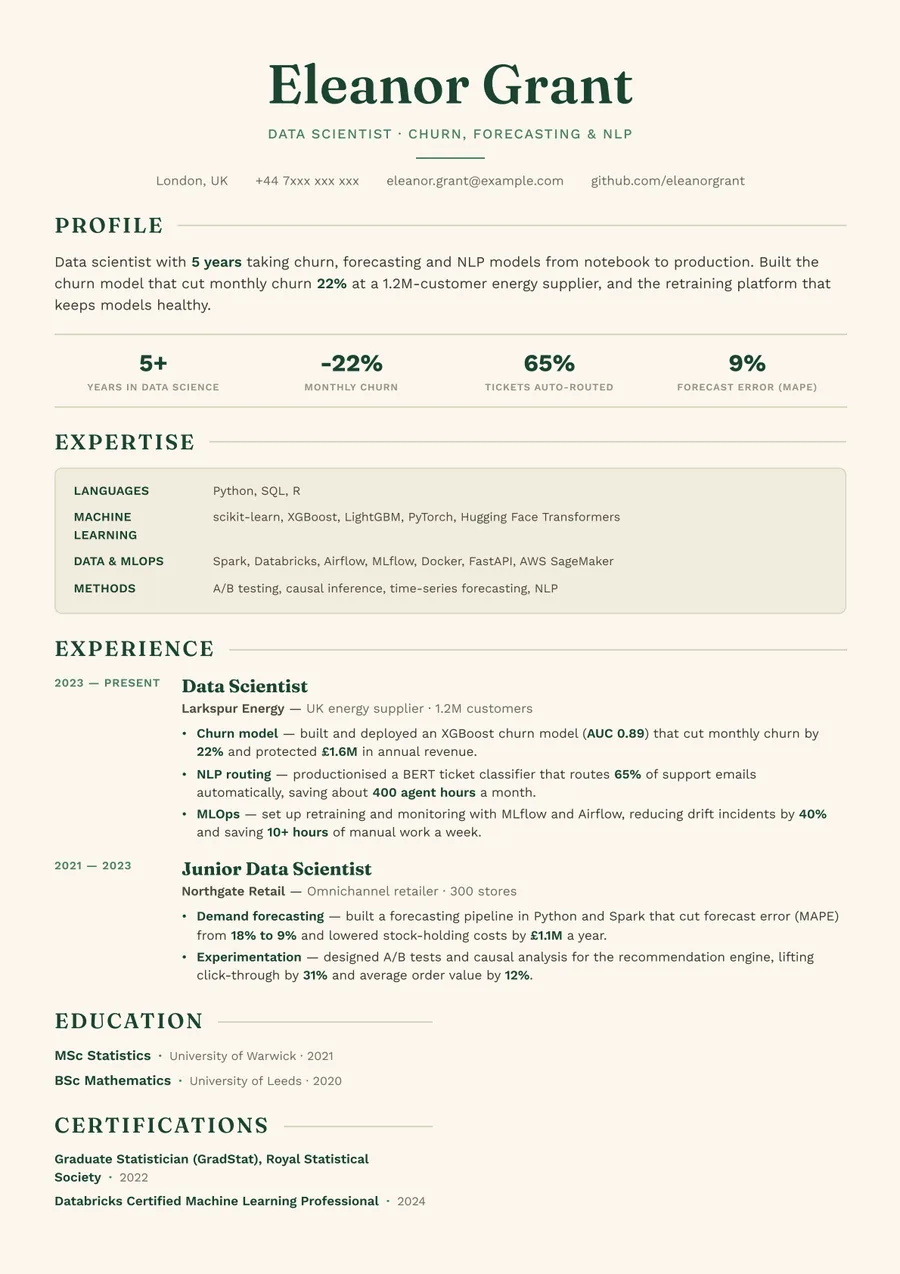
Best resume format for a data scientist
For most data scientists, a one-page resume is right with under 8 years of experience; senior, staff, or PhD-heavy candidates can justify two pages. Use a reverse-chronological layout with clear sections — a short summary, then experience, projects, skills, and education — so a recruiter can scan your impact in seconds.
Recruiters and applicant tracking systems expect quantified business outcomes (model lift, revenue, latency, cost savings), not a wall of algorithm names. Keep a single-column, parseable flow, put your most relevant ML/production work first, and surface the tech stack near each role so both the ATS and a hiring manager can match it to the job description.
What to include in a data scientist resume
- Headline + summary: e.g. "Data Scientist — NLP & forecasting, Python/SQL, models in production" with 2-3 lines on your specialism and measurable impact.
- Technical skills section: languages, ML/DL frameworks, cloud, and MLOps tools grouped clearly (recruiters and ATS scan this first).
- Experience: each role written as quantified outcomes — model performance, business metric moved, scale of data — not task lists.
- Projects / portfolio: 2-4 end-to-end projects (problem, data, model, result) with links to GitHub, Kaggle, or a deployed demo — essential for early-career or career-changers.
- Education: degree(s), and relevant coursework or thesis if it's quantitative (Statistics, CS, ML, Econometrics, Physics).
- Productionisation & impact: evidence you shipped models (A/B tests, deployment, monitoring) — what separates a data scientist from an analyst.
- Certifications (optional): AWS/GCP/Azure ML, Databricks, TensorFlow Developer — only if recent and relevant.
Data scientist certifications and credentials by country
Data science has no licence in any of these countries, and most employers hire on projects and results. A few credentials are still worth a line when you hold them, especially for roles close to statistics.
- UK: the Royal Statistical Society awards Graduate Statistician (GradStat) and Chartered Statistician (CStat), and offers data science professional designations under the Alliance for Data Science Professionals standards. They carry most weight in government, health and research roles.
- US: the American Statistical Association accredits statisticians as GStat (graduate) and PStat (professional). These appear most in pharma, biostatistics and public agencies; tech employers care more about shipped models.
- Australia: the Statistical Society of Australia accredits Graduate Statisticians (GStat) and Accredited Statisticians (AStat). Add your work rights if you are not a citizen or permanent resident.
- India: no professional accreditation is commonly asked for. Employers look at your degree (B.Tech, M.Sc Statistics or Mathematics, M.Tech), your GitHub and Kaggle work, any publications, and your notice period.
- Everywhere: Google Cloud Professional Machine Learning Engineer, AWS Certified Machine Learning Engineer Associate, or Databricks machine learning certificates, listed with the year.
Data scientist resume summary examples
Open with your specialism and one model that changed a business number. Three examples:
- Entry level: MSc Data Science graduate with a 4-month internship building a LightGBM demand forecast that cut forecast error (MAPE) from 21% to 13% across 300 store-product lines. Strong in Python, SQL and scikit-learn, with an NLP review classifier served through FastAPI on GitHub.
- Mid level: Data scientist with 5 years building churn, pricing and forecasting models for subscription businesses. Shipped an XGBoost churn model (AUC 0.89) that cut monthly churn 22%, and designs the A/B tests behind each launch. Python, SQL, Spark, MLflow and SageMaker.
- Senior: Lead data scientist with 11 years in fraud and risk, managing a team of 6. Owns a real-time fraud model with 0.94 precision and the Airflow and MLflow retraining platform that cut drift incidents 40%.
If most of your work is SQL, dashboards and reporting, the data analyst resume guide will fit better. Applying for research posts? An academic CV template suits a long publication list.
Data scientist resume examples by specialism
Data science job ads fall into a few distinct families, and each hires on different evidence. Name your family in the title line and summary, then lead with what that family looks for.
- Product or analytics data scientist: lead with experiments, metrics and the decisions they changed. Hiring managers want deep SQL, sound experiment design and clear writing. Example: "Designed and analysed 30 A/B tests a quarter for the checkout team, including a delivery-threshold test that lifted orders per user 6%."
- Machine learning or applied scientist: lead with models in production, their scale and the business result, plus your serving and monitoring stack. Example: "Trained and shipped a ranking model serving 40M recommendations a day, lifting click-through 9% at 25 ms p95 latency." If your work is mostly pipelines and model serving, the machine learning engineer resume guide may fit better.
- NLP specialist: lead with the language tasks, data size and evaluation, and say whether you fine-tuned models, built retrieval or evaluated large language models. Example: "Fine-tuned a multilingual classifier on 2M support tickets in English, Hindi and Tamil, raising macro F1 from 0.71 to 0.86."
- Research scientist: lead with publications, venues and methods, then any research that reached a product. Example: "First author of two papers on time-series anomaly detection (KDD 2024, NeurIPS 2025 workshop); one method now runs in the company's monitoring platform." Research roles often accept a longer CV with a full publication list.
If most of your week goes on building pipelines, warehouses and data quality checks rather than models, the data engineer resume guide will describe your work more accurately.
Data Scientist resume bullet point examples
- Built and deployed an XGBoost churn-prediction model (AUC 0.89) that cut monthly customer churn by 22% and protected $2M in annual recurring revenue.
- Designed an end-to-end demand-forecasting pipeline in Python and Spark, reducing forecast error (MAPE) from 18% to 9% and lowering inventory costs by $1.4M/year.
- Led A/B test design and causal analysis for a recommendation engine, lifting click-through rate by 31% and average order value by 12%.
- Productionised an NLP ticket-classification model with BERT, automating 65% of support routing and saving ~400 agent hours per month.
- Reduced model inference latency from 800ms to 90ms by refactoring features and serving via a containerised FastAPI endpoint, sustaining 99.9% uptime.
- Developed a real-time fraud-detection model (precision 0.94) that flagged $3.2M in fraudulent transactions in its first year.
- Built automated retraining and monitoring with MLflow and Airflow, cutting model drift incidents by 40% and eliminating 10+ hours of manual work weekly.
- Partnered with product and finance to translate a pricing-optimisation model into a 7% margin improvement across 1.2M SKUs.
Notice the pattern in each line: strong action verb + what you built + a quantified business or model result with a number.
Skills & ATS keywords for data scientist resumes
List the concrete tools and methods from the job description that you genuinely use — applicant tracking systems match on exact terms, so mirror the role's stack. These are the role-specific skills hiring systems and reviewers look for:
- Languages: Python, SQL, R, Scala
- ML / DL frameworks: scikit-learn, XGBoost, LightGBM, PyTorch, TensorFlow, Keras, Hugging Face Transformers
- Data & big data: pandas, NumPy, Spark/PySpark, dbt, Snowflake, BigQuery, Databricks, Hadoop
- Statistics & methods: A/B testing, hypothesis testing, regression, time-series forecasting, causal inference, Bayesian methods, clustering, NLP, recommender systems
- LLM / GenAI: RAG, embeddings, prompt engineering, fine-tuning, LangChain, vector databases (Pinecone, FAISS)
- MLOps & deployment: MLflow, Airflow, Docker, Kubernetes, CI/CD, FastAPI, model monitoring, feature stores
- Cloud: AWS (SageMaker), GCP (Vertex AI), Azure ML
- Visualisation & BI: Tableau, Power BI, Looker, matplotlib, seaborn, Plotly
Common data scientist resume mistakes
- Listing tools with no outcomes: a keyword dump of "Python, TensorFlow, Spark" without showing what you built or moved.
- No quantified impact: writing "built a model" instead of the lift, accuracy, revenue, or cost it produced.
- Reading like an analyst: only dashboards and reporting, with no evidence you trained, deployed, or monitored models.
- Overloading academic theory: equations and coursework for senior roles instead of production and business results.
- Ignoring deployment: no mention of how a model reached production (A/B test, API, monitoring) — recruiters assume it never shipped.
- ATS-breaking design: multi-column tables, graphics-as-text, or skills hidden in images that parsers can't read.
Premium, ATS-friendly templates


Build your resume in minutes
Upload your current resume, edit anything, then preview and download it free.
Upload your resumeFrequently asked questions
How long should a data scientist resume be?
One page is best if you have under about 8 years of experience; senior, staff, or PhD-heavy candidates can use two pages. Prioritise quantified model and business impact over listing every tool.
What skills do I put on a data scientist resume?
Lead with Python and SQL, then ML frameworks (scikit-learn, XGBoost, PyTorch/TensorFlow), big-data tools (Spark, Snowflake), statistics/A-B testing, and MLOps (MLflow, Docker, a cloud platform). Mirror the exact terms in the job description so the ATS matches them.
How do I show impact on a data scientist resume?
Write each bullet as action verb + what you built + a number — model metric (AUC, MAPE, precision), business outcome (revenue, churn, cost), or scale of data. Quantified results are what separate strong data science resumes from generic ones.
Do I need projects if I'm an entry-level data scientist?
Yes. With little work experience, 2-4 end-to-end projects (problem, data, model, measurable result) with GitHub or Kaggle links carry your resume. They prove you can ship models, not just study them.
How do I move from data analyst to data scientist on my resume?
Keep your real job titles, but lead each role with the modelling work you have done, such as forecasts, segmentation, experiments or a model used in a product or report. Add two end-to-end projects that show training, evaluation and deployment, and write a summary that names the data scientist role you are targeting.
Should a data scientist resume list publications or a PhD thesis?
List them when they relate to the job, in a short Publications section with title, venue and year, and describe the thesis in one or two plain-language results. For industry roles keep this brief and put shipped models and business results first; research labs expect a fuller academic CV.
How is a data scientist resume different from a machine learning engineer resume?
A data scientist resume leads with questions answered and models that changed a decision or a metric. A machine learning engineer resume leads with systems: training pipelines, serving, latency, scale and reliability. Many jobs sit in between, so mirror the balance in the job ad.