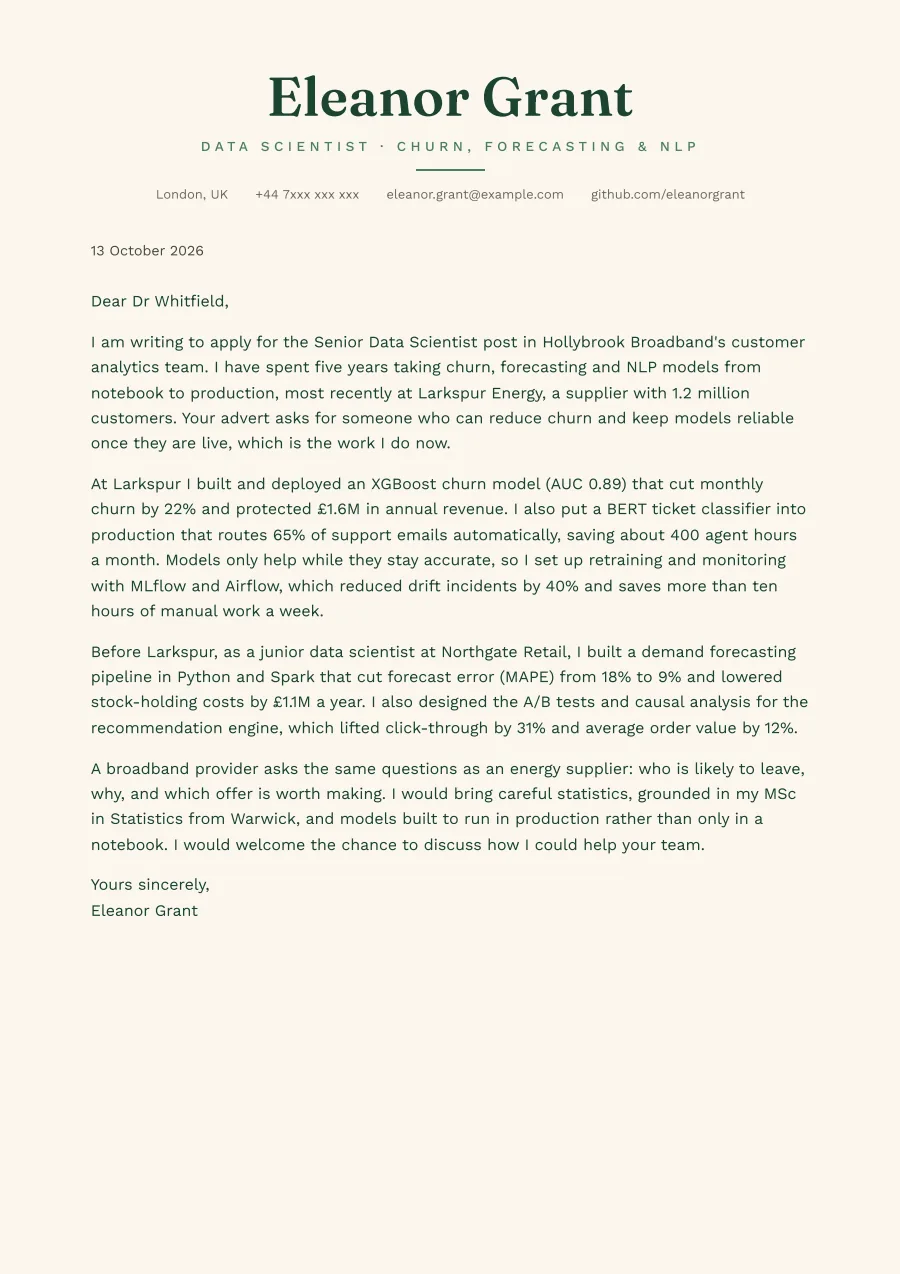
This data scientist cover letter comes from Eleanor Grant, a London data scientist with five years putting churn, forecasting and NLP models into production. It pairs with her example resume, so each figure in the letter appears there too. Below the letter you'll find what each paragraph does, which results hiring managers look for, four openings for different starting points, a worked match against a job advert, and how letters differ in the UK, the US, India and Australia.
I am writing to apply for the Senior Data Scientist post in Hollybrook Broadband's customer analytics team. I have spent five years taking churn, forecasting and NLP models from notebook to production, most recently at Larkspur Energy, a supplier with 1.2 million customers. Your advert asks for someone who can reduce churn and keep models reliable once they are live, which is the work I do now.
At Larkspur I built and deployed an XGBoost churn model (AUC 0.89) that cut monthly churn by 22% and protected £1.6M in annual revenue. I also put a BERT ticket classifier into production that routes 65% of support emails automatically, saving about 400 agent hours a month. Models only help while they stay accurate, so I set up retraining and monitoring with MLflow and Airflow, which reduced drift incidents by 40% and saves more than ten hours of manual work a week.
Before Larkspur, as a junior data scientist at Northgate Retail, I built a demand forecasting pipeline in Python and Spark that cut forecast error (MAPE) from 18% to 9% and lowered stock-holding costs by £1.1M a year. I also designed the A/B tests and causal analysis for the recommendation engine, which lifted click-through by 31% and average order value by 12%.
A broadband provider asks the same questions as an energy supplier: who is likely to leave, why, and which offer is worth making. I would bring careful statistics, grounded in my MSc in Statistics from Warwick, and models built to run in production rather than only in a notebook. I would welcome the chance to discuss how I could help your team.
Eleanor's letter fits on one page with four body paragraphs, and it is built around the theme the advert stresses: models that change a business number and keep working after launch.
Opening: the role, team and company by name, then her specialism and the size of her current employer. The last sentence restates the advert's main need, so the reader knows at once why she is writing.
Current role: three projects, each with a model, a metric and a business result: AUC 0.89 with 22% less churn, 65% of emails routed, 40% fewer drift incidents. The technical figure shows the model was good; the business figure shows it mattered.
Earlier role: forecasting and experimentation, which proves range beyond churn without needing a second page.
Close: one sentence links energy to broadband, her MSc gets a single mention, and she asks for a conversation. “Yours sincerely” is the UK sign-off when you write to a named person.
What to highlight in a data scientist cover letter
Most data science hiring managers have read plenty of notebook projects. What they want to know is whether your work reached production and changed a decision. Lead with:
Business outcomes: churn, revenue protected, costs, hours saved. Put the model metric beside the outcome, not instead of it.
Deployment and upkeep: who used the model, how it was served, how you watched for drift and retrained it. MLflow, Airflow or a feature store named in context says more than a tools list.
Experiment design: A/B tests, causal methods, how you sized samples or handled bias. This is where a statistics background shows.
Domain fit: if you know the employer's sector, or one with similar data, say so in a sentence.
Communication: one line on explaining results to non-technical teams, if you have a real example.
ResumeInk's AI cover letter tool writes a first draft from your resume and the job advert you paste, and the letter is saved as a PDF in your resume's design.
Data scientist cover letter opening lines
Open with the role and the strongest piece of evidence you have for it. Four versions:
Entry level: “I am applying for the Graduate Data Scientist role. My MSc dissertation built a demand forecast for a regional bus operator from public timetable and ticketing data, and I would like to use the same methods in your network planning team.”
Experienced: “Over five years I have taken churn, forecasting and NLP models from notebook to production, including a churn model that cut monthly churn by 22% at an energy supplier with 1.2 million customers.”
Career changer: “I spent six years as an actuarial analyst in general insurance, and for the last two I have built gradient-boosted claims models in Python. Your Data Scientist role is the full-time version of that work.”
Referral: “Tom Ashworth, who leads forecasting at your company, suggested I contact you about the Senior Data Scientist vacancy. We spoke on the same panel at a London data science meetup, and he thought my work on retraining pipelines fits the platform you are building.”
Matching your letter to the job ad
Eleanor wrote to a fictional advert from a broadband provider. Here are three of its lines and how her letter answers each:
Advert: “You will own our churn prediction models and work with marketing on retention offers.” Letter: “I built and deployed an XGBoost churn model (AUC 0.89) that cut monthly churn by 22% and protected £1.6M in annual revenue.”
Advert: “Experience maintaining models in production: monitoring, retraining and MLOps tooling.” Letter: “I set up retraining and monitoring with MLflow and Airflow, which reduced drift incidents by 40%.”
Advert: “Strong statistical grounding and experience with experimentation.” Letter: the A/B tests and causal analysis at Northgate Retail, plus her MSc in Statistics.
Each requirement gets one sentence of evidence in the advert's own terms. If an advert lists ten skills, answer the three it repeats or puts first; the rest can sit in your resume. The data analyst cover letter shows the same method for a reporting-focused role.
Data scientist cover letters by country
Eleanor's letter follows UK conventions. If you are applying somewhere else, adjust for the local hiring process:
UK: a one-page covering letter in British spelling. NHS and other public sector data roles usually ask for a supporting statement that answers the person specification point by point, so mirror its headings. Mention your right to work if a visa could be a question.
US: many forms treat the letter as optional, and some ask a short “why this company” question instead. Keep it under a page, and put publications or a portfolio link in the header.
India: hiring often moves through LinkedIn, job portals and referrals, followed by a take-home task or case round. A brief email or portal note works best: your specialism, one production result and your notice period.
Australia: one page, with your working rights stated. Government and university research roles commonly ask you to address selection criteria in a separate document.
Canada and the Gulf: Canada mirrors US practice. In the Gulf, add your visa status and availability, and keep the tone formal.
Common data scientist cover letter mistakes
Leading with tools. “Proficient in Python, R, SQL and TensorFlow” is how countless letters open. Fix: start with a problem you solved and let the tools appear inside that sentence.
Only model metrics. An AUC on its own doesn't tell a manager what changed. Fix: pair it with churn, revenue, cost or time saved.
Competition ranks as the headline. Kaggle results show skill, but employers hire for messy data and deployment. Fix: lead with projects that touched real users, and mention rankings briefly.
Methods nobody asked about. Two paragraphs on transformer architecture lose a hiring panel. Fix: one plain sentence per method, with its result.
No sign of statistical care. Teams worry about overfitting and false positives. Fix: mention how you validated a model or designed a test.
It is often optional, but a short letter is the one place to explain business impact that resume bullets compress. Write one when the form allows it or when you apply directly to a hiring manager.
Should I mention Kaggle or personal projects in a data science cover letter?
Mention them if you have little industry experience or the project is close to the employer's problem. Describe the data, the method and the result in one or two sentences, and put the repository link in your header.
How technical should a data scientist cover letter be?
Technical enough to be credible: name the model type, the main tools and one metric. Then explain the business outcome in plain words, because a recruiter outside data science may read it first.
How long should a data scientist cover letter be?
One page, three or four paragraphs, about 250 to 350 words. A supporting statement for a UK public sector role can run longer, because it answers each criterion in turn.