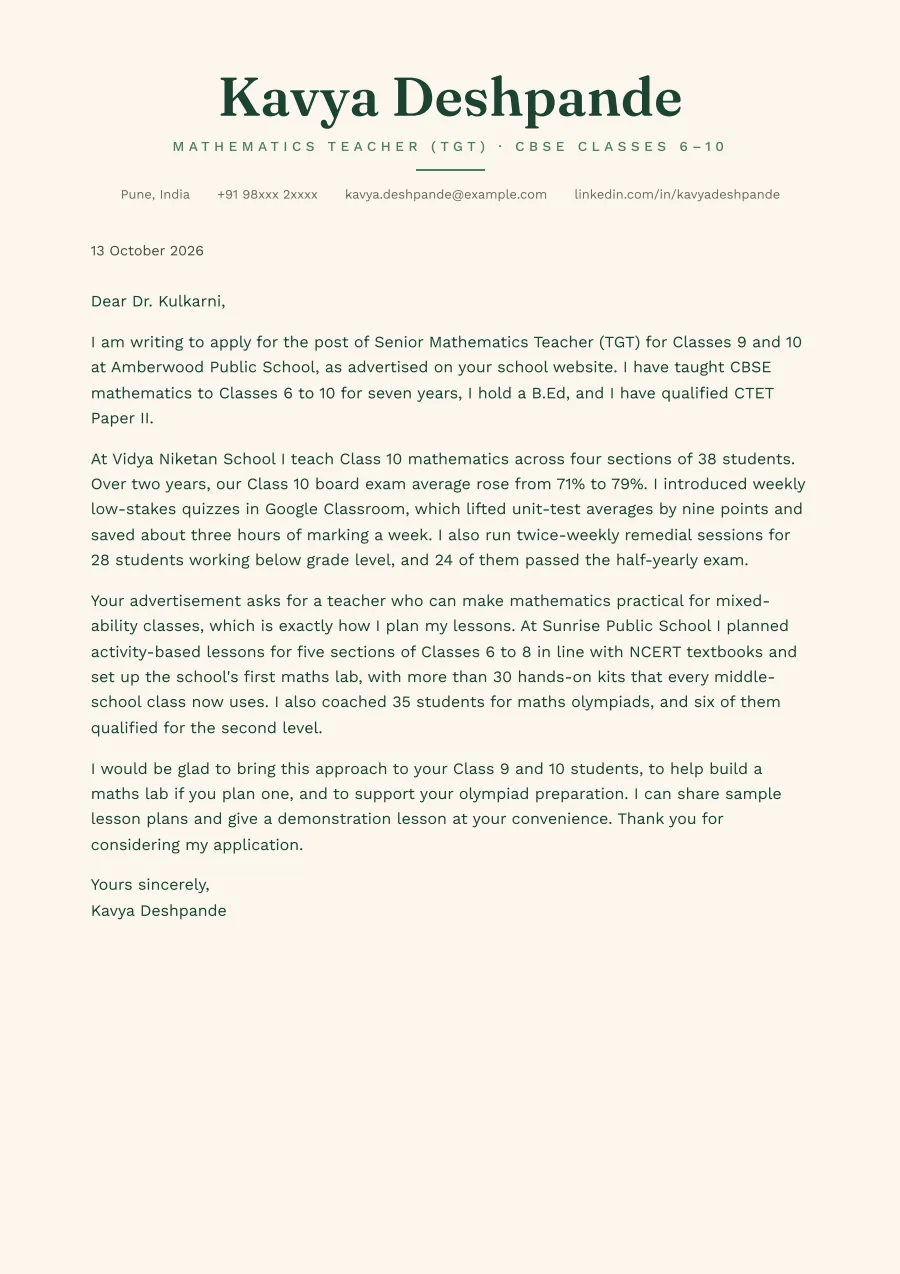
This teacher cover letter example comes from Kavya Deshpande, the CBSE mathematics teacher on our teacher resume example, applying for a senior Class 9 and 10 post at another Pune school. It sticks to what principals look for: subject, board and classes, qualifications, and proof that students learned more. After the letter, see why each paragraph is there, four opening lines, how to answer a school's advert, and how teaching applications work in India, the UK, the US and Australia.
I am writing to apply for the post of Senior Mathematics Teacher (TGT) for Classes 9 and 10 at Amberwood Public School, as advertised on your school website. I have taught CBSE mathematics to Classes 6 to 10 for seven years, I hold a B.Ed, and I have qualified CTET Paper II.
At Vidya Niketan School I teach Class 10 mathematics across four sections of 38 students. Over two years, our Class 10 board exam average rose from 71% to 79%. I introduced weekly low-stakes quizzes in Google Classroom, which lifted unit-test averages by nine points and saved about three hours of marking a week. I also run twice-weekly remedial sessions for 28 students working below grade level, and 24 of them passed the half-yearly exam.
Your advertisement asks for a teacher who can make mathematics practical for mixed-ability classes, which is exactly how I plan my lessons. At Sunrise Public School I planned activity-based lessons for five sections of Classes 6 to 8 in line with NCERT textbooks and set up the school's first maths lab, with more than 30 hands-on kits that every middle-school class now uses. I also coached 35 students for maths olympiads, and six of them qualified for the second level.
I would be glad to bring this approach to your Class 9 and 10 students, to help build a maths lab if you plan one, and to support your olympiad preparation. I can share sample lesson plans and give a demonstration lesson at your convenience. Thank you for considering my application.
The opening gives a principal everything needed to check eligibility in one glance: the post, the subject, the board, the classes, then the B.Ed and CTET Paper II. In Indian schools these decide whether you are considered at all, so they come before anything else.
Paragraph two is the proof. Board results are the number every CBSE school understands, so the rise from 71% to 79% leads. Then comes how it happened, weekly quizzes and remedial groups, each with its own figure, so the result reads as method rather than luck.
Paragraph three quotes the advert's request for practical, mixed-ability teaching and answers it with the maths lab and activity-based lessons. The olympiad club shows what she adds outside lessons.
The final paragraph offers sample lesson plans and a demonstration lesson, which many Indian schools ask for anyway, and closes in two short sentences.
Signed-in ResumeInk users can paste a school's advert into the editor's cover letter tool and get a first draft built only from their own resume.
What to highlight in a teacher cover letter
Eligibility. Subject, classes or key stages, board or curriculum (CBSE, ICSE, state board, IB, Cambridge, the national curriculum) and your teaching qualification: B.Ed with CTET or a state TET in India, QTS in England, a state licence in the US, registration with the state regulator in Australia.
Learning outcomes. Board or exam results, unit-test averages, reading ages or pass rates for groups you supported. Give the before, the after and the time it took.
How you teach. One concrete method, such as low-stakes quizzes, activity-based lessons or small-group support, explained in a sentence.
Beyond the classroom. Clubs, olympiads, labs, sports, house duties or form tutoring. Schools fill a whole timetable, not just a subject slot.
Pastoral care. For UK and international schools especially, show that you take safeguarding and student wellbeing seriously.
Everything you claim should also appear on your teacher resume, ideally with the same numbers.
Teacher cover letter opening lines
A principal may read dozens of letters for one post. Open with the post, your subject and one reason you fit, then adapt these to your own facts.
Entry level: "I have just completed my B.Ed, including a school internship teaching English to Classes 6 and 7, and I am applying for your middle-school English post."
Experienced: "After nine years teaching GCSE and A level chemistry, three of them as second in department, I am applying for your Head of Science post."
Career changer: "For six years I worked as a civil engineer; now, with a PGCE in mathematics, I want to show Year 9 students where trigonometry ends up in the real world."
Referral: "Mr. Arjun Rao, your senior physics teacher, suggested I write to you; we worked together on the district science exhibition, and he felt my lab experience would suit your new STEM programme."
Matching your letter to the job ad
Most school adverts list three or four needs. Here is how Kavya's letter answers the sample advert, line by line.
Ad: "B.Ed and CTET qualified, with CBSE board experience." Letter: "I have taught CBSE mathematics to Classes 6 to 10 for seven years, I hold a B.Ed, and I have qualified CTET Paper II."
Ad: "A record of strong Class 10 board results." Letter: "Over two years, our Class 10 board exam average rose from 71% to 79%."
Ad: "Able to make mathematics practical for mixed-ability classes." Letter: "I planned activity-based lessons for five sections of Classes 6 to 8 in line with NCERT textbooks and set up the school's first maths lab."
Keep the advert's terms (CBSE, Class 10, mixed-ability) where they are true for you. If an advert lists more needs than you can cover, answer the two it repeats most and let your resume carry the rest. Our guide on how to write a cover letter shows the same method for any job.
Teacher cover letters by country
India: private CBSE and ICSE schools usually hire from an emailed CV and a short covering letter, often followed by a written test, a demonstration lesson and an interview with the principal. Keep the letter under a page and state your B.Ed and CTET or TET early. Government posts, such as Kendriya Vidyalaya roles, are filled through exams, not letters.
UK: most state schools in England use an application form with a supporting statement written against the person specification, because safer recruitment needs a full employment history. Many expect around two sides of A4; check the advert. Mention QTS, your subject and the key stages you teach.
US: district portals usually ask for a one-page letter, your state certification and references. Name the grade band and the standards you teach to.
Australia: public schools recruit through each state's education department, often asking for a short statement against the selection criteria. You also need registration with the state regulator, such as the Victorian Institute of Teaching or the Queensland College of Teachers.
Gulf: many schools in the UAE and Qatar follow CBSE or British curricula and recruit from India and the UK; a CV with a photo and a brief email letter is normal.
Common teacher cover letter mistakes
A philosophy instead of evidence. "I believe every child can learn" gives a principal nothing to check. Replace it with one result and how you got it.
Not naming the board or key stage. CBSE Class 10 and Key Stage 3 are different jobs. Say what you have taught and connect it to what the post needs.
Sending a CV when the school wants its form. UK state schools rarely accept a CV on its own. Complete the form and put your best material in the supporting statement.
Leaving out the extras. Schools need club leaders, exam duty cover and form tutors. One line on what you would run can set you apart from an otherwise similar applicant.
Naming students. Describe results by class or group, never by a named pupil, and keep classroom photos out of the application.
One page, roughly 250 to 400 words, suits most private schools and US districts. UK supporting statements and Australian selection criteria responses can be longer, so follow the advert's guidance.
What is the difference between a teacher cover letter and a supporting statement?
A cover letter is a short introduction sent with your CV. A supporting statement, used by most UK state schools, sits inside the application form and shows how you meet each point of the person specification, so it is longer and more structured.
How do I write a teacher cover letter with no experience?
Lead with your teaching qualification and your school placement or internship: the classes, the subject and one lesson or result you are proud of. Add tutoring, coaching or camp work with children if you have it.
Who should I address a teaching cover letter to?
Use the principal's or head teacher's name if the advert or school website gives it, for example Dear Dr. Kulkarni or Dear Mrs Shah. If not, Dear Principal or Dear Head Teacher is better than To whom it may concern.