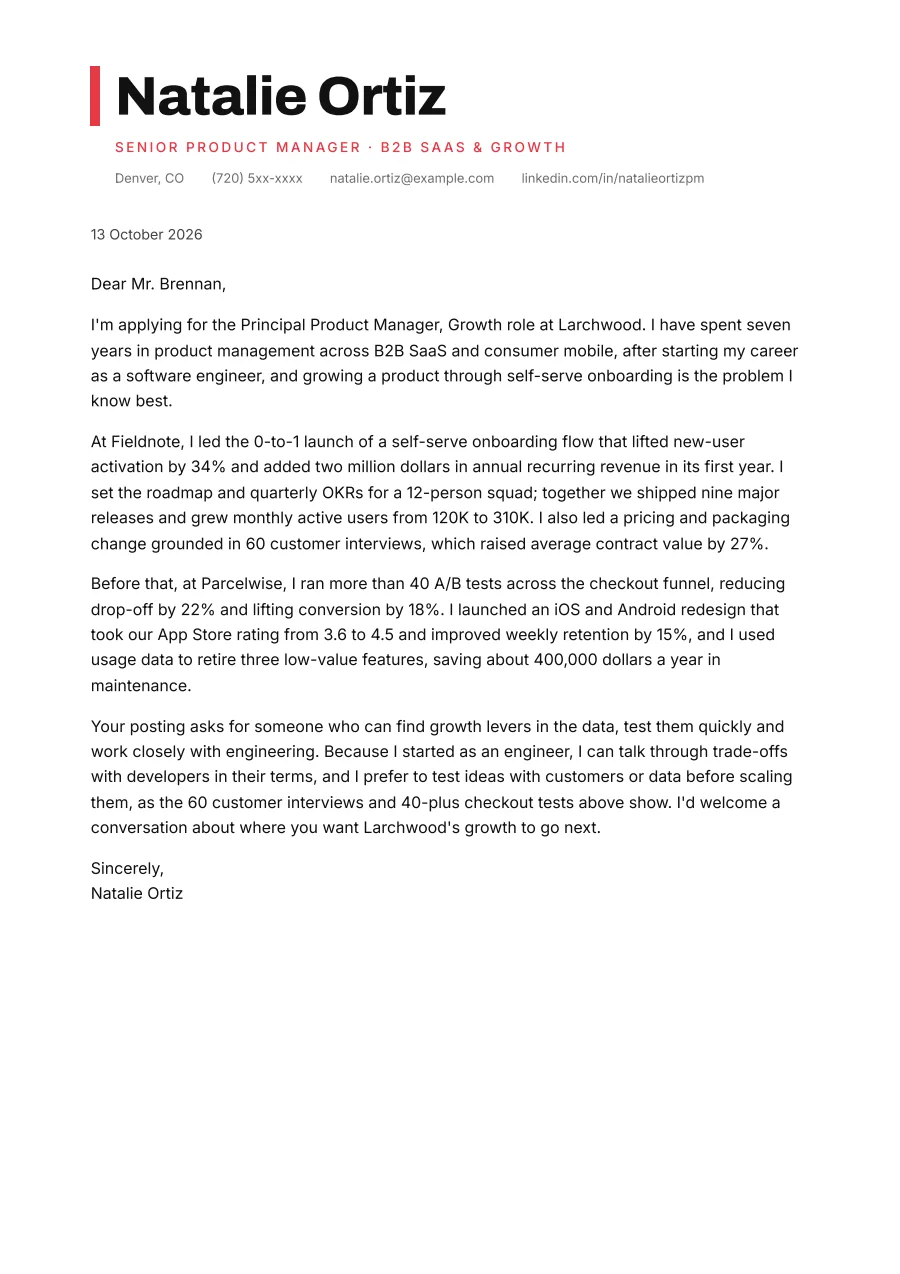
This product manager cover letter is written by Natalie Ortiz, a senior product manager in Denver who moved into product after starting as a software engineer. It matches her example resume, so every metric, from activation to app ratings, is on that page too. Under the letter: what each paragraph is doing, which proof product hiring managers look for, openings for four situations, a line-by-line match with a job posting, and the differences between the US, UK, India and Australia.
I'm applying for the Principal Product Manager, Growth role at Larchwood. I have spent seven years in product management across B2B SaaS and consumer mobile, after starting my career as a software engineer, and growing a product through self-serve onboarding is the problem I know best.
At Fieldnote, I led the 0-to-1 launch of a self-serve onboarding flow that lifted new-user activation by 34% and added two million dollars in annual recurring revenue in its first year. I set the roadmap and quarterly OKRs for a 12-person squad; together we shipped nine major releases and grew monthly active users from 120K to 310K. I also led a pricing and packaging change grounded in 60 customer interviews, which raised average contract value by 27%.
Before that, at Parcelwise, I ran more than 40 A/B tests across the checkout funnel, reducing drop-off by 22% and lifting conversion by 18%. I launched an iOS and Android redesign that took our App Store rating from 3.6 to 4.5 and improved weekly retention by 15%, and I used usage data to retire three low-value features, saving about 400,000 dollars a year in maintenance.
Your posting asks for someone who can find growth levers in the data, test them quickly and work closely with engineering. Because I started as an engineer, I can talk through trade-offs with developers in their terms, and I prefer to test ideas with customers or data before scaling them, as the 60 customer interviews and 40-plus checkout tests above show. I'd welcome a conversation about where you want Larchwood's growth to go next.
Natalie's letter is a compact product case for hiring her, in four body paragraphs with clear roles:
Opening: the exact title and company, her years and domains, the engineering start, and the one problem she knows best. Growth roles want a growth story, so she names hers in the first paragraph.
Current role: outcomes, not features. Activation, recurring revenue, monthly active users and contract value each tie to something she led. The nine releases appear only next to the user growth they produced.
Previous role: experimentation and judgement. Running 40+ tests shows method; retiring three features shows she can say no to work that isn't earning its keep.
Close: she repeats the posting's three needs, answers them with her background, and asks for a conversation.
The “Sincerely” sign-off and “Mr.” with a full stop follow American style. Her product manager resume holds the detail behind each number.
What to highlight in a product manager cover letter
A product manager's letter should read like a short review of your own work: problem, decision, result. The proof that carries most weight:
Metrics you moved: activation, retention, conversion, revenue or contract value, with the before and after where you have it.
Discovery: customer interviews, usage data or research that changed what you built. A number like 60 interviews shows the habit.
Experimentation: how many tests, on what, and what you learned, including what you stopped.
Scope: team size, products owned, and whether you set the roadmap or delivered someone else's.
Work with engineering and design: a technical background, a tough trade-off, a launch you coordinated across teams.
Avoid claiming sole credit; “I led” and “we shipped” together read as honest. In ResumeInk, the AI cover letter tool can draft this kind of letter from your resume and a pasted job ad, saved as a PDF that matches your resume's design.
Product manager cover letter opening lines
Product managers are judged on clarity, so the opening should state the fit plainly:
Entry level: “I am applying for your Associate Product Manager program. As a computer science senior I led a four-person team that built a study-group app, ran 30 user interviews before writing any code, and grew it to 900 weekly users on campus.”
Experienced: “I have spent seven years in B2B SaaS and consumer mobile product, most recently leading a self-serve onboarding launch that lifted activation by 34%, and your growth team is solving the problem I know best.”
Career changer: “For five years I led customer support for a scheduling software company, where I turned ticket trends into the top items on the product roadmap. I am applying for your Product Manager role to own those decisions directly.”
Referral: “Marcus Bell, a design lead on your team, suggested I reach out about the Senior Product Manager opening. We worked together on a checkout redesign at my last company, and he thought my experimentation background fits your growth team.”
Matching your letter to the job ad
Natalie's letter answers a fictional posting for a growth product role. Three lines from that posting, with her response:
Posting: “Own activation and onboarding for new self-serve accounts.” Letter: “I led the 0-to-1 launch of a self-serve onboarding flow that lifted new-user activation by 34%.”
Posting: “Run a disciplined experimentation program across the funnel.” Letter: “I ran more than 40 A/B tests across the checkout funnel, reducing drop-off by 22% and lifting conversion by 18%.”
Posting: “Partner closely with engineering on scope and trade-offs.” Letter: “Because I started as an engineer, I can talk through trade-offs with developers in their terms.”
The method: pick the three needs the posting stresses, find your strongest true answer to each, and reuse the posting's nouns (activation, funnel, trade-offs) so a recruiter reading both documents sees the match at once. If your path into product was unusual, the career change resume guide covers how to frame it.
Product manager cover letters by country
Natalie applies in the US, so her letter is direct, a little informal (“I'm”) and focused on metrics. Other markets differ:
US: letters are often optional for product roles, and some companies ask a short written question instead, such as why their product. Treat that answer like a mini cover letter: specific, under a page, with one result.
UK: a one-page letter in British spelling with a slightly more formal tone. Write “Yours sincerely” to a named reader, and mention your right to work if a visa is involved.
India: product roles at startups are often filled through referrals and LinkedIn, then a product case or assignment. Keep your first message short: your domain, one metric you moved, your notice period and your resume attached.
Australia: one page, working rights stated near the top or the end, and a professional but plain tone. “Kind regards” is a common close.
Canada and the Gulf: Canada follows US norms; mention your work permit status if relevant. In the Gulf, a formal tone, visa status and notice period are expected, and some employers ask for a CV with a photo.
Common product manager cover letter mistakes
Writing about features instead of outcomes. “Launched a new dashboard” says nothing about whether it worked. Fix: add the metric it moved.
Using “we” for everything. Hiring managers can't tell what you did. Fix: use “I” for your decisions and “we” for the team's delivery.
Product jargon without substance. “Customer-obsessed, data-driven product leader” fits anyone. Fix: show one decision you made from customer data.
Ignoring the company's product. Fix: use it before you write, and mention one specific, respectful observation.
A letter longer than a page. Product managers are hired to prioritise. Fix: cut to the three proof points the posting cares about most.
Not always, since many product applications make it optional. It is worth writing when you are changing industries, moving into product from another role, or writing directly to a hiring manager, because it lets you explain decisions a resume can only list.
How do I write a product manager cover letter with no PM experience?
Show product work you have already done in another role, such as turning customer feedback into a feature, running a test or coordinating a launch. Name the result and say why you want to own those decisions full time.
What metrics should a product manager mention in a cover letter?
Use the ones the posting cares about: activation, retention, conversion, revenue or engagement for growth roles, and adoption or reliability for platform roles. Two or three clear numbers are enough.
Should a product manager cover letter mention the company's product?
Yes, briefly. One specific, respectful observation from using the product shows interest better than general praise, and it gives the interviewer something to ask about.