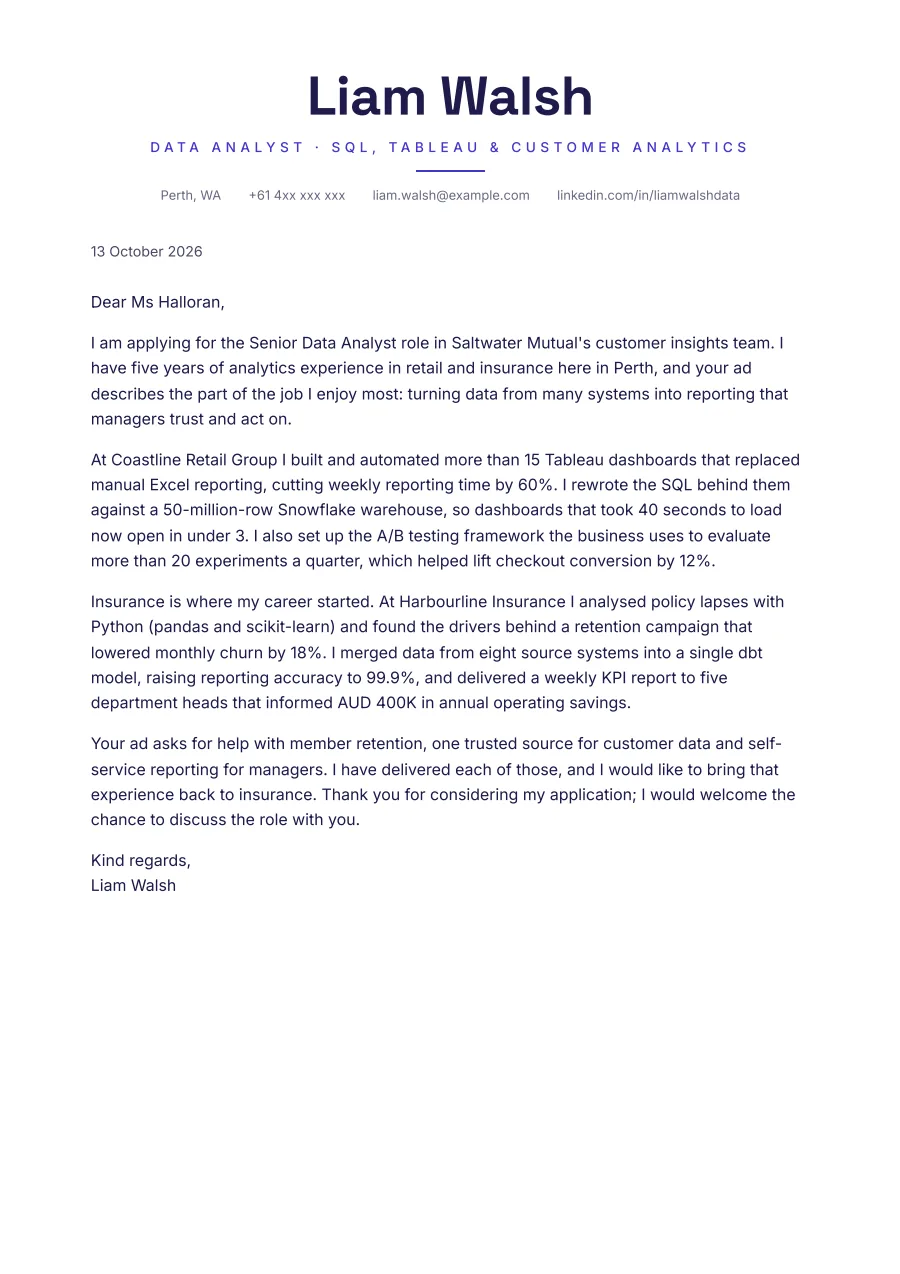
Here is a complete data analyst cover letter written by Liam Walsh, an analyst in Perth with five years in retail and insurance. It matches his example resume, so the dashboards, warehouse and churn work it mentions are all listed there. After the letter: why each paragraph is built the way it is, what proof analysts should lead with, four ways to start, how to answer a job ad line by line, and how letters change from Australia to the UK, the US and India.
I am applying for the Senior Data Analyst role in Saltwater Mutual's customer insights team. I have five years of analytics experience in retail and insurance here in Perth, and your ad describes the part of the job I enjoy most: turning data from many systems into reporting that managers trust and act on.
At Coastline Retail Group I built and automated more than 15 Tableau dashboards that replaced manual Excel reporting, cutting weekly reporting time by 60%. I rewrote the SQL behind them against a 50-million-row Snowflake warehouse, so dashboards that took 40 seconds to load now open in under 3. I also set up the A/B testing framework the business uses to evaluate more than 20 experiments a quarter, which helped lift checkout conversion by 12%.
Insurance is where my career started. At Harbourline Insurance I analysed policy lapses with Python (pandas and scikit-learn) and found the drivers behind a retention campaign that lowered monthly churn by 18%. I merged data from eight source systems into a single dbt model, raising reporting accuracy to 99.9%, and delivered a weekly KPI report to five department heads that informed AUD 400K in annual operating savings.
Your ad asks for help with member retention, one trusted source for customer data and self-service reporting for managers. I have delivered each of those, and I would like to bring that experience back to insurance. Thank you for considering my application; I would welcome the chance to discuss the role with you.
Liam's letter is one page with four body paragraphs. Each answers a question a hiring manager has about an analyst:
Why this job? The opening names the role, team and company, says where he works and for how long, and restates the ad's core task in plain words.
Can you build things people use? The retail paragraph moves from dashboards to query speed to experiments, and every claim carries a number: 15+ dashboards, 60% less reporting time, 20+ tests a quarter.
Do you know our industry? The insurance paragraph opens with a short bridge sentence, then shows churn analysis, data consolidation and reporting to department heads.
What would you do here? The close names three needs from the ad, says he has delivered each, and asks for an interview without pleading.
He doesn't explain what Tableau or dbt is, because the reader already knows. The tools stay in because they match the ad, and the full list sits on his data analyst resume.
What to highlight in a data analyst cover letter
Analyst jobs range from reporting to experimentation to light modelling, so read the ad for which kind it is. Then pick your proof from this list:
Time saved through automation: reports or dashboards you replaced, and the hours or percentage saved.
Decisions your analysis changed: a campaign, a budget or a process, with the result. This is the strongest line an analyst can write.
SQL depth: table size, query speed, the warehouse you used (Snowflake, BigQuery, Redshift). One concrete detail shows more than “advanced SQL”.
Data quality: sources merged, accuracy improved, definitions agreed with stakeholders.
Audience: who read your reports. Department heads or executives tell the reader you can explain numbers clearly.
If you write in the ResumeInk editor, the AI cover letter tool turns your resume and the pasted job ad into a first draft, and the letter downloads as a PDF in the same design as your resume. If the ad leans towards requirements and process, the business analyst resume page may fit you better.
Data analyst cover letter opening lines
Start with the role, then one specific result or reason. Four versions for different situations:
Entry level: “I am applying for the Graduate Data Analyst role. In the final year of my commerce degree I cleaned and analysed three years of sales data for a local bakery in Excel and SQL, and the roster changes I suggested are still in use.”
Experienced: “I have spent five years turning retail and insurance data into dashboards and decisions, most recently automating 15 Tableau dashboards that cut weekly reporting time by 60%.”
Career changer: “After seven years in retail store management, where I built the weekly sales and staffing reports for 12 stores, I completed a data analytics certificate and now want to do that work full time on your commercial team.”
Referral: “Hannah Lee in your finance team mentioned you are hiring a Data Analyst for margin and forecasting work. We studied together at university, and she thought my experience with Snowflake and dbt matches your new data stack.”
Matching your letter to the job ad
Liam is answering a fictional ad from a Perth insurer. Here are three lines from it and the sentence that answers each:
Ad: “Help us understand why members leave and what keeps them.” Letter: “I analysed policy lapses with Python (pandas and scikit-learn) and found the drivers behind a retention campaign that lowered monthly churn by 18%.”
Ad: “Bring data from our policy, claims and contact centre systems into one trusted model.” Letter: “I merged data from eight source systems into a single dbt model, raising reporting accuracy to 99.9%.”
Ad: “Build self-service dashboards so managers stop waiting on ad hoc reports.” Letter: “I built and automated more than 15 Tableau dashboards that replaced manual Excel reporting.”
The letter takes the ad's ideas (retention, one source of data, self-service) but keeps Liam's own words and numbers. Copying whole phrases reads as filler; answering each need with a result reads as a fit. To check the same keywords on the resume side, run it through the ATS resume checker.
Data analyst cover letters by country
Liam's letter follows Australian habits: “Dear Ms Halloran” with no full stop, “Kind regards” to close, and a single page. Elsewhere, analyst hiring works a little differently:
Australia: say whether you have full working rights. State and federal government analyst jobs often ask for a statement addressing the selection criteria, sometimes with a page or word limit, instead of a standard letter; keep to the limit exactly.
UK: a similar one-page letter, with “Yours sincerely” to a named reader. Civil Service analyst roles use Success Profiles, so expect a personal statement and examples written against the listed behaviours.
US: brief and direct, often pasted into a form where the letter is optional. Don't add a photo or personal details.
India: analyst hiring often starts with a portal application and an SQL or Excel test. A short email or note with your tools, one result and your notice period is enough.
Canada and the Gulf: Canada follows the US format. Gulf employers often expect your visa status, nationality and earliest start date stated clearly.
Common data analyst cover letter mistakes
Describing tasks, not outcomes. “Responsible for weekly reporting” says what you were asked to do. Fix: say what changed because of it, such as reporting time cut by 60%.
Listing every tool. Excel, SQL, Python, R, Tableau, Power BI, Looker and SAS in one line looks like padding. Fix: name the two or three the ad asks for, inside sentences about real work.
Numbers without meaning. “Analysed 50M rows” is size, not value. Fix: add what the analysis made possible.
Forgetting the audience. Analysts are hired partly to explain. Fix: mention who used your work, such as department heads or store managers.
Sending the same letter to a bank and a retailer. Fix: add one sentence on the employer's industry and the kind of data it holds.
The role you are applying for, two or three results with numbers that match the ad, the tools you used to get them, and a short close asking for an interview. Keep contact details in the header.
How do I write a data analyst cover letter with no experience?
Use coursework, a capstone or a personal project built on real data, and describe the question, the method and what you found. Mention any SQL, Excel or Tableau work you can show in a portfolio.
What if I don't have every tool listed in the data analyst job ad?
Name the closest tool you do use and what you built with it, and say briefly that you are learning the other one. Most of the skills behind one dashboard tool carry over to another.
How long should a data analyst cover letter be?
About 250 to 350 words on one page. For Australian or UK public sector roles, follow the page or word limit the ad sets for the selection criteria statement.