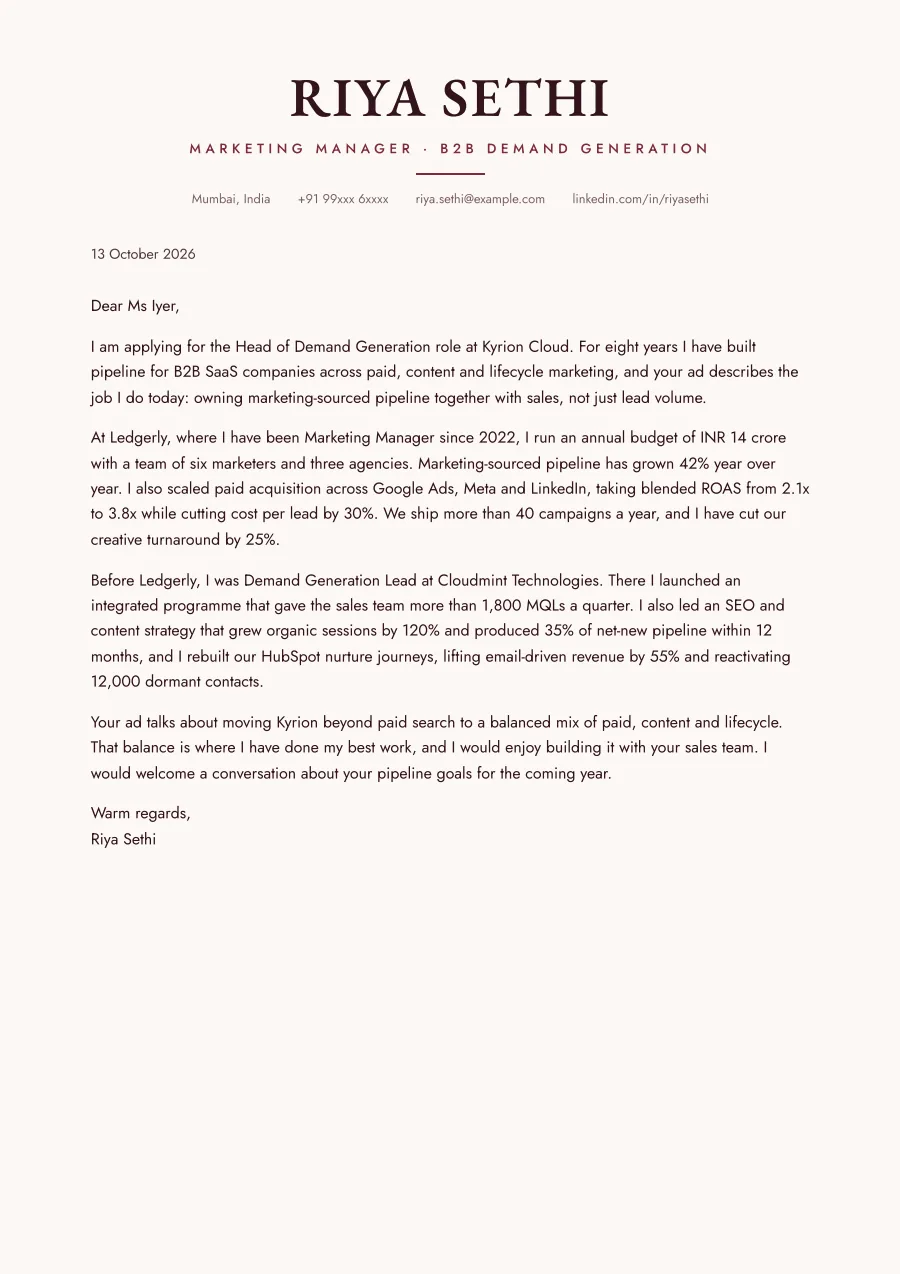
This marketing cover letter example is written by Riya Sethi, the Mumbai B2B marketing manager on our marketing resume example, applying to lead demand generation at a larger SaaS company. Every number comes from her resume: pipeline, ROAS, budget and team. Below the letter you'll see why each paragraph is there, which proof points marketing hiring managers look for, four opening lines, how to answer a job ad line by line, and how letters differ by country.
Riya SethiMarketing Manager · B2B Demand GenerationMumbai, India · +91 99xxx 6xxxx · riya.sethi@example.com · linkedin.com/in/riyasethi
Dear Ms Iyer,
I am applying for the Head of Demand Generation role at Kyrion Cloud. For eight years I have built pipeline for B2B SaaS companies across paid, content and lifecycle marketing, and your ad describes the job I do today: owning marketing-sourced pipeline together with sales, not just lead volume.
At Ledgerly, where I have been Marketing Manager since 2022, I run an annual budget of INR 14 crore with a team of six marketers and three agencies. Marketing-sourced pipeline has grown 42% year over year. I also scaled paid acquisition across Google Ads, Meta and LinkedIn, taking blended ROAS from 2.1x to 3.8x while cutting cost per lead by 30%. We ship more than 40 campaigns a year, and I have cut our creative turnaround by 25%.
Before Ledgerly, I was Demand Generation Lead at Cloudmint Technologies. There I launched an integrated programme that gave the sales team more than 1,800 MQLs a quarter. I also led an SEO and content strategy that grew organic sessions by 120% and produced 35% of net-new pipeline within 12 months, and I rebuilt our HubSpot nurture journeys, lifting email-driven revenue by 55% and reactivating 12,000 dormant contacts.
Your ad talks about moving Kyrion beyond paid search to a balanced mix of paid, content and lifecycle. That balance is where I have done my best work, and I would enjoy building it with your sales team. I would welcome a conversation about your pipeline goals for the coming year.
Riya's letter runs to four body paragraphs, and each one has a single job. Nothing in it is decoration.
Opening: the role, the company, eight years in B2B SaaS and the ad's main ask, owning pipeline with sales. By the second sentence the reader knows why she is a fit.
Current role: scale first (budget, six marketers, three agencies), then the three results that matter most in demand generation: pipeline growth, ROAS and cost per lead.
Previous role: proof of the work paid media doesn't cover, such as MQL volume, SEO and content, and lifecycle email in HubSpot. It shows range without listing every tool she has touched.
Close: she repeats the ad's phrase about a balanced mix, says what she would build and asks to talk about their pipeline goals, not about “any opportunity”.
Every figure also appears on her marketing resume, so the two documents back each other up. ResumeInk's AI cover letter tool drafts a first letter from your own resume and the job ad, and saves it as a PDF in your resume's design.
What to highlight in a marketing cover letter
Marketing is measured, so your letter should be too. Choose two or three results that match the job and give each a starting point: “ROAS from 2.1x to 3.8x” says far more than “strong ROAS”.
Pipeline and revenue: marketing-sourced or influenced pipeline, MQL to SQL conversion, revenue from email or organic search. In B2B, pipeline carries more weight than clicks.
Efficiency: ROAS, cost per lead or acquisition, and the budget you managed. Name the currency and the time period.
Channels and tools: the platforms the ad lists, such as Google Ads, Meta, LinkedIn, HubSpot, GA4 or Salesforce, each tied to something you did with it.
Scope: team size, agencies and campaigns a year. This is what separates a manager's letter from an executive's.
Brand and content roles: swap pipeline for reach, engagement, share of voice or launch results, and add a portfolio link.
The first two lines decide whether the rest is read. Four ways to open, depending on where you are:
Entry level: “During my final-year internship at a skincare brand, I ran the Instagram calendar and grew the account from 4,000 to 11,000 followers in five months; I'd like to bring that pace to your Marketing Executive role.”
Experienced: “I've spent six years running performance marketing for consumer apps, most recently cutting cost per install by a third while doubling monthly installs, and your Growth Marketing Manager role is the next step I've been looking for.”
Career changer: “Five years in B2B sales taught me exactly what makes a lead worth a rep's time, and I want to use that from the marketing side as your Demand Generation Executive.”
Referral: “Ananya Rao, who leads content on your team, suggested I write to you about the Content Marketing Manager role; we worked together on the SEO programme that doubled organic sign-ups at my current company.”
Each one names the role, gives one concrete fact and shows why this job. If your first sentence only says you are applying, make the second carry the proof, as Riya's does.
Matching your letter to the job ad
Read the ad and mark the three lines that describe the work, not the perks. Then check that one sentence in your letter answers each. Here is how Riya's letter maps to the Kyrion Cloud ad:
Ad: “You will own marketing-sourced pipeline targets jointly with sales leadership.” Letter: “your ad describes the job I do today: owning marketing-sourced pipeline together with sales, not just lead volume.” The 42% growth figure follows as proof.
Ad: “Experience managing a multi-channel budget and agency partners.” Letter: “I run an annual budget of INR 14 crore with a team of six marketers and three agencies.”
Ad: “Help us move beyond paid search to a balanced channel mix.” Letter: the Cloudmint paragraph on SEO, content and HubSpot nurture, then “That balance is where I have done my best work.”
Use the ad's own words where they are true for you: “marketing-sourced pipeline”, not just “leads”. Readers scan for them, and so does screening software. Keep the same terms on your resume too.
Marketing cover letters by country
US: one page, three or four paragraphs, roughly 250 to 400 words. Most applications go through an online portal where the letter is optional; fill it in for roles you really want. Leave out photo and age, and close with “Sincerely” or “Best regards”.
UK: similar length, British spelling, and CV rather than resume. “Dear Ms Iyer” pairs with “Yours sincerely”; “Dear Sir or Madam” with “Yours faithfully”. Agencies handle many marketing roles, so keep a short version for recruiters.
India: the letter is often your email body or a portal note, so 200 to 300 words is plenty. Recruiters ask early about notice period and current city; add them in one line. Leave current and expected CTC for the form or the call unless the ad asks.
Australia: one page, “Kind regards”, Australian spelling. Mention work rights if you hold a visa. Government and university marketing roles may ask you to address selection criteria separately.
Canada and the Gulf: Canada follows US norms, with French a plus in Quebec. In the UAE and Saudi Arabia, keep it brief and mention visa status, notice period and Arabic if you have it.
Riya writes from Mumbai, so her letter uses Indian conventions: British spelling, a named reader and “Warm regards”.
Common marketing cover letter mistakes
Calling yourself creative and data-driven. Every applicant does. Replace the adjectives with one campaign and its result.
Vanity metrics with no baseline. “A million impressions” means little on its own; “cost per lead down 30%” shows what changed.
Listing every channel you've touched. Pick the two or three the ad cares about and go deeper on those.
One letter for brand and performance roles. A brand role wants positioning and launches; a performance role wants CAC and ROAS. Rewrite the middle paragraph for each.
Forgetting it's a writing sample. Marketing managers read your letter as copy. Check the company name, the tone and every number twice.
Send one whenever the application allows it. In marketing the letter doubles as a writing sample, so a short, tailored one with a result or two is worth the effort.
How long should a marketing cover letter be?
Aim for 250 to 400 words in three or four paragraphs, which fits easily on one page. When the letter is the body of an email, as it often is in India, a little shorter works well.
How do I write a marketing cover letter with no experience?
Lead with the closest real work you have: an internship, a college event you promoted, a blog or social account you grew, or a course project with results. Give one number for each and link a portfolio if you have one.
Should a marketing cover letter include metrics?
Yes. Two or three numbers with a baseline and a time frame, such as ROAS, cost per lead or pipeline growth, tell a hiring manager more than any adjective.