Free Teacher Resume Template & Examples
A strong teacher resume shows what changed for your students, not just what you taught. Schools want your subjects, grade levels and curriculum at a glance, your licence or registration status, and evidence such as results, attendance or programmes you started. This page covers format, summaries, bullet points and keywords for primary and secondary teachers, with the credentials that matter in India, the US, the UK and Australia. Upload your current resume or CV as a PDF, Word file or photo, and ResumeInk rebuilds it in a clean, ATS-readable design you can edit line by line.
Best resume format for a teacher
Use reverse-chronological order, with your current or most recent school first. One page suits student teachers and teachers with under five years in the classroom. Two pages are normal for experienced teachers, heads of department and coordinators, and a two-page CV is common for school jobs in the UK and India. University lecturers need a full academic CV instead.
A reliable order: contact details, a short summary, teaching credentials, experience, education, skills, then extras such as clubs, training and languages. If you are newly qualified, move your education and teaching practice above other jobs; ResumeInk's Academic layout puts education first for exactly this.
Keep the design calm and readable. Many districts and education departments collect applications through online systems, so a single-column layout such as Classic or Traditional is the safest choice.
What to include in a teacher resume
- Credentials near the top: in India, your B.Ed or D.El.Ed and CTET or state TET status; in the US, your state teaching license with subject and grade endorsements; in England, QTS and your ECT induction status if you are early career; in Australia, registration or accreditation with your state or territory regulator, such as VIT in Victoria or NESA in New South Wales.
- Teaching context: subjects, grade levels or year groups, board or curriculum (CBSE, ICSE, IB, Cambridge, state standards, GCSE and A level) and typical class sizes.
- Experience: school, role, dates and three to five bullets on outcomes: results, progress, attendance, programmes you led.
- Education: degree, teaching qualification (B.Ed, PGCE, a teacher preparation program or a Master of Teaching) and your student teaching or placements with grade levels.
- Checks and training: a current background check where it applies, such as an enhanced DBS check in the UK or a Working with Children Check in Australia, plus first aid, safeguarding or special education training.
- Extras that help: clubs, sports coaching, exam duties, mentoring trainees and languages you can teach in.
Teacher resume summary examples
Two or three lines: your subject and level, your credential and one result. Adapt these:
- Entry level: Mathematics graduate with a B.Ed and CTET Paper II, fresh from a 16-week school internship teaching Classes 6 to 8 at a CBSE school. Plans activity-based lessons, uses Google Classroom and teaches confidently in English and Hindi.
- Mid-level: Science teacher with QTS and seven years teaching Key Stages 3 and 4 in a large comprehensive. Raised the share of GCSE combined science students at grade 5 or above from 44% to 58% through targeted intervention and retrieval practice.
- Senior: Head of English with 14 years in US public middle and high schools and a state license in English Language Arts for grades 6 to 12. Leads a team of nine, built the department's writing curriculum and mentors new teachers through their first two years.
Teacher resume bullet point examples
Start with an action, add the scale, end with a result. Mix these to match your level:
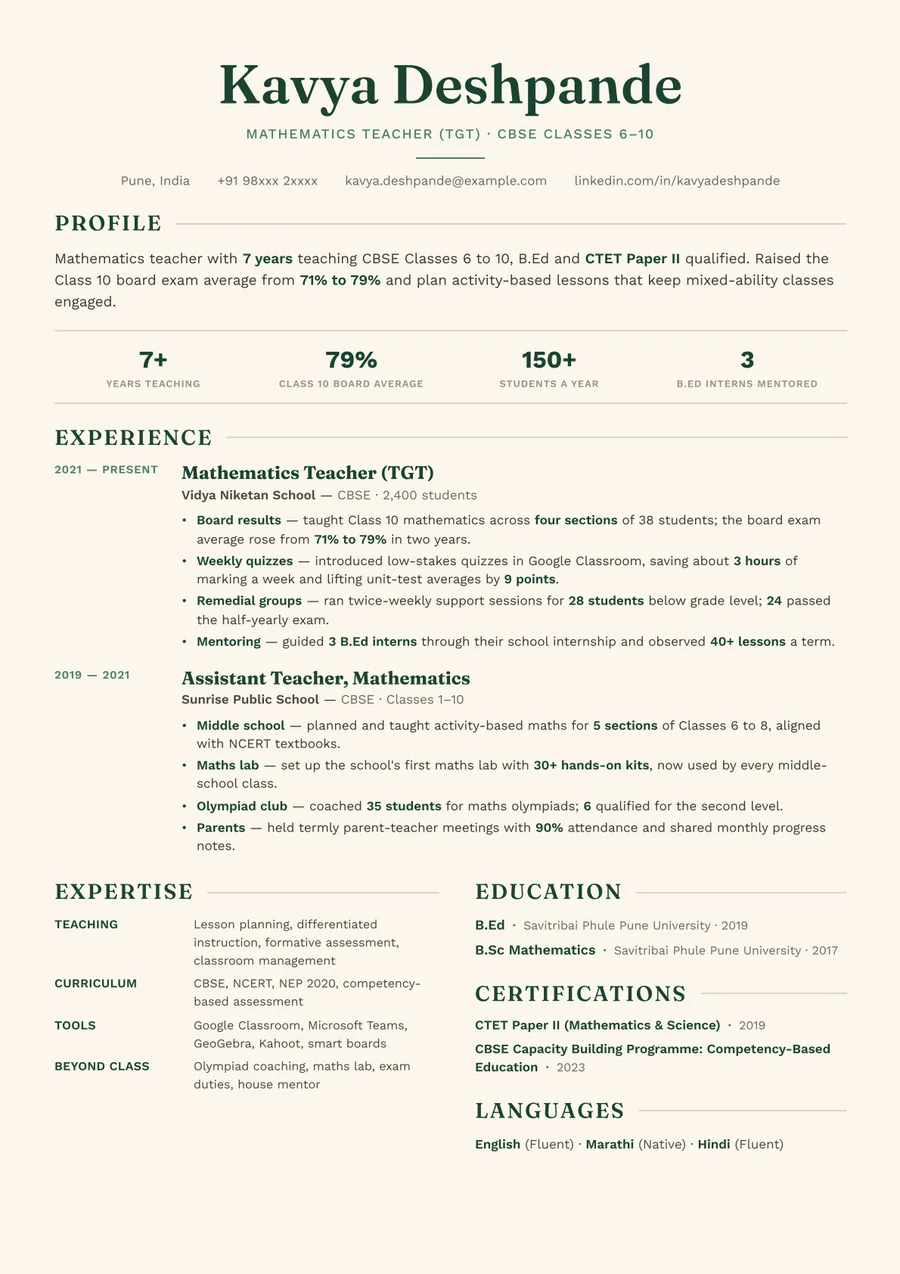
- Taught Class 10 mathematics (CBSE) across four sections of 38 students; the board exam average rose from 71% to 79% in two years.
- Designed differentiated reading plans for 26 Grade 3 students, including four with IEPs; 81% met the end-of-year reading benchmark, up from 58%.
- Ran Year 11 maths intervention groups twice a week; 22 of 30 students moved up at least one GCSE grade between mocks and final exams.
- Introduced weekly low-stakes quizzes in Google Classroom, saving about three hours of marking a week and lifting unit-test averages by 9 points.
- Cut chronic absence in a homeroom of 30 from 14% to 6% with weekly calls home and an attendance recognition scheme.
- Led a department of six English teachers and rewrote the Key Stage 3 schemes of work; internal assessments improved in all three year groups.
- Mentored five student teachers and two early career teachers; all completed their placements or induction.
- Started an after-school robotics club for 35 students that placed second at the regional championship.
Never name students or include anything that could identify a child.
Skills & ATS keywords for teacher resumes
Take the exact words from the job advertisement and use the ones that are true for you. Terms that come up again and again in teaching ads:
- Teaching practice: lesson planning, differentiated instruction, classroom management, formative and summative assessment, feedback, curriculum design, inclusive education, blended learning.
- Curriculum and frameworks: CBSE, ICSE, IB, Cambridge IGCSE and NEP 2020 (India); state standards, IEPs and MTSS (US); national curriculum, GCSE, A level, SEND and safeguarding (UK); the Australian Curriculum and the Australian Professional Standards for Teachers.
- Tools: Google Classroom, Microsoft Teams, Canvas, Seesaw, Kahoot, interactive whiteboards and your school's information system, such as PowerSchool.
- Soft skills: communication with parents, patience, collaboration, adaptability, behaviour management.
Put the subject and level in your title line too, for example Secondary Mathematics Teacher, because that is what schools search for. More on choosing resume keywords.
Common teacher resume mistakes
- Duties instead of outcomes. Planned lessons and marked books describes every teacher. Show results, progress, attendance or a programme you built.
- Hiding your credential. A school needs to know at once whether you hold QTS, a state license, TET status or registration. Put it in the summary or a credentials line near the top.
- Leaving out the context. Without subjects, grade levels and curriculum, a reader cannot tell whether you fit. Add them to every role.
- A philosophy essay in the summary. Keep the summary to evidence. Save your teaching philosophy for the cover letter or a statement the school asks for.
- In-house acronyms. Spell out school programme names the first time, or describe what they did.
- Student details. Never include names, photos or work that identifies a child.
Premium, ATS-friendly templates


Build your resume in minutes
Upload your current resume, edit anything, then preview and download it free.
Upload your resumeFrequently asked questions
How do I write a teacher resume with no teaching experience?
Lead with your teaching qualification and your student teaching, internship or placement: the school, grade levels, subjects and what you taught. Add tutoring, coaching, camps or volunteer work with young people, and state your license, TET or registration status clearly.
Should I list my teaching license or registration number?
Name the credential, its subject or grade area and its status, for example a state license with an endorsement, QTS or registration with VIT. Add the number only if the advertisement or application form asks for it, since schools usually verify it with the issuing body.
How long should a teacher resume be?
One page for student and early career teachers, two pages for experienced teachers and leaders. In the UK, India and Australia a two-page teaching CV is common, and many schools also use their own application forms, so keep your CV consistent with what you write there.
Should a teacher resume include a teaching philosophy?
Not as a paragraph. Show your approach through results and one line in your summary, such as how you use assessment or support mixed-ability classes. If a school asks for a philosophy statement, write it as a separate document.