Free Traditional Resume Template
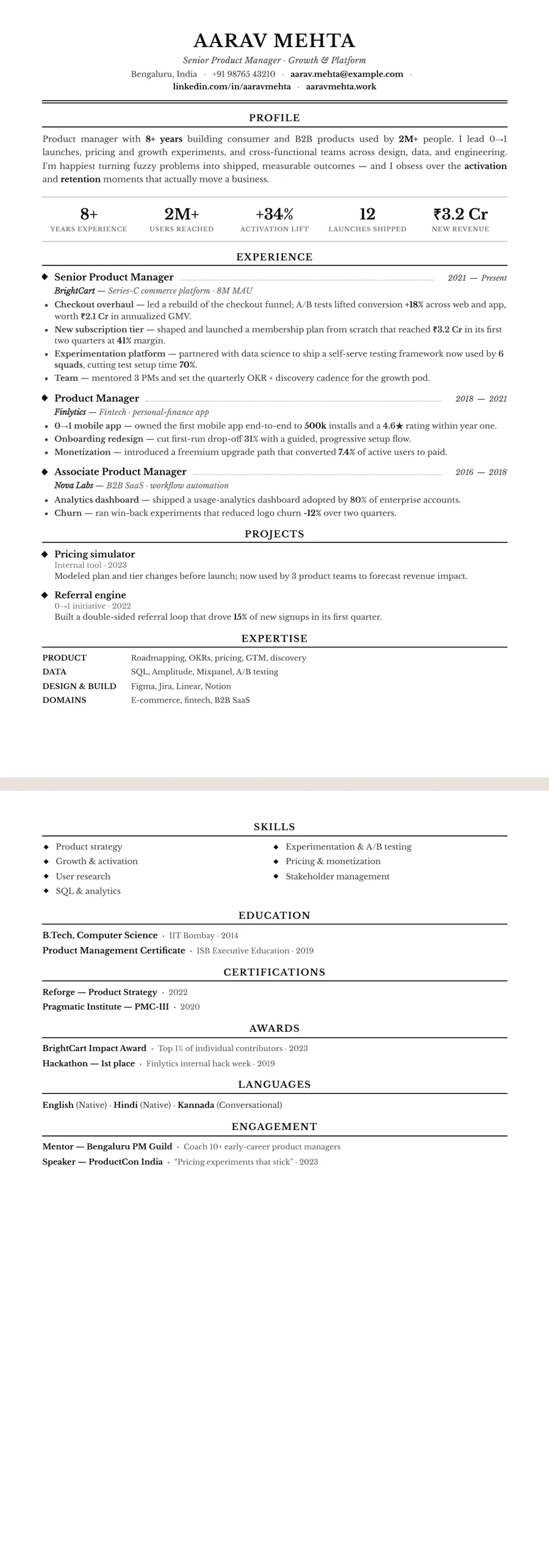
A traditional resume template follows the format employers know best: your name centred at the top, serif headings, and your jobs listed newest first. Nothing on the page competes with your record. That makes it the safe choice for conservative fields such as law, banking, insurance, accounting, government and the public sector, including formal applications to PSUs and public-sector banks in India. It also suits anyone who wants a resume that reads as calm, careful and serious, at any stage of their career.
What makes a resume traditional
A traditional resume is defined by a handful of conventions rather than one fixed look:
- A centred header — your name, often in capitals, with contact details on one line below.
- Serif type for the name and section headings, which reads as formal and print-like.
- Reverse-chronological order — the most recent role first, each with title, employer, location and dates.
- Plain section names such as Profile, Experience, Education and Skills.
- One column, with restrained colour or none at all.
Next to a modern two-column template, it gives up side panels, icons and skill bars in exchange for order and clarity. Next to a skills-first format, it keeps your career history at the centre, so a reader can follow your progression from role to role without hunting for dates.
Who should use the classic format, and when to skip it
Reach for it when the employer is formal and the reader is senior. It fits:
- Law — associates, in-house counsel and legal officers.
- Banking, finance and insurance — credit, audit, compliance and relationship roles.
- Government and the public sector — civil service, regulators, and experienced hiring at Indian PSUs and public-sector banks.
- Senior and executive roles, where a long, steady track record is the main selling point.
A chronological layout works best when your history is continuous and moving upward. If you are changing careers, returning after a long gap, or relying mostly on skills and projects, a skills-first design such as Sage skills-first may tell your story better. Design-led and startup roles can take something with more personality, though a traditional resume is rarely the wrong answer.
Why the traditional format reads cleanly in ATS
A traditional resume is about as easy for an applicant tracking system as a resume gets. One column means the text comes out in the same order you read it. Standard headings like Experience and Education are exactly what parsing software looks for. And reverse-chronological entries, each with a title, employer and dates, map neatly onto the fields an ATS fills in.
A few habits keep it that way. Write dates the same way everywhere, as month and year, with Present for your current job. Keep the job title and employer on their own line rather than buried in a sentence. Don't put contact details in a word processor's page header or footer, since some systems skip those areas.
ResumeInk's Traditional, Letterpress and Formal layouts are all single column, and every design is checked to read cleanly in ATS text extraction, with real, selectable text in a logical order. The ATS score in the editor shows how readable yours is.
Build a traditional resume with ResumeInk
Start from the sample, or upload the resume you have now — a PDF, a Word file or even a photo of a printed copy. The AI rebuilds it, and you choose a classic design:
- Traditional layout, Classic traditional theme — black serif type, a centred header and your name in capitals. The most conventional of the set.
- Letterpress layout, Letterpress classic theme — a cream page, wine accents and a large serif name with a small ornament, like printed stationery. See the Letterpress classic template.
- Formal layout, Classic traditional theme — a restrained centred header for senior legal, finance and government applications.
Click any line to edit it, reorder sections so the most relevant comes first, and fine-tune fonts and spacing. Switching designs takes one tap and your words stay, so you can keep a Formal version for a bank and a Letterpress one for a law firm without retyping anything.
Traditional designs you can use


Build your resume in minutes
Upload your current resume, edit anything, then preview and download it free.
Upload your resumeFrequently asked questions
What is a traditional resume format?
It is a one-column resume with a centred header, serif headings and your work history in reverse-chronological order, newest job first. The focus is your career record rather than the design.
Is a chronological resume better than a functional one?
For most people with a steady work history, yes, because readers can see what you did and when. A skills-first style can suit career changers or people with gaps, but most employers still want clear dates for each role.
Is a traditional resume old-fashioned?
No. It is conventional, and that is the point in fields like law, banking and government, where a familiar format lets your record do the talking. Good spacing and a clean serif keep it looking current.
Should I use a traditional resume for a government job in India?
A clean, conservative resume suits most public-sector and PSU applications. Always follow the advertisement first, since many government posts use their own online form or a prescribed format.