Free Financial Analyst Resume Template & Examples
A financial analyst resume is read by people who build models for a living, so vague claims stand out. They want to see what you forecast, how accurate it was, which decisions your analysis shaped and which tools you used. Whether you work in FP&A, corporate finance, equity research or banking, this page covers the right format, summary and bullet examples with believable numbers, the keywords finance job ads repeat, and the mistakes to avoid. Upload your current resume and ResumeInk rebuilds it in a clean design that ATS software can read.
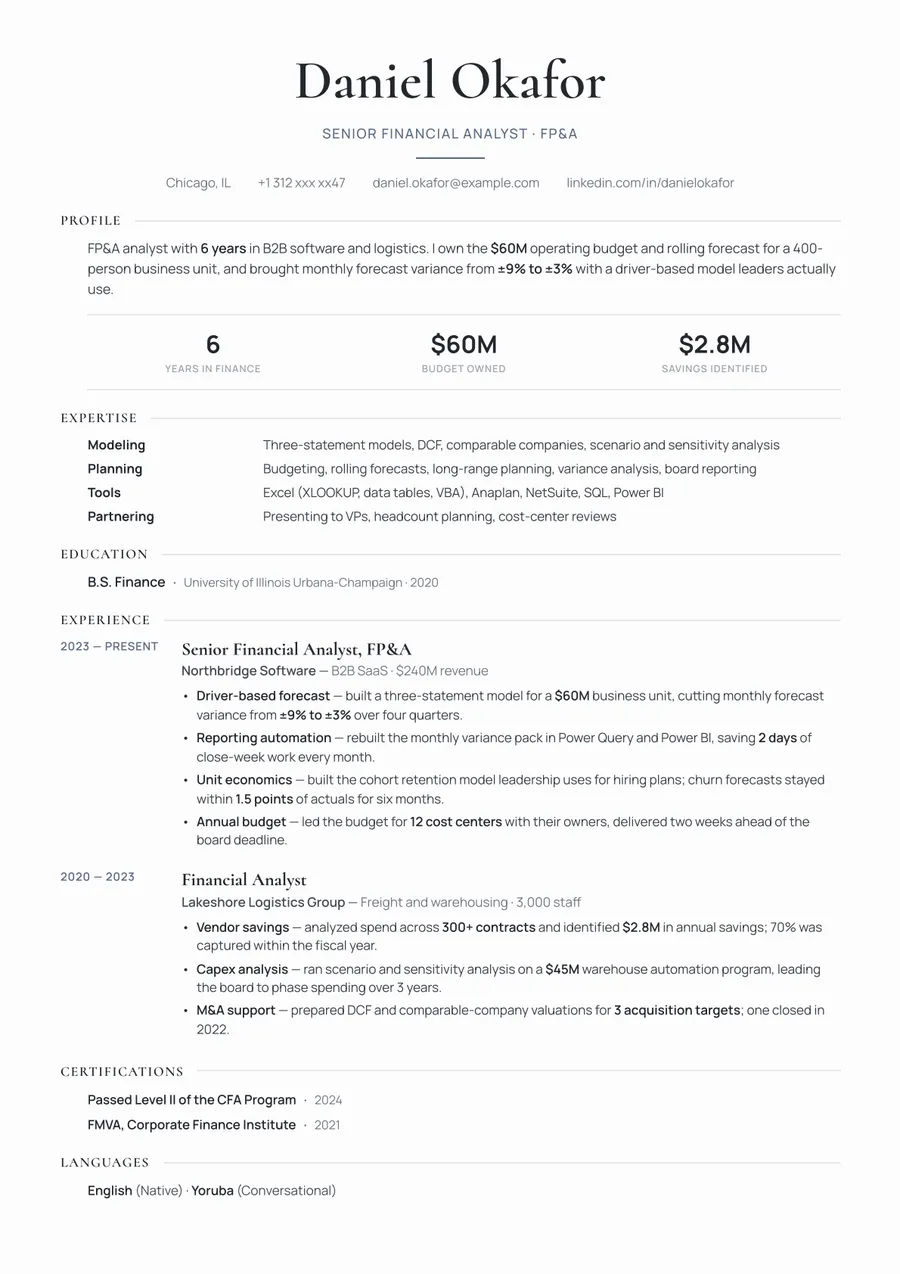
Best resume format for a financial analyst
Keep it to one page until you have around seven years of experience. For investment banking, private equity and equity research applications, one page is expected at junior and mid levels. Senior FP&A managers and finance business partners can use two pages when the extra space holds results, not lists.
A section order that works: header, a two-line summary (students can skip it), experience, education with your professional exam status, then skills. Students and recent graduates should lead with education and give grades in the local format: CGPA or percentage in India, GPA in the US, degree classification such as a 2:1 in the UK, and WAM or GPA in Australia.
Layout tip: dense, single-column and easy to compare. ResumeInk's Compact layout fits the most on a page, and Classic gives each role more air. If you are cutting down, see our one-page resume templates.
What to include in a financial analyst resume
- Your area of finance. FP&A, corporate finance, investment banking, equity research, credit and treasury are different jobs. Make yours obvious in the first line.
- Models you built, such as three-statement, DCF, LBO or budget models, and the decision each one informed.
- Scale: the budget, portfolio, deal size or business unit you covered.
- Accuracy and impact: forecast variance, savings found, investments or deals supported.
- Credentials: your CFA Program status, plus CA or CMA in India, ACCA or CIMA in the UK, CPA in the US, or CA ANZ or CPA Australia. Licences such as FINRA's SIE and Series 7 in the US, or NISM certifications in India, matter only for roles that require them.
- Tools: Excel, planning software, BI tools and financial data platforms, each named.
If your work is mostly closing the books and statutory reporting, our accountant resume guide will fit better.
Financial analyst resume summary examples
- Entry level: Finance graduate (BCom, 8.6 CGPA) who has passed Level I of the CFA Program. Interned with the FP&A team of a consumer goods company, rebuilding the monthly sales forecast in Excel. Skilled in three-statement modelling, basic SQL and Power BI.
- Mid level: FP&A analyst with five years in B2B software, owning a USD 60M operating budget and the rolling 18-month forecast. Brought monthly forecast variance from ±9% to ±3% and built the unit-economics model leadership uses to plan hiring. Advanced Excel, Anaplan and SQL.
- Senior: Senior financial analyst and CFA charterholder with ten years in corporate finance and M&A. Led valuation and diligence models for 7 acquisitions totalling £300M, and works with the CFO on capital allocation, investor reporting and long-range planning.
Name your area of finance and your strongest number early, because that is what a hiring manager scans for first. Keep adjectives for the interview.
Financial analyst resume bullet point examples
- Built a driver-based three-statement model for a USD 60M business unit, cutting monthly forecast variance from ±9% to ±3% over four quarters.
- Automated the monthly variance pack with Power Query and Power BI, saving 2 days of close-week work every month.
- Identified INR 4.2 crore in annual cost savings by analysing vendor spend across 300+ contracts; 70% was captured within the financial year.
- Prepared DCF and comparable-company valuations for 5 acquisition targets; the two that closed added 18% to group revenue.
- Ran scenario and sensitivity analysis on a £45M capital programme, leading the board to phase spending and keep £8M of cash headroom.
- Led the annual budget for 12 cost centres with their budget owners, delivering two weeks ahead of the board deadline.
- Maintained earnings models for 14 listed consumer companies as a research associate and drafted the quarterly previews used by the lead analyst.
- Built a cohort-based revenue model that forecast churn within 1.5 points of actuals for six consecutive months.
Every bullet names the model or analysis, the scale and what changed because of it.
Skills & ATS keywords for financial analyst resumes
- Modelling and valuation: financial modelling, three-statement models, DCF, comparable companies, precedent transactions, LBO, scenario and sensitivity analysis.
- Planning and reporting: FP&A, budgeting, rolling forecasts, long-range planning, variance analysis, management reporting, board packs, business partnering.
- Finance concepts: EBITDA, working capital, cash flow forecasting, NPV, IRR, WACC, unit economics, IFRS and US GAAP.
- Tools: Excel (XLOOKUP, INDEX/MATCH, pivot tables, data tables, VBA), PowerPoint, Power BI, Tableau, SQL, Python (pandas), Anaplan, Workday Adaptive Planning, Oracle Hyperion, SAP, Bloomberg, Capital IQ, FactSet.
- Data sources: annual reports, earnings calls, SEC filings in the US and stock exchange filings in India, the UK and Australia.
- Soft skills: presenting to senior leaders, turning numbers into recommendations, attention to detail, working to tight deadlines.
Mirror the ad's wording: if it says FP&A and Anaplan, use those exact words. Run a draft through our ATS resume checker to see how it reads.
Common financial analyst resume mistakes
- Models without outcomes. “Built DCF models” is a task. Say what the model was for and what was decided.
- Using CFA as a title too early. CFA Institute asks candidates to describe their status in words, such as “Passed Level II of the CFA Program”. Only charterholders write CFA after their name.
- Unlabelled figures. Say whether a number is revenue, EBITDA, budget or savings, and keep one currency format.
- Tool lists with no proof. Twenty tools in a row look padded. Keep the ones you could be tested on and show them in bullets.
- Two pages for a banking application. Junior banking and research resumes are expected to fit one page.
- Confidential details. Don't name undisclosed deals or clients' figures. Describe them instead, for example “a USD 200M acquisition in logistics”.
Premium, ATS-friendly templates


Build your resume in minutes
Upload your current resume, edit anything, then preview and download it free.
Upload your resumeFrequently asked questions
How do I write a financial analyst resume with no experience?
Lead with education, grades and relevant coursework, then add your CFA or other exam progress. Include internships, an investment club or case competitions, and one modelling project, such as a DCF of a listed company built from its annual report. Keep it to one page.
Should I put CFA Level 1 on my resume?
Yes, once you have passed it: write “Passed Level I of the CFA Program”. If you are registered but have not sat the exam yet, you can write “Level I Candidate in the CFA Program”. Don't put CFA after your name until you hold the charter.
What is the difference between an FP&A resume and an investment banking analyst resume?
An FP&A resume stresses budgeting, forecasting, business partnering and planning tools. A banking resume stresses deals, valuation and transaction work, is kept to one page, and puts education near the top for junior candidates. Tailor bullets and keywords to the one you are applying for.
Which Excel skills should a financial analyst list?
Name the functions and features you really use, such as XLOOKUP or INDEX/MATCH, pivot tables, data tables for sensitivities, Power Query and VBA. “Advanced Excel” on its own tells a recruiter little, so pair it with what you built.