Free One Page Resume Template
A one page resume template is built to hold your whole story on a single sheet: header, profile, experience, skills and education, without feeling crammed. It suits students, freshers and early to mid-career professionals, and anyone applying where a short, single page resume is the norm. The trick is a layout that uses space well, plus editing that cuts every line that does not earn its place. ResumeInk's Compact header layout is the densest of its 13 layouts, and it still reads cleanly in ATS text extraction.
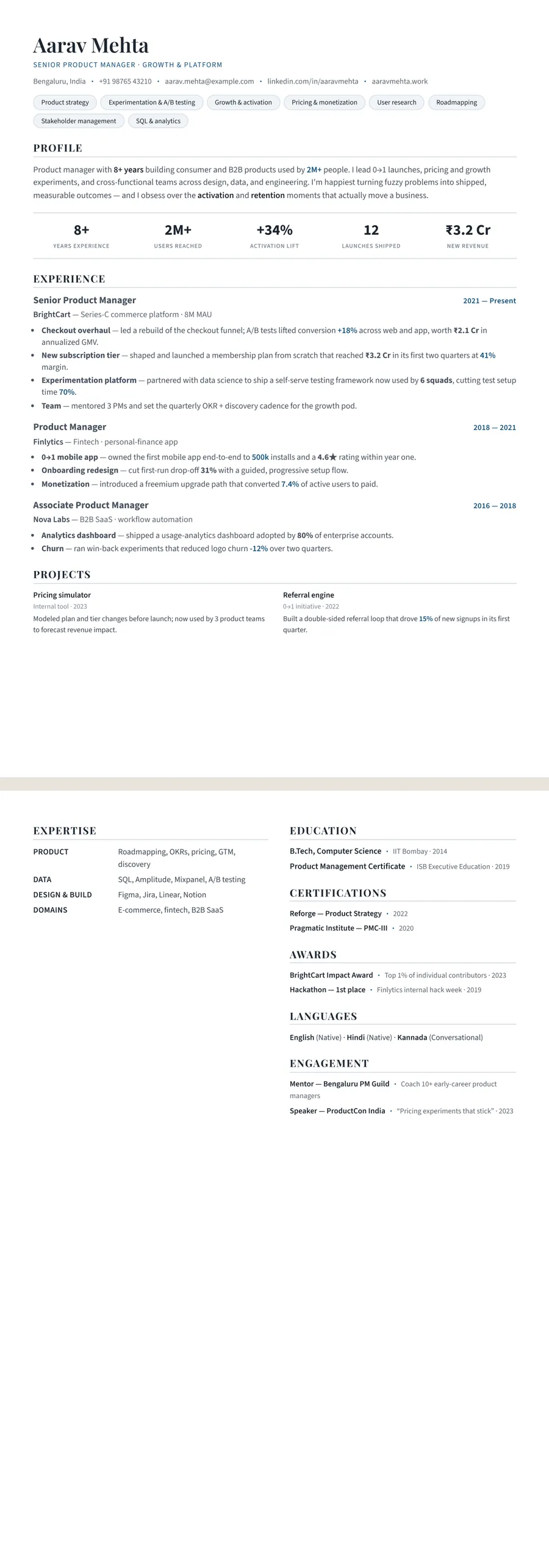
What makes a template good for one page
Any resume can fit on one page if you cut enough. A template made for one page helps you cut less. It does that in three ways: a tight header that does not waste the top of the page, skills shown compactly instead of as a long list, and spacing that is even but not generous.
ResumeInk's Compact header layout is the densest of the 13. Your name, title and contact line sit in a short header, and your skills appear as small chips right under it, so they take two or three lines instead of half a column. Experience follows straight after.
Two other layouts also suit a single page. Classic keeps dates in a narrow column to the left of each role, so every entry stays tidy and easy to scan. Skills-first groups your skills in a shaded Expertise block before experience, which works well when your skills say more than a short work history does.
When one page is right, and when two pages are better
One page is the right length for most people in roughly the first ten years of their career. That includes:
- Students and freshers with internships, projects and coursework; see the resume builder for freshers
- Early-career professionals with one to three jobs
- Career changers who want the focus on relevant work
- Applications in the US and Canada, where one page is a common expectation below senior level
Two pages are fine, and often better, for senior people with a long record of relevant roles, for specialists with many projects, and for mid to senior CVs in the UK and India, where two pages is normal. Academic CVs, with publications and grants, run longer still.
A useful test: if you have to shrink the font below a comfortable size to fit, you are ready for page two. Our guide to one page vs two page resumes goes deeper.
Fitting more on a page without hurting ATS readability
The risky ways to squeeze a resume are the ones that hide text from software: putting skills inside an image, setting tiny text in a table, or dropping headings to save a line. An applicant tracking system needs clear section headings, such as Experience and Education, and real text it can select and copy.
The Compact header layout saves room through layout, not tricks. The skill chips are real text. The section headings stay. The single column means a parser reads it top to bottom, in the same order a person does, and every ResumeInk design is checked in ATS text extraction.
A few editing habits keep a one-page resume tight and readable:
- Keep three or four bullets for recent roles, and one or two for older ones
- Drop the street address; city and country are enough
- Merge short, related bullets into one line with a number
- Remove skills you could not discuss in an interview
Build a one-page resume in ResumeInk
Start with the resume you have, even if it runs to two pages. Upload the PDF, Word file or a photo of it, and the AI rebuilds it in the layout you pick. Good starting points for a single page:
- Professional Compact — blue accents, dense and businesslike
- Swiss minimal Compact — neutral type with one red accent, a lot packed in neatly
- Noir executive Compact — a black header band for senior one-pagers
Still over a page? Hide a section you can live without, such as interests or an old project, so it drops out of the PDF without being deleted. Fine-tune the spacing and font size in the editor, and let the AI tighten the wording of long bullets. If your content truly needs two pages, switch to a roomier layout such as Classic or Skills-first in one tap, without retyping anything. The ATS score shows whether the result still reads cleanly before you download.
One page designs you can use


Build your resume in minutes
Upload your current resume, edit anything, then preview and download it free.
Upload your resumeFrequently asked questions
Should my resume be one page?
If you have less than about ten years of relevant experience, one page is usually right. Senior candidates, academics and many mid to senior CVs in the UK and India can run to two pages.
How do I fit my resume on one page without it looking crowded?
Use a dense layout such as Compact header, cut older roles to one or two bullets, and remove details that do not support the job. If you have to make the text hard to read to fit, edit more instead of squeezing.
Is a one page resume better for ATS?
Length does not decide ATS readability; structure does. Software reads a two-page resume just as well if the text is real and the headings are clear. One page mainly helps the human reader.
What should I remove first to get down to one page?
Start with an objective line, references, a full street address and duties anyone in that role would have. Then trim older jobs and any skill you would not want to be tested on.