Free Creative Resume Template
A creative resume template shows some personality — a confident accent colour, a side column, a layout that feels designed — while every word stays real, selectable text. It suits graphic and UX designers, marketers, content writers, social media managers and brand people, where the resume itself hints at your taste. ResumeInk keeps the creativity in colour, type and structure rather than graphics, so hiring software can still read the page. Your portfolio shows the work; the resume makes the case for opening it.
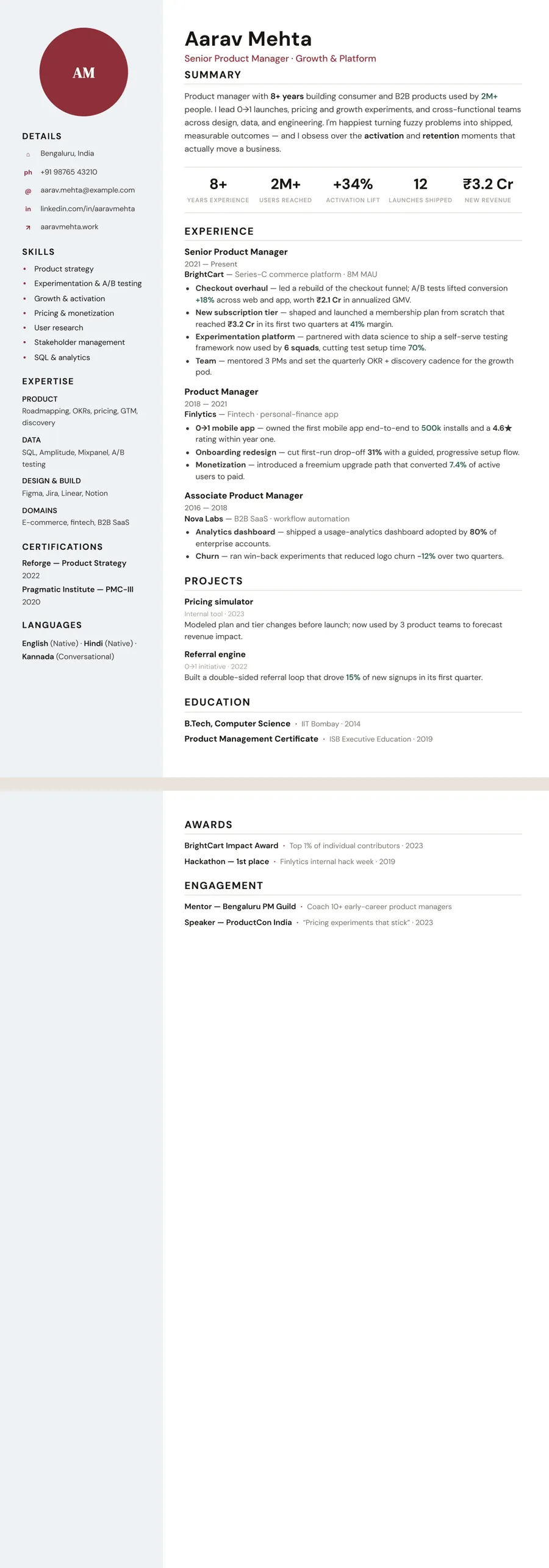
Creative, but not a poster
Search for creative resume templates and you will find two very different things. One is the infographic resume: icons for every heading, pie charts of skills, a career path drawn as a picture, text placed in floating boxes. It looks lively in a thumbnail and falls apart the moment software, or a busy recruiter, tries to read it.
The other is a designed resume that keeps a normal structure and shows personality through choices that never get in the way:
- Colour — an earthy terracotta, a calm green or a bold accent on white, instead of the usual navy and grey.
- Layout — a side column for contact details and skills, or a vertical line running through your experience.
- Type — a characterful heading font paired with a plain body font.
- A photo, if your market expects one — set in a circle at the top of the side column.
ResumeInk builds only the second kind, and that is the honest version of creative for most job applications.
Who should use a creative resume, and who should not
A creative template fits roles where taste is part of the brief: graphic, product and UX designers, illustrators, marketers, copywriters, content and social media managers, brand and PR people, event planners, and people in fashion and media. Agencies, consumer brands and startups tend to welcome it. Marketers will find role-specific advice on content in our marketing resume template.
A photo is a separate question. It is common on CVs in India, the Middle East and parts of Europe and Asia, and usually left off in the US, UK, Canada and Australia. The Portrait and Sidebar layouts show an optional photo in a circle at the top of the side column.
Skip the creative look for banks, law firms, government jobs and audit, where a quieter design suits the reader. And if you are a designer, remember the resume is not your portfolio. Put the portfolio link near the top, keep the page easy to scan, and let your best work do the convincing once someone clicks through.
What really breaks ATS in creative resumes
Colour and a side column are rarely the problem. These are:
- Skill bars and star ratings. A parser sees nothing in a bar, and a recruiter can't tell what four dots out of five means.
- Text inside images. A name or heading saved as a picture simply disappears when the text is extracted.
- Floating text boxes. They can be read out of order, splicing one job title onto another job's dates.
- Clever headings. My Journey and What I Bring are harder to map than Experience and Skills.
Every ResumeInk design, including the two-column Portrait and Sidebar layouts, is checked so its text extracts as real words in a logical reading order, and the ATS score in the editor shows how readable your version is. If you are applying through a large company portal and want the plainest structure, the single-column Timeline layout keeps your colour with one top-to-bottom flow. Before you send, run through the ATS resume checklist.
Make a creative resume with ResumeInk
Bring in your existing resume as a PDF, Word document or photo, or begin from a sample, and the AI lays it out in whichever design you choose. Any text changes with a click. Four themes carry a creative look well:
- Gallery white — a white page with bold accents.
- Dune terracotta — warm and earthy; see the Dune design.
- Sage botanical — a calm green that feels fresh rather than corporate.
- Forest editorial — a fresh green with an editorial feel.
Pair them with Portrait, a light left column holding your photo, details, skills and languages; Sidebar, a dark full-height column on the left; or Timeline, a single column with your roles on a vertical line. Gallery white on Portrait suits a graphic designer, Dune terracotta on Sidebar a content strategist, Sage botanical on Timeline a UX researcher. Try all three: switching design keeps every word, and fonts, colours and spacing stay yours to adjust.
Creative roles designs you can use


Build your resume in minutes
Upload your current resume, edit anything, then preview and download it free.
Upload your resumeFrequently asked questions
Are creative resumes bad for ATS?
Not by default. The trouble comes from skill bars, text saved as images and floating text boxes. A creative resume built from real text in a logical reading order, as every ResumeInk design is, reads cleanly.
Should a designer's resume look designed?
A little. Show taste through spacing, type and one considered colour, and let your portfolio show the actual work. A resume that is hard to scan works against you, however good it looks.
Should I put a photo on a creative resume?
It depends on the country. Photos are common in India, the Middle East and parts of Europe and Asia, and usually left off in the US, UK, Canada and Australia. If you add one, the Portrait and Sidebar layouts show it in a circle at the top of the side column.
Are skill bars a good idea on a resume?
Usually not. A bar or a rating of four out of five tells a recruiter very little, and hiring software can't read it. List skills as words in short groups and prove them in your experience.