Free Civil Engineer Resume Template & Examples
A good civil engineer resume reads like a project list with proof: what you designed or delivered, how big it was, and whether it finished on time, within budget and safely. This guide covers the best format for site, design and project engineers, what to include, summary and bullet examples, the software and keywords employers search for, and the licences and site cards that matter in India, the US, the UK and Australia. Upload your current resume and ResumeInk's AI rebuilds it into a clean, ATS-readable design you can edit and reorder.
Best resume format for a civil engineer
Use reverse-chronological order with your projects front and centre. Graduates and engineers with under about seven years of experience should aim for one page; senior engineers and project managers with a long list of major schemes can use two (our guide to one page vs two pages explains the trade-off).
Section order: header, summary, licences and registrations (near the top if the ad asks for them), experience, key projects, software and technical skills, education. Site engineers should lead with delivery numbers: contract value, quantities, programme and safety record. Design engineers should lead with what they designed and the codes they designed to.
Layout tip: keep it single-column so project names, values and dates stay in order for an ATS. ResumeInk's Timeline layout suits a career that moves from project to project; Classic or Formal suit consultancies and government roles. If you have more major projects than fit, keep the best on the resume and attach a separate project list.
What to include in a civil engineer resume
- Summary: your discipline (structural, geotechnical, transport, water, site or project engineering), years of experience and the scale of work you handle.
- Licences and site cards: US: EIT after the FE exam, then the PE licence, and the SE licence in states that require it for major structures. UK: ICE membership and CEng or IEng, plus a CSCS card and SMSTS or SSSTS for site roles. Australia: CPEng or NER through Engineers Australia, RPEQ for Queensland work, and a White Card for construction sites. India: your B.E./B.Tech Civil, AMIE or Chartered Engineer status from the Institution of Engineers (India), and a GATE score for PSU roles.
- Key projects: name, client type, value, your role and your scope for three to six projects.
- Codes: the ones you design to, such as ACI 318 and ASCE 7 (US), Eurocodes (UK), AS 3600 and AS 5100 (Australia), or IS 456 and IS 800 (India).
- Software: AutoCAD Civil 3D, Revit, STAAD.Pro, ETABS, 12d Model, Primavera P6 and similar.
- Safety: lost-time injury record, permits, inspections and safety training you led.
Civil engineer resume summary examples
Name your discipline, the scale of your projects and one proof point. Three examples:
- Entry level: Civil engineering graduate with nine months of site experience on a residential tower: setting out with a total station, checking reinforcement and logging concrete pours. Confident in AutoCAD, Civil 3D and quantity take-offs; holds a White Card and is working towards NER.
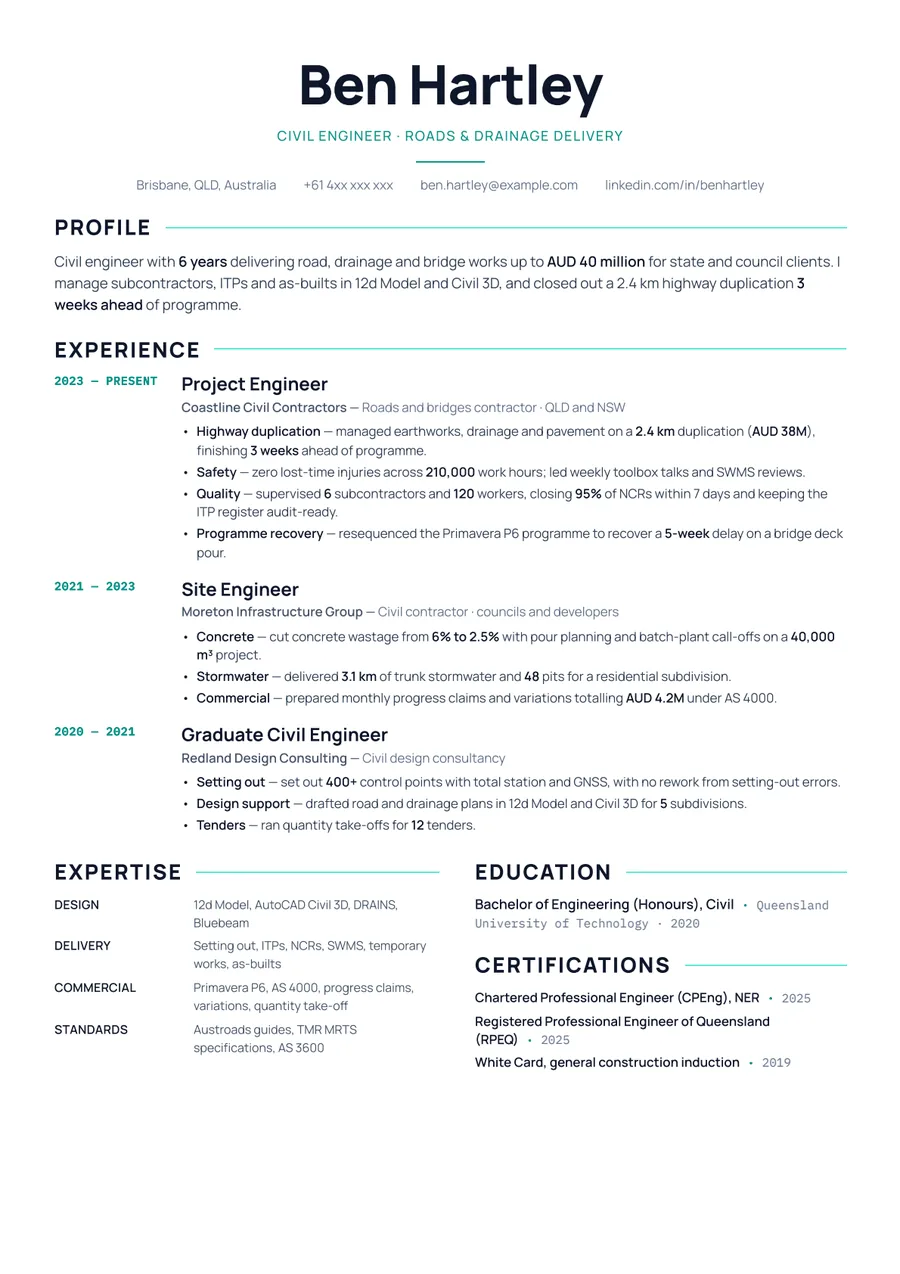
- Mid level: Civil engineer with 6 years delivering road, drainage and bridge works up to AUD 40 million for state and council clients. Manages subcontractors, ITPs and as-builts in 12d Model and Civil 3D, and closed out a 2.4 km highway duplication three weeks ahead of programme.
- Senior: Chartered civil engineer (CEng MICE) with 15 years in water and flood infrastructure across the UK. Leads design teams of 10 under NEC4 contracts, has delivered schemes worth over GBP 60 million, and specialises in hydraulic modelling and value engineering.
Civil engineer resume bullet point examples
- Managed earthworks, drainage and pavement on a 2.4 km highway duplication (AUD 38 million), finishing three weeks ahead of programme with zero lost-time injuries across 210,000 work hours.
- Designed reinforced concrete frames and raft foundations for a 12-storey residential block to IS 456 in ETABS and SAFE, saving 140 tonnes of steel through value engineering.
- Built HEC-RAS models for a flood alleviation scheme protecting 1,150 homes, gaining Environment Agency approval at first submission.
- Cut concrete wastage from 6% to 2.5% on a 40,000 m³ project by introducing pour planning and batch-plant call-offs.
- Supervised 6 subcontractors and 120 workers, closing 95% of non-conformance reports within 7 days and keeping the ITP register audit-ready.
- Resequenced the Primavera P6 programme to recover a five-week delay on a bridge deck pour.
- Prepared quantities and cost estimates for 18 tenders worth INR 260 crore, contributing to five contract wins.
- As a graduate engineer, set out 400+ control points with total station and GNSS with no rework from setting-out errors.
Lead with the numbers a project director checks first: value, programme, quantities, safety and savings.
Skills & ATS keywords for civil engineer resumes
Mirror the ad's own words. If it says “site engineer” and “Civil 3D”, use exactly those. Common keywords by area:
- Design software: AutoCAD, AutoCAD Civil 3D, Revit, STAAD.Pro, ETABS, SAP2000, SAFE, Tekla Structures, 12d Model, OpenRoads.
- Water and geotechnical: HEC-RAS, HEC-HMS, InfoWorks ICM, DRAINS, PLAXIS, stormwater design, slope stability.
- Project controls: Primavera P6, MS Project, BOQ, quantity take-off, cost estimation, variations, progress claims, NEC4, FIDIC, AS 4000.
- Site delivery: setting out, total station, ITPs, NCRs, method statements, RAMS (UK) or SWMS (Australia), temporary works, quality control.
- Soft skills: client and stakeholder liaison, subcontractor management, report writing, mentoring graduates.
To check your resume against a specific ad, paste both into the ATS resume checker and add only the terms you can back up.
Common civil engineer resume mistakes
- No scale. “Worked on bridge projects” becomes “site engineer on a three-span, 90 m bridge (GBP 14 million)”.
- Burying licences. If the ad asks for PE, CPEng, RPEQ or a CSCS card, show it in the summary or header, not on the last line.
- Claiming the whole project. Say what you personally did: “designed the drainage”, “managed the earthworks package”. Interviewers will ask.
- Every code and program you have touched. Keep the ones you could defend in a technical interview.
- Leaving out safety. A zero-harm record, permit systems you ran and toolbox talks you led are real evidence for site roles.
- Drawings and site photos on the page. An ATS cannot read them. Keep visuals for a portfolio and the resume as plain, selectable text.
Premium, ATS-friendly templates


Build your resume in minutes
Upload your current resume, edit anything, then preview and download it free.
Upload your resumeFrequently asked questions
How do I write a civil engineer resume with no experience?
Lead with a projects section: your final-year design project, internships, vacation work and site visits, each with what you did and a number. Add your software, any site safety card you hold, and your degree.
Should I include project values on a civil engineering resume?
Yes. Contract value, length, floor area or quantities tell an employer the scale you can handle. Use the currency of the country you are applying in and round sensibly, for example AUD 38 million.
Do I need a PE, CEng or CPEng to apply for civil engineering jobs?
Not for graduate and most mid-level roles, where you work under a senior engineer. Senior roles that sign off designs often need a PE in the US or RPEQ in Queensland, while in the UK CEng is usually preferred rather than legally required. If you are working towards one, say so with a target year.
How long should a civil engineer resume be?
One page for graduates and most engineers with under about seven years of experience, two pages for senior engineers with many major projects. Beyond that, keep the resume to two pages and attach a project list.