Free Electrical Engineer Resume Template & Examples
An electrical engineer resume has to show two things quickly: which part of the field you work in (power, building services, controls, electronics or renewables) and the systems you designed, commissioned or kept running. This guide covers format, what to include, summary and bullet examples with measurable results, the software and standards employers search for, and the registrations that matter in the UK, the US, Australia and India. Upload your existing resume and ResumeInk's AI rebuilds it in a clean, ATS-readable design where you can edit every line.
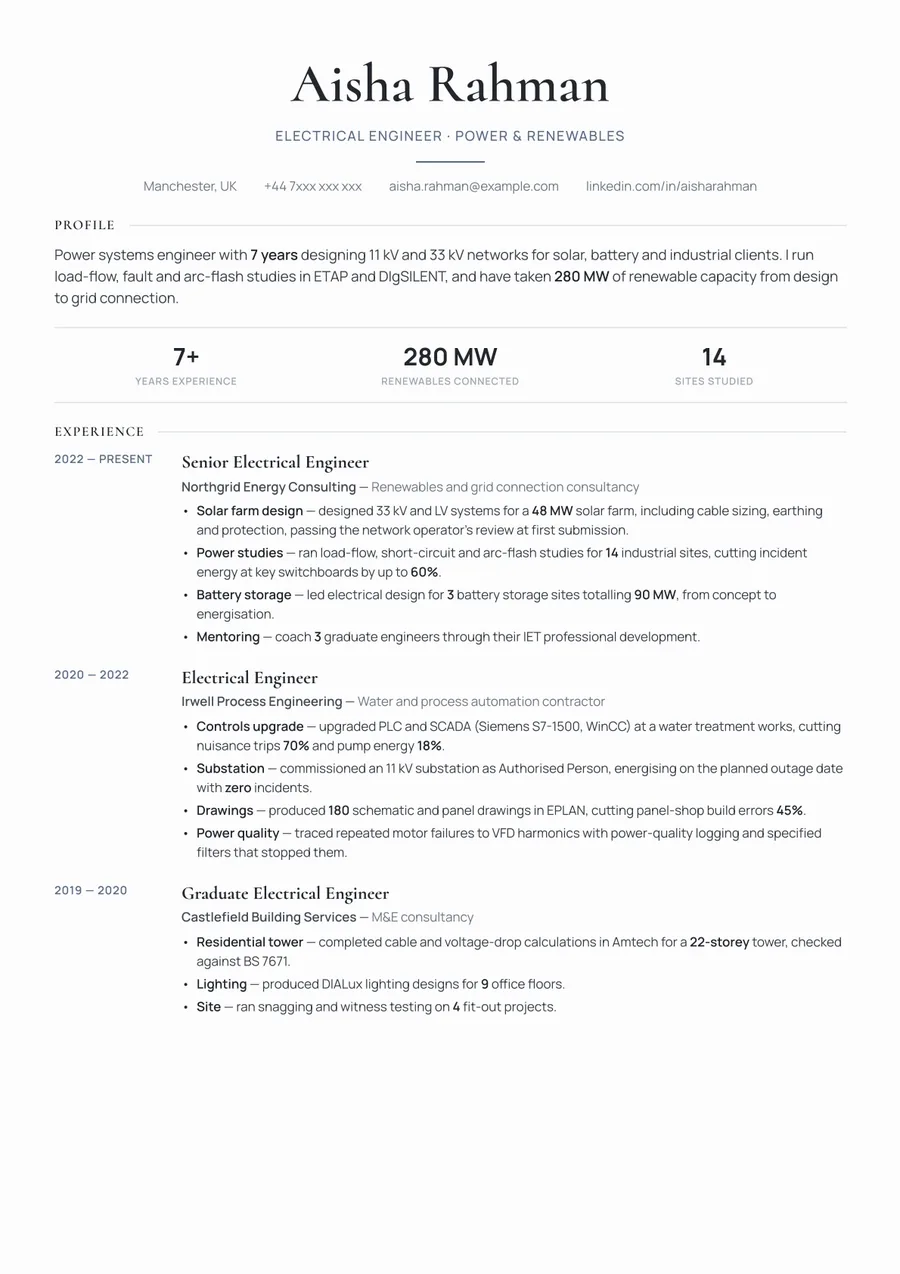
Best resume format for an electrical engineer
Use reverse-chronological order and name your specialism in the first line, because “electrical engineer” covers very different jobs. One page suits graduates and engineers with under about eight years of experience; two pages are normal for senior, chartered or principal engineers. In the UK and India the document is often called a CV; the content is the same.
Section order: header, summary, technical skills, experience, key projects, education, then registrations and certifications. Move registrations up beside the summary if the advert requires them, for example a PE licence in the US or Authorised Person status for high-voltage work in the UK. For each job, open with scope (voltage levels, plant size, number of sites, project value) before results.
Layout tip: a single-column layout such as ResumeInk's Classic or Skills-first keeps voltage ratings, standards and software in a clean reading order. Keep schematics and single-line diagrams in a portfolio, not on the page.
What to include in an electrical engineer resume
- Summary: specialism, years of experience, the voltage range or systems you work on, and two results.
- Technical skills: study and design software, CAD, PLC platforms and the standards you design to.
- Experience with scale: kV levels, MW or MVA, panel counts, number of sites, project values.
- Key projects: substations, solar or battery sites, building services fit-outs, automation lines or PCB designs.
- Registrations and licences: US: EIT after the FE exam, then the PE licence in Electrical and Computer. UK: IET membership and CEng or IEng, the 18th Edition (BS 7671) qualification, and AP or SAP status for HV work. Australia: CPEng or NER through Engineers Australia, RPEQ in Queensland, and working knowledge of AS/NZS 3000, the Wiring Rules. India: your B.E./B.Tech in electrical engineering, a state electrical supervisor certificate of competency where the job needs one, and a GATE score for PSU roles.
- Safety training: NFPA 70E arc flash (US), CompEx for hazardous areas, lockout/tagout and permit-to-work systems.
Electrical engineer resume summary examples
State your specialism, the scale you work at and one result. If you are a graduate, see our tips on resumes for freshers too.
- Entry level: Electrical engineering graduate (B.Tech EEE, 8.1 CGPA) with a six-month internship at a 220 kV substation and a final-year project on MPPT control for rooftop solar. Skilled in MATLAB/Simulink, AutoCAD Electrical and PLC ladder logic.
- Mid level: Power systems engineer with 7 years designing 11 kV and 33 kV networks for solar, battery and industrial clients. Runs load-flow, fault and arc-flash studies in ETAP and DIgSILENT, and has taken 280 MW of renewable capacity from design to grid connection.
- Senior: Chartered electrical engineer (CEng MIET) with 15 years in distribution substations up to 132 kV. Leads 9 design and protection engineers, holds Senior Authorised Person status, and has delivered 21 substation upgrades with zero safety incidents.
Electrical engineer resume bullet point examples
- Designed 33 kV and LV systems for a 48 MW solar farm, including cable sizing, earthing and protection coordination, passing the network operator's review at first submission.
- Ran load-flow, short-circuit and arc-flash studies in ETAP for 14 industrial sites, relabelling 600+ panels and cutting incident energy at key switchboards by up to 60%.
- Commissioned an 11 kV substation as Authorised Person, energising on the planned outage date with zero safety incidents.
- Upgraded PLC and SCADA controls (Siemens S7-1500, WinCC) at a water treatment works, cutting nuisance trips 70% and pump energy use 18%.
- Led LED and lighting-control retrofits across 9 office buildings, reducing lighting energy 52%, about 1.1 GWh a year.
- Produced 180 schematic and panel drawings in EPLAN, cutting build errors reported by the panel shop by 45%.
- Traced repeated motor failures to harmonics from variable frequency drives using power-quality logging, and specified filters that stopped the failures.
- As a graduate, completed cable and voltage-drop calculations in Amtech for a 22-storey residential tower, checked against BS 7671.
Notice the scale in every line: kV, MW, sites, drawings or energy saved.
Skills & ATS keywords for electrical engineer resumes
Electrical job ads are specific, so match their wording exactly and keep only the tools you can use. Common keywords by area:
- Power systems: ETAP, DIgSILENT PowerFactory, PSS/E, SKM PowerTools, PSCAD, load flow, short circuit, protection coordination, arc flash, earthing.
- CAD and electronics: AutoCAD Electrical, EPLAN, Revit MEP, SolidWorks Electrical; Altium Designer and KiCad for PCB roles.
- Building services: Amtech, DIALux, Relux, cable sizing, lighting design, fire alarm and emergency lighting.
- Controls and automation: PLC, Siemens TIA Portal, Rockwell Studio 5000, SCADA, HMI, VFDs, instrumentation, MATLAB/Simulink.
- Standards and safety: NEC (NFPA 70), NFPA 70E, BS 7671, IEC 61439, IEC 61850, AS/NZS 3000, IS 732, CompEx, LOTO.
- Soft skills: utility and client liaison, technical reports, site supervision, mentoring graduates.
Write an acronym and its full name together once, for example “variable frequency drive (VFD)”, so either search term matches.
Common electrical engineer resume mistakes
- No specialism. A power systems manager and an embedded electronics manager want different resumes. Name yours in the headline and summary.
- No scale. Give voltage levels, MW or MVA, the number of panels or sites, and project values.
- Generic safety claims. “Safety conscious” means little; “Authorised Person (HV), six years, zero incidents” means a lot.
- Listing every standard. Keep the ones you have designed or tested to and can discuss in an interview.
- Undated credentials. Give the year for each registration and course, and if you have moved from the 17th to the 18th Edition of BS 7671, list the newer one.
- Diagrams pasted as images. An ATS reads none of the text inside them. Our guide to an ATS-friendly resume covers what to keep as plain text.
Premium, ATS-friendly templates


Build your resume in minutes
Upload your current resume, edit anything, then preview and download it free.
Upload your resumeFrequently asked questions
What should an electrical engineering fresher put on a resume?
Your degree and grade, internships or placements, a final-year project with a measured result, and the software you can use, such as MATLAB, AutoCAD Electrical or a PLC platform. Add certificates like the 18th Edition in the UK, or a GATE score in India if you are applying to PSUs.
Should I put my PE licence or CEng on my resume?
Yes. Put it after your name or in the summary, for example “PE” in the US or “CEng MIET” in the UK, and give the state or year in a licences section. If you are working towards it, say so with a target year.
How do I show power systems experience on a resume?
Give the scale and the studies: voltage levels, MW or MVA, number of sites, and which studies you ran (load flow, short circuit, protection coordination, arc flash) in which software.
Is a two-page resume OK for an electrical engineer?
Yes, once you have about eight or more years of experience or many projects to show. Graduates and early-career engineers should keep to one page.