Free Consultant Resume Template & Examples
A consultant resume is judged like a good slide: the answer comes first, the evidence is quantified and nothing is padded. Whether you work in strategy, management, Big Four advisory or technology consulting, recruiters look for the problems you solved, the sectors you served, the impact you can prove and how quickly you were promoted. This page covers format norms for consulting applications, summaries for each level, bullet examples, keywords and the mistakes that make capable consultants sound like everyone else.
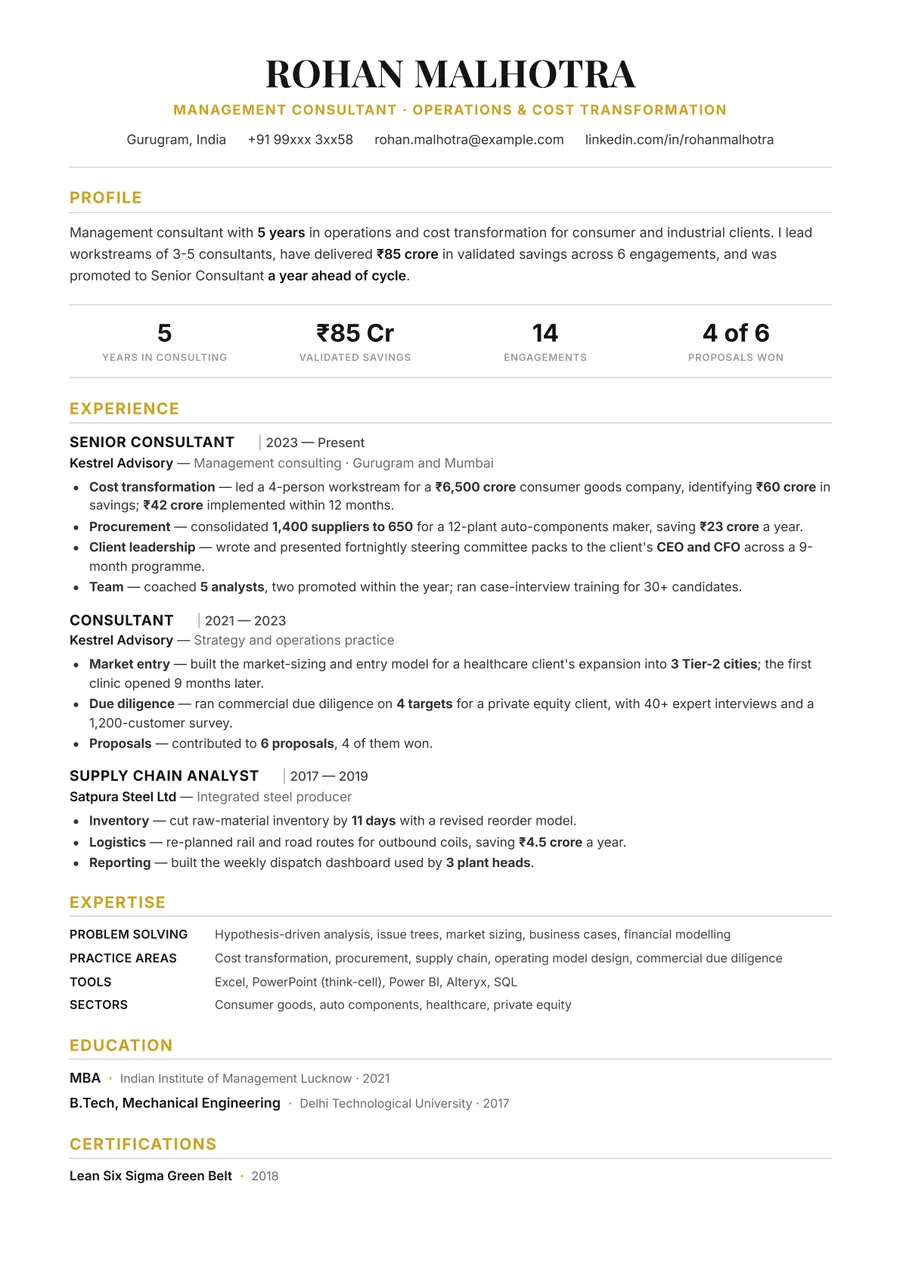
Best resume format for a consultant
For strategy and management consulting, one page is the norm for campus hires and for most people in their first eight or so years. Experienced hires joining at manager or director level, and independent consultants, can use two pages, often with a short selected-engagements section. Our one-page vs two-page guide covers the trade-off.
For MBA and campus applications, put education first with grades, scholarships and test scores where firms ask for them, then work experience, then leadership and interests. Many Indian business schools prescribe their own one-page CV format for campus placements; use theirs there and your own for lateral moves. Experienced consultants lead with experience and show each promotion under the same firm with its own dates.
Keep the layout conservative and single-column. ResumeInk's Classic and Formal layouts suit consulting, and senior candidates can look at our executive resume templates.
What to include in a consultant resume
- Engagements written as results: the client's sector and size, the problem, your role and the measurable outcome.
- Anonymised clients: “a top-10 Indian private bank”, “a FTSE 250 retailer”, “an ASX-listed insurer” or “a Fortune 500 manufacturer”, rather than names.
- Promotions and pace: each title with its dates, and early promotions if you had them.
- Functional and sector depth: for example cost transformation, operating model design, supply chain, due diligence or digital transformation.
- Team and client leadership: analysts you managed, the seniority of the client stakeholders and any business development work.
- Credentials: your degree or MBA, plus CA or CFA for transaction advisory, PMP or PRINCE2 for implementation roles, and SAP, Salesforce or cloud certifications for technology consulting. The CMC (Certified Management Consultant) can help independents but is rarely required by firms.
Consultant resume summary examples
- Entry level: Analyst with 18 months at a boutique strategy firm, working on market-entry and cost studies for consumer and healthcare clients. Built the market-sizing model behind a client's move into three new cities and ran weekly client data requests. Strong in Excel, PowerPoint and survey analysis.
- Mid level: Management consultant with five years in a Big Four advisory practice, focused on operations and cost transformation in manufacturing and retail. Leads workstreams of 3 to 5 consultants and has delivered INR 85 crore of validated savings across 6 engagements.
- Senior: Engagement manager with ten years in strategy consulting for financial services and telecoms clients in the UK and Australia. Runs programmes of up to 15 people, owns C-suite relationships and has sold £6M of follow-on work.
A summary is optional for campus hires. For experienced hires it should state your practice, your sectors and the size of the problems you handle.
Consultant resume bullet point examples
- Led a 4-person workstream on a cost transformation for a USD 2B consumer goods company, identifying USD 38M in savings, of which USD 26M was implemented within 12 months.
- Built the market-sizing and entry model for a healthcare client's expansion into 3 Tier-2 cities; the board approved the plan and the first clinic opened 9 months later.
- Redesigned order-to-cash for a FTSE 250 distributor, cutting debtor days from 62 to 45 and releasing £14M of working capital.
- Ran commercial due diligence on 4 targets for a private equity client, including 40+ expert interviews and a survey of 1,200 customers.
- Designed and ran a 12-week operating model pilot in an insurer's claims division, cutting claim cycle time by 30%.
- Wrote and presented fortnightly steering committee packs to the client's CEO and CFO across a 9-month programme.
- Contributed to 6 proposals, 4 of them won, worth £3.5M in new work for the practice.
- Coached 5 analysts, two of whom were promoted within the year, and ran case-interview training for 30+ candidates.
Lead with the outcome where you can, and make your own role clear with verbs like led, built, ran and wrote.
Skills & ATS keywords for consultant resumes
- Problem solving: hypothesis-driven analysis, issue trees, structured problem solving, market sizing, competitive analysis, business cases, financial modelling.
- Practice areas: growth strategy, operating model design, cost transformation, procurement, supply chain, commercial due diligence, post-merger integration, digital transformation, change management, PMO.
- Tools: Excel, PowerPoint with think-cell, Power BI or Tableau, Alteryx, SQL, Qualtrics; SAP, Salesforce or ServiceNow for technology consulting.
- Sector measures: the KPIs your clients track, such as NPS, cost-to-income ratio, OEE or working capital.
- Client and leadership: stakeholder management, workshop facilitation, executive communication, storylining, team leadership, business development.
Firm job ads often ask for structured problem solving and client impact. Show those through bullets instead of listing them as adjectives. Technology consultants should name the platform and modules in full, such as SAP S/4HANA Finance, and can borrow requirements keywords from our business analyst resume guide.
Common consultant resume mistakes
- Describing the project, not your part. “The team delivered a new operating model” hides you. Say what you owned.
- Breaking confidentiality. Client names and non-public figures do not belong on a resume. Use sector, size and region instead.
- Jargon without results. “Drove synergies across value levers” says nothing. Give the saving, the time or the decision, and keep each bullet to one or two lines.
- Hiding promotions. Showing only your current title undersells a fast rise. List each title with its dates.
- Two pages for a campus application. Firms expect one tight page from students and recent graduates. Cut coursework and minor roles first.
- One resume for every firm. Strategy, implementation and technology practices value different evidence. Reorder your bullets for each application, leading with the engagements closest to the practice you want to join.
Premium, ATS-friendly templates


Build your resume in minutes
Upload your current resume, edit anything, then preview and download it free.
Upload your resumeFrequently asked questions
How do I write a consulting resume with no experience?
Put education first with grades and awards, then internships, leadership roles, case competitions and research, each written as a result with a number. Keep it to one page and cut anything that does not show analysis, leadership or impact.
Should I name my clients on a consultant resume?
Usually not. Describe them by sector, size and region, such as a top-10 US regional bank, unless the work is public and the client has agreed. Check your firm's policy first.
How do I show promotions at the same consulting firm?
Write the firm name once and list each title beneath it with its own dates, most recent first. If a promotion came early, say so in a bullet or in your summary.
Should a technology or SAP consultant resume look different?
Yes. Lead with the platform, the modules and the number of full-cycle implementations or go-lives, and list current certifications. Still show business outcomes, such as a faster close or fewer manual steps, not just configuration work.