Free Java Developer Resume Template & Examples
A hiring manager reads a Java resume looking for three things: which Java versions and frameworks you work in, how big the systems you run are, and what you made faster or more reliable. This page shows how to write a Java developer resume that answers all three, with summaries, bullet examples and Spring keywords you can adapt. Upload your current resume as a PDF, Word file or photo and ResumeInk's AI rebuilds it in a clean, ATS-readable design, or start from the example below.
Best resume format for a Java developer
Use a reverse-chronological resume. Keep it to one page with under five years of experience; two pages are normal for senior and lead engineers, especially if you have worked on several client projects at an IT services firm.
A good section order is summary, technical skills, experience, projects, education, certifications. Put the skills block high: Java job ads are keyword-heavy (Java 17, Spring Boot, Hibernate, Kafka), and recruiters and ATS filters look for exact versions and frameworks. Under each job title, name the stack in one short line, then write outcomes.
If you worked for a services company, name the client's domain (banking, insurance, retail) rather than the client, and keep confidential details out. For general engineering advice that isn't Java-specific, see the software engineer resume template. For layout, a single column like the developer resume template keeps versions and tool names easy to scan; ResumeInk's Developer stack layout with the Slate tech theme is a good starting point.
What to include in a Java developer resume
- Header: name, city, phone, email, LinkedIn and GitHub. In India, a line with your notice period helps recruiters who screen on it. In the US, UK and Australia, leave out photo, date of birth and marital status, and add your work-rights status if you need a visa.
- Summary: years of experience, Java version, main frameworks and the systems you build (APIs, batch jobs, lending or trading platforms).
- Technical skills: grouped as language, frameworks, data, messaging, cloud and testing.
- Experience: 3-5 bullets per role on throughput, latency, uptime, migrations and code quality.
- Projects: an open-source contribution, a Spring Boot service on GitHub or a hackathon build, especially early in your career.
- Education: B.Tech, B.E., BSc or MCA, with the year.
- Certifications: Oracle Certified Professional (OCP) Java SE 17 or 21 Developer, Spring Certified Professional, or an AWS, Azure or Google Cloud associate certificate. None is required; list the ones you hold with the year.
Java Developer resume summary examples
Write two or three lines: who you are, your stack and one proof point. Change the Java version and frameworks to match each job ad.
- Entry level: "Computer science graduate with a 6-month internship building REST APIs in Java 17 and Spring Boot. Wrote JUnit and Mockito tests to 80% coverage on a student-records service and deployed it with Docker on AWS. Looking for a backend role on a team that ships to production weekly."
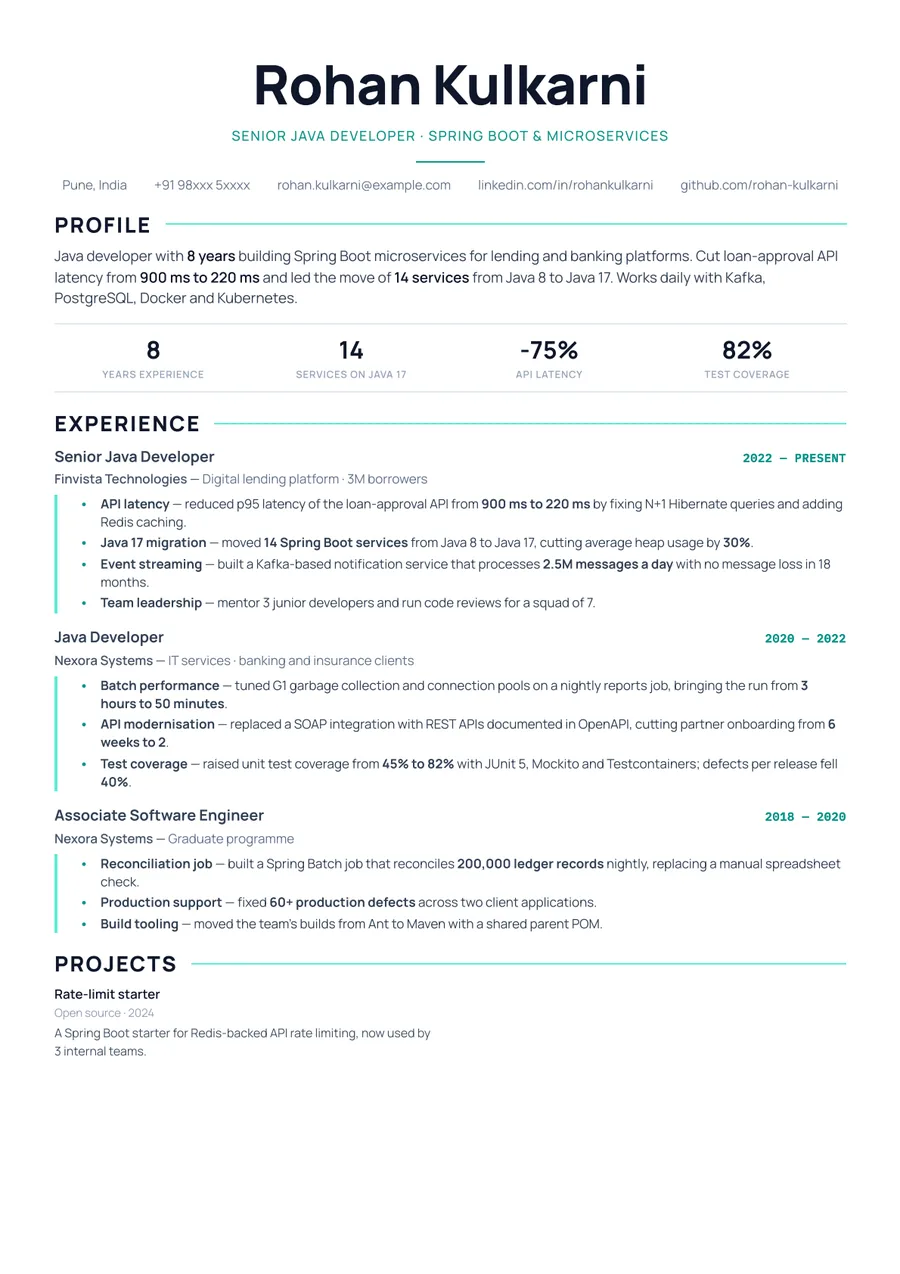
- Mid level: "Java developer with 5 years building Spring Boot microservices for a lending platform. Cut loan-approval API latency from 900 ms to 220 ms and moved 14 services from Java 8 to Java 17. Works daily with Kafka, PostgreSQL, Docker and Kubernetes."
- Senior: "Senior Java engineer with 11 years in high-volume banking systems. Led the split of a 400,000-line monolith into 30 Spring Boot services handling 6M transactions a day at 99.99% uptime. Mentors 8 developers and owns the team's JVM performance and code-review standards."
Java Developer resume bullet point examples
Start with a verb, name the Java technology, and end with a number you could explain in an interview.
- Migrated 14 Spring Boot services from Java 8 to Java 17, cutting average heap usage by 30% and container memory requests by 25%.
- Reduced p95 latency of the loan-approval API from 900 ms to 220 ms by fixing N+1 Hibernate queries and adding Redis caching.
- Built a Kafka-based notification service that processes 2.5M messages a day with no message loss in 18 months of production.
- Raised unit test coverage from 45% to 82% with JUnit 5, Mockito and Testcontainers, and cut production defects per release by 40%.
- Tuned G1 garbage collection and connection pools on a nightly reports batch job, bringing the run from 3 hours to 50 minutes.
- Replaced a SOAP integration with REST APIs documented in OpenAPI, cutting partner onboarding from 6 weeks to 2.
- Led 6 developers through splitting a monolith into 30 services on Kubernetes, with zero-downtime blue-green releases throughout.
- As a graduate engineer, built a Spring Batch job that reconciles 200,000 ledger records nightly, replacing a manual spreadsheet check that took two people a full day.
Skills & ATS keywords for Java developer resumes
Use the exact terms from the job ad when they are true for you. Some ATS searches match words literally, so "Spring Boot" and "Spring" may not count as the same skill. More on this in resume keywords for ATS screening.
- Core Java: Java 8, 11, 17 and 21, collections, streams, concurrency, multithreading, JVM tuning, garbage collection
- Frameworks: Spring Boot, Spring MVC, Spring Security, Spring Data JPA, Spring Cloud, Hibernate, Quarkus, Micronaut
- Data & messaging: PostgreSQL, Oracle Database, MySQL, MongoDB, Redis, Apache Kafka, RabbitMQ
- Build, test & delivery: Maven, Gradle, JUnit 5, Mockito, Testcontainers, Jenkins, GitHub Actions, SonarQube
- Cloud & architecture: Docker, Kubernetes, AWS, Azure, microservices, REST, gRPC, OpenAPI
- Soft skills: code review, mentoring, working with QA and product teams, clear incident write-ups
Common Java developer resume mistakes
- No Java version. "Java" alone hides whether you have worked past Java 8. Name the versions you have shipped on.
- Every Spring module listed. Twelve Spring entries look padded. Name the four or five you use and prove them in bullets.
- Describing the client's app instead of your work. Services-company resumes often spend a paragraph on the application. Cut it to one line and use the space for what you built.
- No scale. Requests per second, records per night, number of services or users show how hard the work was.
- Old technology at the top. Struts, JSP and EJB can stay if relevant, but lead with your current stack.
- One resume for every job. A bank and a startup want different keywords. Tailor each version and check it with the ATS resume checker before you apply.
Premium, ATS-friendly templates


Build your resume in minutes
Upload your current resume, edit anything, then preview and download it free.
Upload your resumeFrequently asked questions
How do I write a Java developer resume with no experience?
Lead with education and two or three projects instead of work history, such as a Spring Boot REST API with tests and a GitHub link. Add internships, hackathons and any OCP Java SE certification, and keep it to one page.
Is an Oracle Java certification worth adding to a resume?
It helps most early in your career and at employers that shortlist on certifications. Senior engineers are judged more on the systems they have built, so list it under certifications rather than in the summary.
Should I mention Java 8 if I now work on newer versions?
Yes, if the job ad mentions it or you have migrated code off it, because migration experience is valued. Writing it as a Java 8 to Java 17 migration shows you work on current versions too.
Should my resume say Java developer or software engineer?
Use the title in the job ad you are applying to. If your real title is different, a headline like Software Engineer (Java) puts both terms on the page for ATS searches.