Free Software Engineer Resume Template & Examples
Writing a software engineer resume means proving impact, not just listing technologies. ResumeInk helps you build a clean, ATS-friendly software engineer resume that highlights your stack, your shipped work, and measurable results — upload your existing PDF, Word doc, or photo and let AI rebuild it. Preview and download free.
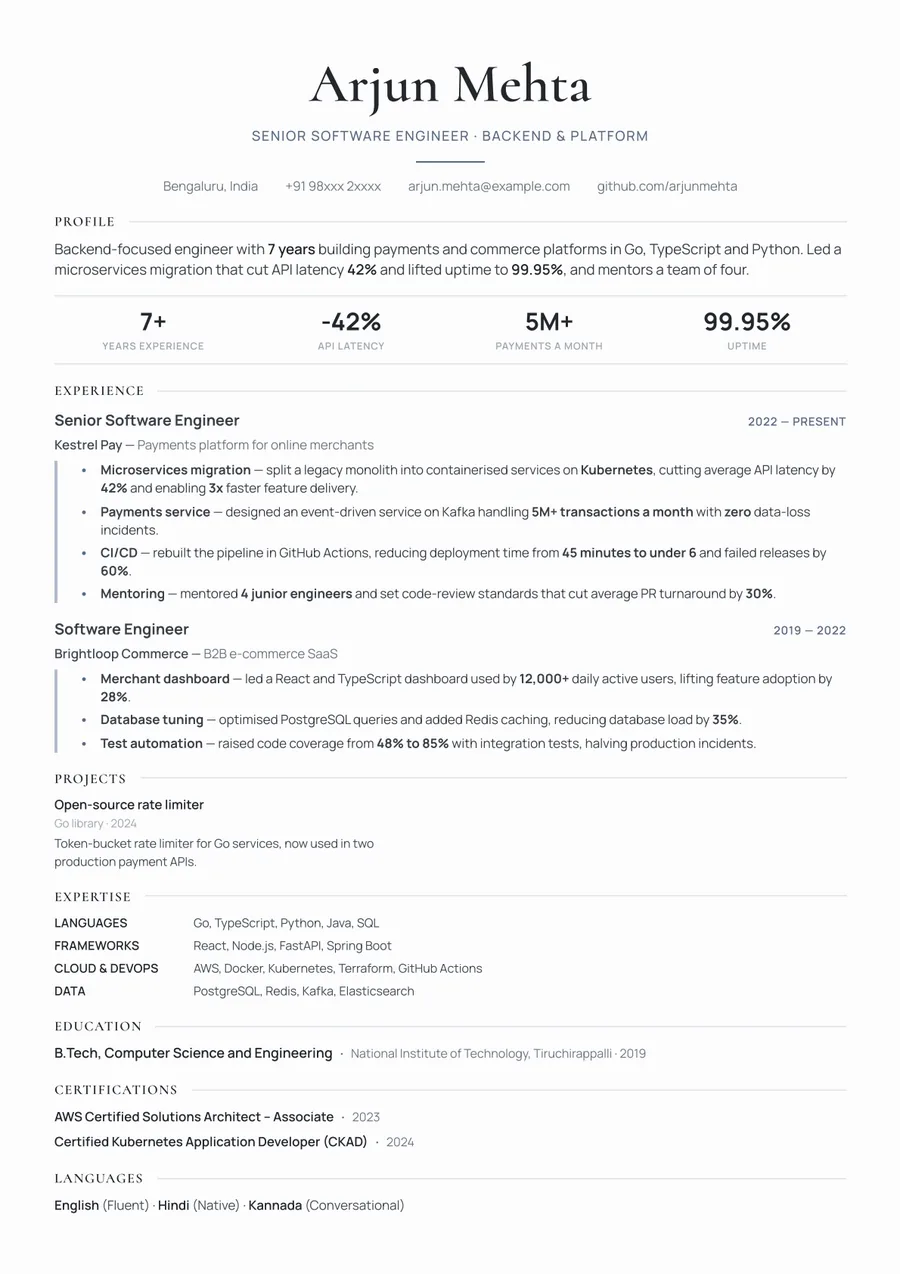
Best resume format for a software engineer
For most software engineers, one page is right early in your career and through mid-level; two pages become acceptable once you have roughly 8+ years of experience or a long list of relevant, high-impact roles. Use reverse-chronological order, lead with a short summary, and put your strongest, most recent engineering work near the top where recruiters and the ATS look first.
Structure it as: summary, technical skills, experience, projects, and education. A clean, single-flow layout (even with a sidebar) parses far better in applicant tracking systems than multi-column tables or graphics. Recruiters skim for languages, frameworks, scope, and measurable impact within seconds — make those scannable.
What to include in a software engineer resume
- Contact + links: name, email, phone, location (or remote), and a GitHub, portfolio, or LinkedIn URL.
- Professional summary: 2–3 lines stating your specialty (e.g. backend, full-stack, mobile), years of experience, and a headline result.
- Technical skills: languages, frameworks, databases, cloud, and tooling — grouped so they are easy to scan and keyword-match.
- Experience: role, company, dates, and 3–5 impact bullets per job focused on what you built, scaled, or fixed and the result.
- Projects: personal, open-source, or side projects with the stack and outcome — especially valuable if your work history is light.
- Education: degree, institution, year; bootcamps and relevant coursework count too.
- Certifications (optional): AWS, Azure, GCP, Kubernetes, or security certs when relevant to the role.
Software engineer certifications and credentials by country
No country licenses software engineers the way it licenses nurses or accountants, so you can be hired in India, the US, the UK or Australia without a certificate. What changes is which extras are worth a line.
- India: your B.Tech, B.E., MCA or BSc Computer Science with the year, and your CGPA if it is strong. Freshers can add NPTEL certificates and competitive programming ratings, such as Codeforces or CodeChef, when they are good.
- US: nothing formal is expected. Federal and defence work often needs an active security clearance, so state its level if you hold one, and say whether you will need visa sponsorship.
- UK: BCS, The Chartered Institute for IT, awards Chartered IT Professional (CITP) status and can register engineers as Chartered Engineers (CEng). Senior engineers in government and regulated industries sometimes list them. Add your right to work.
- Australia: the Australian Computer Society (ACS) assesses ICT skills for skilled migration and awards Certified Professional (CP) status. Mention your work rights if you are not a citizen or permanent resident.
- Everywhere: AWS Certified Solutions Architect Associate, Microsoft Azure Developer Associate, Google Cloud Professional Cloud Developer, CKA or CKAD. List each with the year.
If cloud and Kubernetes are most of your work, the DevOps engineer resume guide fits better.
Software engineer resume summary examples
Name your focus, years and stack, then one result. Change the stack to match each job ad.
- Entry level: Computer science graduate with a 6-month backend internship building REST APIs in Python and FastAPI. Built a campus events app in React and Node.js used by 3,000 students, with integration tests and a GitHub Actions pipeline deploying to AWS.
- Mid level: Full-stack engineer with 5 years building TypeScript, React and Node.js products. Led a dashboard used by 12,000+ daily active users that lifted feature adoption 28%, and cut deployment time from 45 minutes to under 6.
- Senior: Senior backend engineer with 10 years in distributed systems. Led the move from a monolith to services on Kubernetes that cut API latency 42% and tripled delivery speed, designed a payments service handling 5M+ transactions a month, and mentors a team of 6.
Writing your first resume? The resume builder for freshers shows how to lead with projects. Language specialists can compare the Java developer and Python developer guides.
Software engineer resume by experience level
The same job title produces a very different resume at each stage. Here is what changes in length, summary, bullets and projects as you move up.
- New grad or fresher (0 to 2 years): one page. Education sits near the top with your degree and, if it is strong, your CGPA or GPA. Two or three projects with the stack, a GitHub link and a result do most of the work, followed by internships. Keep the summary to two lines naming the role and your main languages. Example: "Built a React and Flask timetable planner used by 900 students each semester, with 80% test coverage."
- Mid-level (3 to 7 years): still one page for most. Experience moves to the top, projects shrink to one or two that show something your jobs don't, and education drops to a single line. Bullets show ownership of a feature or service and its effect on users, speed or cost.
- Senior (8 years or more): two pages are fine if the second page carries real work. The summary names your domain and the scale you have worked at. Bullets move from what you built to what you led: design decisions, migrations, reliability and the engineers you mentored.
- Staff, principal or tech lead: two pages, with the first carrying your widest-reaching work. Show influence across teams: architecture you set, standards other teams adopted, hiring, and the business result. Example: "Set the service-ownership model adopted by 14 teams, cutting cross-team incidents 35% in a year." Side projects usually drop off unless they are widely used open source.
Specialists can follow the same pattern with the full stack developer, frontend developer, Java developer and Python developer guides, and the developer resume template shows layouts that keep a long stack readable.
Software Engineer resume bullet point examples
- Architected and shipped a microservices migration that cut average API latency by 42% and improved uptime to 99.95%.
- Built a CI/CD pipeline in GitHub Actions that reduced deployment time from 45 minutes to under 6 and cut failed releases by 60%.
- Optimized PostgreSQL queries and added caching, reducing database load by 35% and saving ~$80K/year in infrastructure costs.
- Led development of a React + TypeScript dashboard used by 12,000+ daily active users, lifting feature adoption by 28%.
- Designed an event-driven payments service handling 5M+ transactions/month, supporting $2M ARR with zero data-loss incidents.
- Reduced production incidents by 50% by introducing automated integration tests and raising code coverage from 48% to 85%.
- Mentored 4 junior engineers and instituted code-review standards, cutting average PR review turnaround by 30%.
- Refactored a legacy monolith into containerized services on Kubernetes, enabling 3x faster feature delivery.
Notice the pattern: strong action verb + what you built or improved + a quantified result.
Skills & ATS keywords for software engineer resumes
List the concrete technologies you actually use, and mirror the exact terms from the job description so the ATS matches them. Group them so a recruiter can scan in seconds:
- Languages: Python, JavaScript, TypeScript, Java, Go, C++, C#, Rust, SQL
- Frameworks & libraries: React, Node.js, Next.js, Django, Spring Boot, FastAPI, .NET
- Cloud & DevOps: AWS, Azure, GCP, Docker, Kubernetes, Terraform, CI/CD, GitHub Actions
- Databases & data: PostgreSQL, MySQL, MongoDB, Redis, Kafka, Elasticsearch
- Practices: REST & GraphQL APIs, microservices, system design, TDD/unit testing, Agile/Scrum, Git
- Specialties (as relevant): distributed systems, observability, security, performance optimization, ML/LLM integration
Common software engineer resume mistakes
- Listing responsibilities ("responsible for backend") instead of measurable impact and outcomes.
- Dumping every technology you have ever touched — padding the skills list dilutes the keywords that matter.
- No metrics: bullets with no numbers (latency, scale, uptime, users, cost) read as vague.
- Using multi-column tables, icons, or graphics that scramble the reading order for ATS parsers.
- Omitting a GitHub or portfolio link when your code is your strongest proof.
- One generic resume for every job instead of mirroring each role's required stack and keywords.
Premium, ATS-friendly templates


Build your resume in minutes
Upload your current resume, edit anything, then preview and download it free.
Upload your resumeFrequently asked questions
How long should a software engineer resume be?
One page for junior to mid-level engineers; two pages are fine once you have roughly 8+ years of relevant, high-impact experience. Recruiters skim quickly, so keep it tight and front-load your strongest work.
What skills do I put on a software engineer resume?
List the languages, frameworks, cloud, databases, and tools you actually use (e.g. Python, React, TypeScript, AWS, Docker, Kubernetes, PostgreSQL), and mirror the exact terms in the job description so the ATS matches them.
Should a software engineer resume include a GitHub or portfolio link?
Yes. A GitHub, portfolio, or relevant open-source link is some of the strongest proof of ability for an engineer, so include it in your contact header where recruiters can find it.
Is a ResumeInk software engineer resume ATS-friendly?
Yes. Every template uses clean, parseable structure and real selectable text, so applicant tracking systems can read your skills and experience. You can preview and download it free.
How do I write a software engineer resume with no experience?
Lead with projects instead of jobs: two or three things you built, each with the stack, a GitHub link and a result such as users, speed or test coverage. Put education and relevant coursework near the top, then internships, hackathons and open-source contributions, and keep it to one page.
Do certifications help a software engineer resume?
They help most when the job is cloud or platform focused and the ad names a certificate, such as AWS, Azure, Google Cloud or Kubernetes. For general development roles, shipped projects and measurable impact count for more, so list certificates briefly near the end with the year.
Is a software developer resume different from a software engineer resume?
Mostly in the title and emphasis, not the format, because many employers use the two titles for the same job. Match the wording in each ad: engineer roles often stress system design, testing and scale, while developer ads tend to name specific languages and frameworks.
What should a resume for an experienced software engineer focus on?
Your last two or three roles and the systems you owned, with their scale and results, plus the decisions you led and the people you mentored. Keep older jobs to a line each, and use two pages only if page one already holds your strongest work.