Free Systems Engineer Resume Template & Examples
A systems engineer resume has to answer one question quickly: which systems do you keep running, and how well? For IT systems engineers that means servers, virtualisation, identity, cloud and uptime. For systems engineers in aerospace and defence it means requirements, architecture and verification across a whole product. This page leads with IT infrastructure and covers the defence side briefly, with format, credentials by country, examples, keywords and mistakes. Upload your resume as a PDF, Word file or photo, and ResumeInk rebuilds it in an ATS-readable design you can edit line by line.
Best resume format for a systems engineer
Reverse-chronological order suits both kinds of systems engineer. Use one page with up to five years of experience and two pages once you have led migrations, platform rebuilds or programme phases; the guide to one page vs two page resumes helps you decide.
For IT roles: header, summary, technical skills grouped by area, certifications, experience, education. For aerospace and defence: header, summary with your clearance, experience organised by programme and lifecycle phase, tools and standards, education, then professional registration.
Layout tip: ResumeInk's Stacked layout puts an expertise grid and education above experience, which helps when your value is breadth across Windows, Linux, VMware, cloud and networking. Formal and Classic suit defence and government employers who expect a conservative document. Every design keeps real, selectable text in a logical order, and you can switch layouts in one tap without retyping.
What to include in a systems engineer resume
- Header: name, city, phone, email and LinkedIn, plus an active clearance level if you hold one.
- Summary: your platforms, the size of the estate (servers, users, sites) and an availability or efficiency result.
- Technical skills: operating systems, virtualisation, identity, cloud, backup, monitoring, scripting and automation.
- Experience: projects and run work with numbers: uptime, incidents, patch compliance, migration size, hours saved by automation.
- Certifications: with the year earned and current status.
- Education: degree or diploma. Many IT systems engineers come up through support, so experience can outweigh the degree.
- Aerospace and defence extras: the programmes and lifecycle phases you worked on, the requirements and verification you owned, MBSE tools, standards such as ISO/IEC/IEEE 15288, and your engineering registration.
If your work is mostly pipelines and automation, compare the DevOps engineer page; if it is mostly cloud, the cloud engineer page; if it is mostly switching and routing, the network engineer page.
Systems engineer certifications and credentials by country
IT systems engineering has no licence in any country; employers look at vendor certifications and what you have run. Common ones: Microsoft Certified: Azure Administrator Associate (AZ-104) and Windows Server Hybrid Administrator Associate, Red Hat RHCSA and RHCE, VMware VCP-DCV, CompTIA Server+ and Linux+, CCNA for network-heavy roles, and ITIL 4 Foundation for service management.
Systems engineering in aerospace and defence is different. INCOSE offers ASEP for early-career engineers and CSEP once you have several years of documented systems engineering experience. Engineering status and clearance count too:
- US: a PE licence is rarely required for systems roles, but many defence jobs need US citizenship to hold a Secret or Top Secret clearance.
- UK: CEng or IEng through a licensed institution such as the IET or the Royal Aeronautical Society, plus SC or DV clearance.
- Australia: Engineers Australia chartered status (CPEng) and a Baseline, NV1 or NV2 clearance for defence work.
- India: no licence; Microsoft, Red Hat and VMware certifications are frequent asks in IT services and data centre roles.
- Canada: engineer is a regulated title, so defence and aerospace employers may ask for a P.Eng or eligibility for one.
Systems engineer resume summary examples
Say which kind of systems engineer you are in the first few words:
- Entry level: IT graduate and former service desk analyst with CompTIA Server+ who rebuilt a lab domain with Windows Server, Active Directory and Group Policy, and automated user onboarding with PowerShell. Ready for a junior systems engineer role supporting a hybrid Microsoft estate.
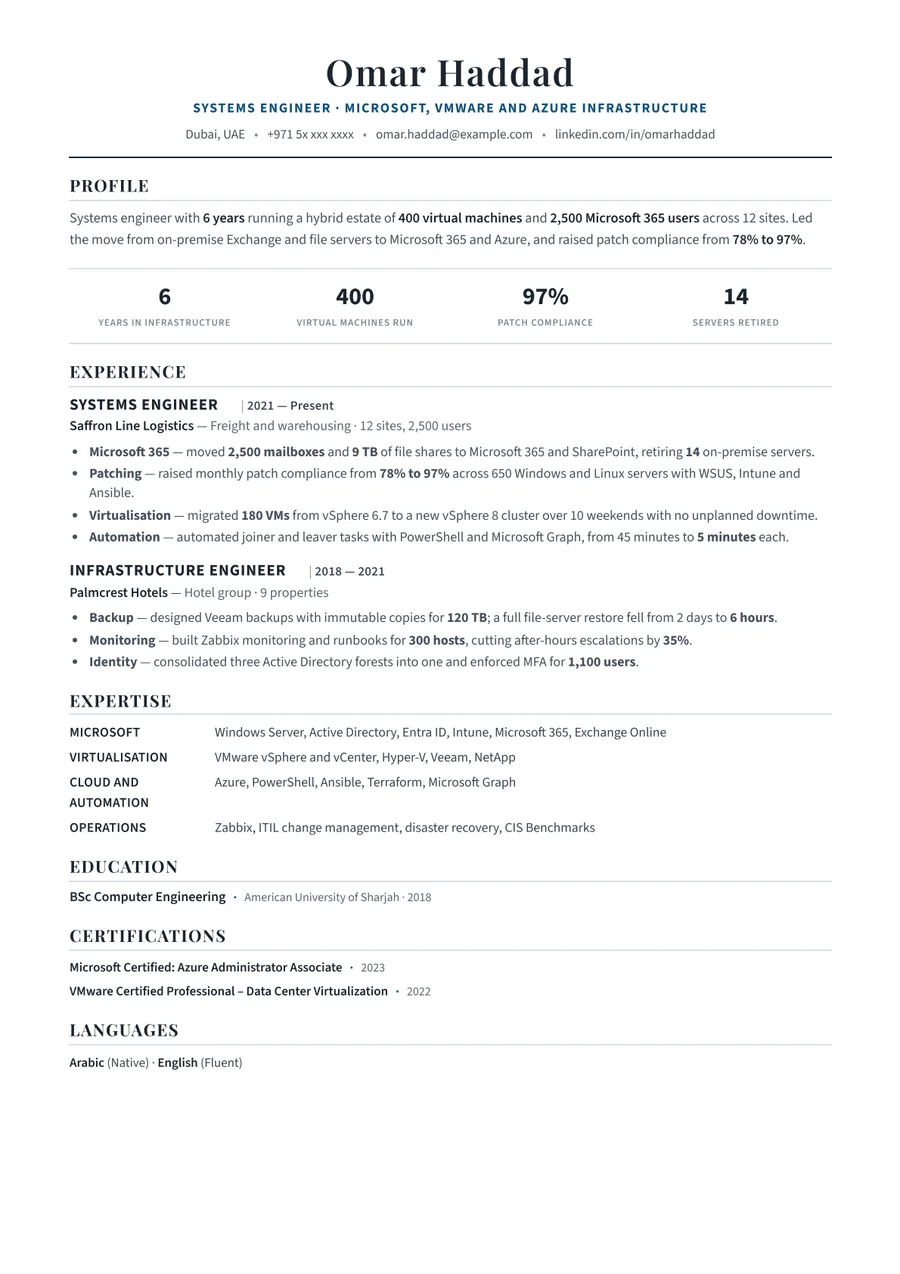
- Mid level: Systems engineer with six years running a hybrid estate of 400 VMware virtual machines and 2,500 Microsoft 365 users across 12 sites. Led the move from on-premise Exchange and file servers to Microsoft 365 and Azure, and lifted monthly patch compliance from 78% to 97%.
- Senior: Chartered engineer (CEng) and INCOSE CSEP with 14 years on air and maritime defence programmes, now leading requirements and verification for a radar upgrade with 1,800 requirements. SC cleared; introduced model-based systems engineering that cut interface defects found in integration by 40%.
If you have both IT and defence experience, write the summary for the job in front of you and reduce the other side to a single line.
Systems engineer resume bullet point examples
Quantify uptime, scale and the hours you gave back to the business:
- Migrated 180 virtual machines from vSphere 6.7 to a new vSphere 8 cluster over 10 weekends with no unplanned downtime.
- Automated joiner and leaver tasks with PowerShell and Microsoft Graph, cutting a 45-minute manual job to five minutes for about 60 starters a month.
- Raised monthly patch compliance from 78% to 97% across 650 Windows and Linux servers using WSUS, Intune and Ansible.
- Designed Veeam backups with immutable copies for 120 TB of data and tested restores quarterly; a full file-server restore now takes six hours instead of two days.
- Moved 2,500 mailboxes and 9 TB of file shares to Microsoft 365 and SharePoint, retiring 14 on-premise servers.
- Built Zabbix monitoring and runbooks for 300 hosts, reducing after-hours escalations by 35% in the first quarter.
- Owned 1,800 system requirements in IBM DOORS Next for a radar upgrade, traced to 640 verification tests, and passed the critical design review with no major actions.
- Led interface control across five subsystem suppliers, closing 92 open interface issues before system integration testing.
Skills & ATS keywords for systems engineer resumes
Use the platform names exactly as the posting does, and keep versions current:
- Operating systems: Windows Server, Red Hat Enterprise Linux, Ubuntu, Group Policy.
- Virtualisation and storage: VMware vSphere and vCenter, Hyper-V, Nutanix, SAN and NAS, Veeam.
- Identity and cloud: Active Directory, Microsoft Entra ID, Intune, Microsoft 365, Azure, AWS EC2 and VPC.
- Automation and monitoring: PowerShell, Bash, Ansible, Terraform, Zabbix, PRTG, Datadog.
- Practice: ITIL incident, change and problem management, disaster recovery, capacity planning, hardening to CIS Benchmarks.
- Aerospace and defence: requirements management, MBSE, SysML, Cameo Systems Modeler, IBM DOORS, V-model, verification and validation, interface control, trade studies.
- Soft skills: change communication, vendor management, documentation, calm incident handling.
Where a posting pairs a method with a tool, such as SysML with Cameo, use the same pairing if it is true for you. For help choosing which of these to feature, see skills to put on a resume.
Common systems engineer resume mistakes
- An ambiguous title. Systems engineer means different things to different employers. Make your title line say which: Windows and VMware systems engineer, or systems engineer on air defence programmes.
- Run work with no numbers. Keeping things running is the job, so quantify it: uptime, patch rates, tickets, servers, users and restore times.
- Outdated versions up front. Windows Server 2008 and vSphere 5 date you. Lead with current platforms.
- Hiding automation. Scripts that save hours are a strong hiring signal; give them their own bullets and say how much time they returned to the team.
- Programme detail you cannot share. Defence engineers should describe systems generically and leave out anything classified or export-controlled.
- No bridge between worlds. Moving from IT into aerospace systems engineering, or back? Use the summary to connect the two, and see the engineering resume guide for degree and registration details.
Premium, ATS-friendly templates


Build your resume in minutes
Upload your current resume, edit anything, then preview and download it free.
Upload your resumeFrequently asked questions
What is the difference between a systems engineer and a systems administrator resume?
A systems administrator resume centres on day-to-day running: tickets, patching, accounts and backups. A systems engineer resume should also show design and change, such as migrations, automation, capacity planning and standards you set.
How do I write a systems engineer resume with no experience?
Start from support or internship work where you managed accounts, devices or servers, and add a home lab with a domain, virtualisation and scripts you can explain. A certification such as AZ-104, RHCSA or Server+ helps fill the gap.
Which certifications should a systems engineer put on a resume?
The ones that match the stack in the job ad, for example Azure Administrator, RHCSA or VMware VCP for IT roles, and INCOSE ASEP or CSEP for aerospace and defence systems engineering. Show the year earned and drop certifications for platforms nobody runs any more.
Should a systems engineer resume include a security clearance?
Yes, if it is active and relevant to the job, list the level, such as Secret in the US, SC or DV in the UK, or NV1 in Australia. Do not add any other detail about the vetting.
How do I move from IT systems engineering into aerospace systems engineering?
Show the overlap: requirements you gathered, designs you documented, testing and change control you ran, and any SysML or MBSE training. An engineering degree and progress towards chartered or professional status make the move much easier.