Free Engineering Resume Template & Examples
An engineering resume template has to work for very different jobs. A graduate process engineer, a site civil engineer and a software lead all need to prove technical judgement with numbers, and to show the right credentials for their country. This hub covers what every engineering resume shares, then points you to detailed pages for each discipline: format, licences by country, summary and bullet examples across fields, keywords and common mistakes. Upload your current resume as a PDF, Word file or photo, and ResumeInk rebuilds it in an ATS-readable design you can edit.
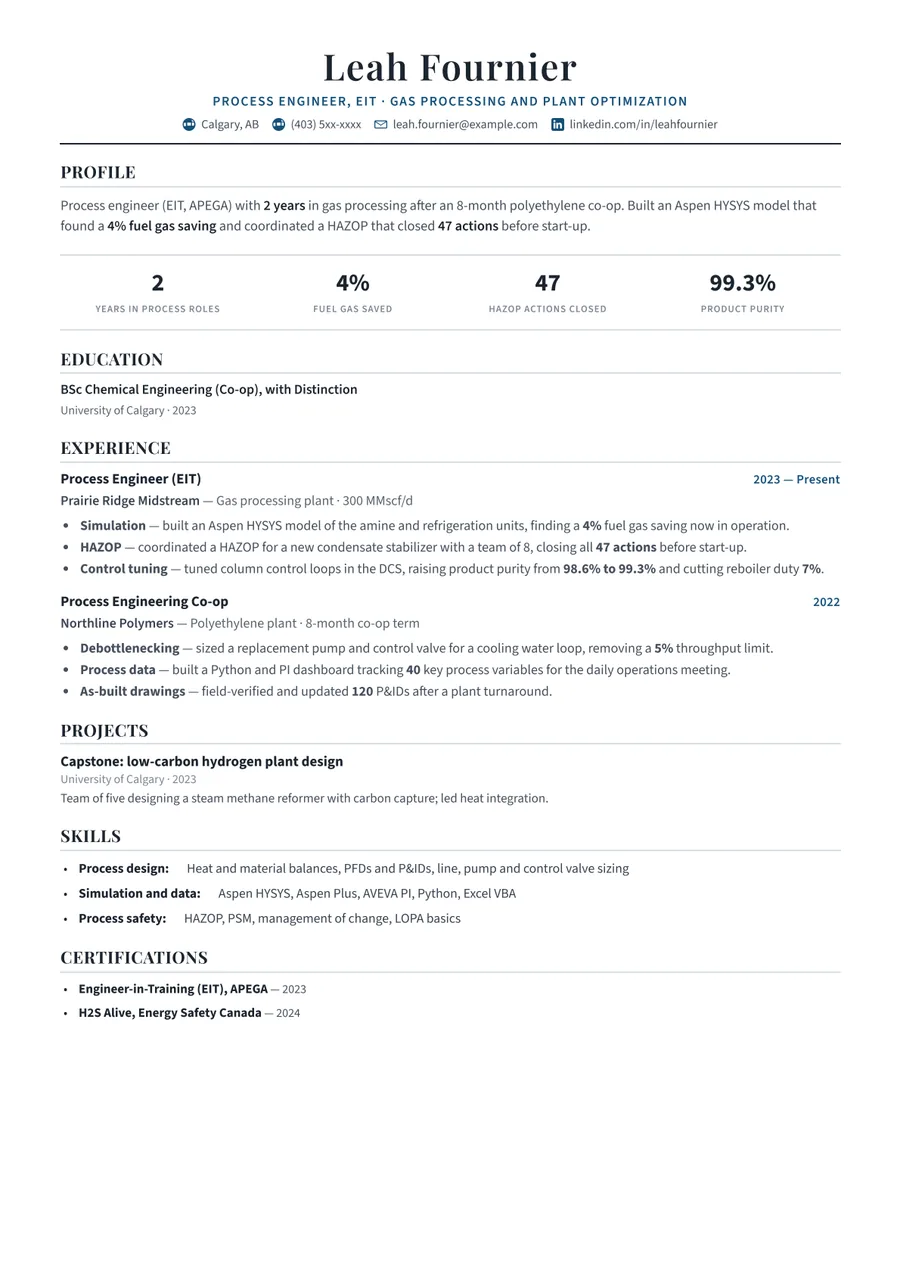
Best resume format for an engineer
Reverse-chronological order is the standard across disciplines. One page works for graduates and engineers with up to five years of experience. Two pages are normal after that, and engineering employers in the UK, India and Australia are used to a two-page CV.
A dependable order: header, a three-line summary, technical skills, experience, key projects, education, then licences, registrations and certifications. Graduates should put education and their final-year or capstone project straight after the summary, with internships and co-op terms next; the resume format for freshers guide walks through it.
Layout tip: ResumeInk's Academic layout puts education first, which suits graduates whose degree and projects are their strongest evidence. Classic and Compact header are single-column and parse cleanly in applicant tracking systems; choose Compact header to fit everything on one page. The Stacked layout suits experienced engineers whose skills span many tools and codes.
What to include in an engineering resume
The core sections are the same in every discipline; what changes is the evidence.
- Mechanical: parts and products designed, CAD and FEA tools, and manufacturing results such as scrap, cycle time and cost. See the mechanical engineer resume.
- Civil and structural: project types and values, design codes, site supervision and safety record. See the civil engineer resume.
- Electrical: voltage levels, power systems or electronics, commissioning and compliance work. See the electrical engineer resume.
- Chemical and process: units and throughput, yield, energy use, safety studies such as HAZOP, and your simulation tools.
- Software, systems and data: what you built, at what scale, how reliable and how fast you delivered. See the software engineer, systems engineer, DevOps engineer and data engineer pages.
Every engineer also needs a grouped skills section, education with degree and year, licence or registration status, and two or three projects with your role and a measurable result.
Engineering certifications and credentials by country
Licensing is where engineering resumes differ most by country. State your status exactly, because employers check it.
- US: pass the NCEES FE exam to become an Engineer in Training (EIT) or Engineer Intern, then, usually after four years of qualifying experience, the PE exam for a state Professional Engineer licence. A PE matters most where you seal designs, as in civil, structural and consulting work; many industrial jobs do not need one.
- UK: the Engineering Council registers EngTech, IEng and CEng through licensed institutions such as IMechE, ICE, IET and IChemE. Registration is voluntary but valued, and an accredited MEng meets the academic requirement for CEng.
- India: there is no general licence. The Institution of Engineers (India) runs the AMIE examinations, taken mostly by working diploma holders, and awards Chartered Engineer status to experienced members. Freshers applying to PSUs such as NTPC, IOCL or ONGC should list their GATE score and year; a score stays valid for three years.
- Australia: Engineers Australia membership and Chartered status (CPEng), the National Engineering Register (NER), and state registration such as RPEQ in Queensland and registration in Victoria for some areas of practice.
- Canada: engineer is a protected title. You work as an EIT until a provincial regulator such as PEO or APEGA grants your P.Eng, typically after four years of experience.
Engineering resume summary examples
Lead with discipline, level and one result. Three examples from different fields:
- Entry level: Chemical engineering graduate with a B.Tech (CGPA 8.4) and a GATE 2025 score, plus a six-month internship at a fertiliser plant modelling a heat exchanger network in Aspen HYSYS that identified a 4% steam saving. Looking for a graduate process engineer role in operations or design.
- Mid level: Civil engineer (PE, Texas) with seven years designing stormwater and roadworks for municipal clients, including a 14 km arterial upgrade. Uses Civil 3D, manages subconsultants and cut redesign requests by a third through early utility coordination.
- Senior: Chartered electrical engineer (CEng MIET) with 15 years in power distribution, leading a team of 11 on substation design and grid connections for solar and battery projects totalling 900 MW. Delivered 23 grid connections without compliance rework in the last four years.
Write licence abbreviations exactly as your regulator does, and spell out anything an overseas reader may not recognise.
Engineering resume bullet point examples
Each bullet: action, scale, result. Examples across disciplines:
- Redesigned a cast aluminium bracket with topology optimisation in ANSYS, cutting weight by 22% while keeping a safety factor of 1.5.
- Supervised construction of a four-storey, 2,800 square metre school block, handed over two weeks early with zero lost-time injuries.
- Coordinated a HAZOP for a new condensate stabiliser with a team of eight, closing all 47 actions before start-up.
- Tuned column control loops in the plant DCS, raising product purity from 98.6% to 99.3% and cutting reboiler duty by 7%.
- Designed the layout and protection settings for a 33/11 kV substation that passed utility witness testing first time.
- Cut line changeover time from 90 to 35 minutes with SMED, adding six hours of production a week.
- Built a LabVIEW test rig that reduced validation for each motor controller from three days to one.
- Wrote the service behind a field inspection app that handles 2 million API requests a day with p99 latency under 200 ms.
Skills & ATS keywords for engineering resumes
Your discipline sets the tools, but some keyword groups appear in engineering ads everywhere:
- Design and analysis: AutoCAD, SolidWorks, CATIA, Creo, Revit, Civil 3D, ANSYS, Abaqus, MATLAB, Simulink, ETAP, Aspen HYSYS or Aspen Plus.
- Methods: root cause analysis, FMEA, HAZOP, design for manufacture, geometric dimensioning and tolerancing, Lean, Six Sigma, value engineering.
- Standards and codes: name the ones you work to, such as ASME, ASCE, IEC, IEEE, Eurocodes, British Standards, IS codes in India and Australian Standards.
- Project skills: scope, cost and schedule control, MS Project or Primavera P6, technical reports, drawing review, commissioning.
- Digital tools: Python, Excel with VBA, Power BI, SAP and plant data historians such as AVEVA PI.
- Soft skills: clear technical writing, working with contractors and clients, safety leadership, mentoring.
Use the exact names from the job advertisement, then check how readable your final version is with the ATS resume checker.
Common engineering resume mistakes
- Responsibilities instead of results. Responsible for design reviews tells the reader nothing new. Say what changed: weight, cost, yield, schedule, defects or safety.
- A vague licence status. Write EIT, PE with the state, CEng MIET, CPEng or P.Eng exactly, and never imply a licence you do not yet hold.
- Project names with no role. For team projects, give the scope you owned and the outcome, not just the project title.
- Ignoring local norms. GATE scores matter to Indian PSUs and nowhere else, working rights matter in Australia, and UK employers usually expect your degree classification.
- Drawings pasted into the resume. Text inside images cannot be read by hiring software. Link a portfolio instead.
- One resume for every discipline. If you apply across fields, tailor the summary and skills each time. Graduates building a first one can use the resume builder for freshers.
Premium, ATS-friendly templates


Build your resume in minutes
Upload your current resume, edit anything, then preview and download it free.
Upload your resumeFrequently asked questions
What is the best resume format for an engineer?
Reverse-chronological for most engineers, with a short summary, grouped technical skills, experience with measurable results, key projects, education and licences. Graduates can put education and projects first.
How do I write an engineering resume with no experience?
Lead with your degree, your final-year or capstone project and any internships, co-op terms or competition teams, giving your role and a number for each. Add lab skills, software and any FE pass, GATE score or student membership that counts in your country.
Should I put my GPA, CGPA or degree classification on an engineering resume?
Include it as a graduate if it is strong or the employer asks: a GPA of 3.0 or above in the US, a CGPA or percentage in India, and your classification in the UK. After a few years of experience, drop it unless an application form requests it.
Should I put my FE exam or EIT status on my resume?
Yes. Passing the FE exam and holding EIT or Engineer Intern status shows you are on the path to a PE licence, so put it in your summary and in a licences section with the state. Do the same with a GATE score in India and EIT status in Canada.
How long should an engineering resume be?
One page for graduates and early-career engineers, and up to two pages for experienced engineers. Senior consulting engineers sometimes attach a separate project list instead of adding a third page.