Free Network Engineer Resume Template & Examples
Network engineers look after the thing everyone notices only when it breaks. A strong network engineer resume shows what you run (sites, devices, users, links), the vendors and protocols you know, and proof that the network became faster, safer or more reliable on your watch. Certifications such as CCNA and CCNP still carry real weight, so this guide covers which to list in each country, plus format by seniority, summaries, bullets and the keywords networking ads repeat. Start from the example below, or upload your resume as a PDF, Word file or photo for ResumeInk to rebuild.
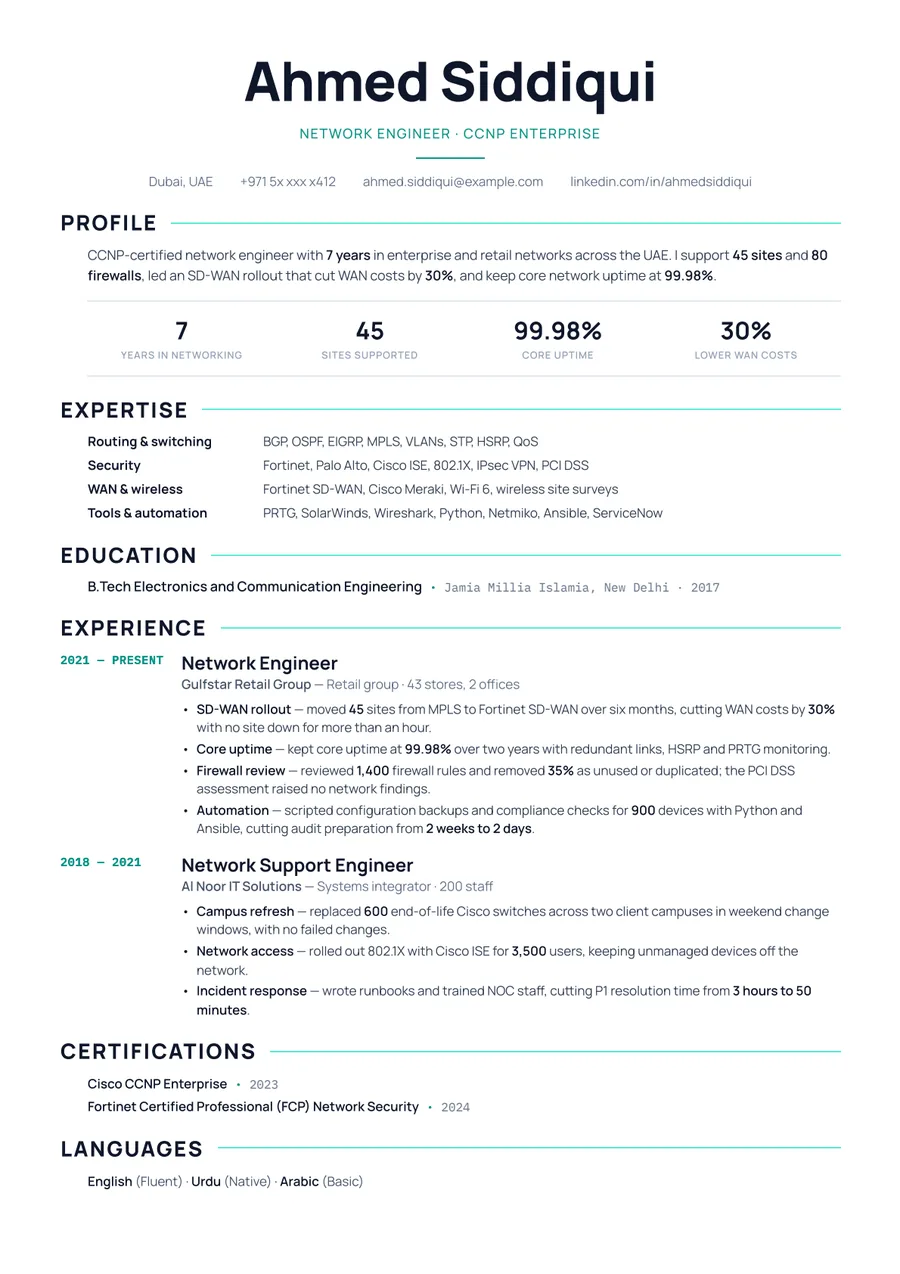
Best resume format for a network engineer
Use reverse-chronological order. One page works for NOC engineers and network engineers with up to about five years; two pages are normal for senior engineers and architects with large projects, several vendors and on-call leadership to describe. In India, the UK and the Gulf, a two-page CV is common from mid level. If you have moved from support into engineering, cut older helpdesk jobs to one or two lines.
Order: summary, certifications, technical skills grouped by area (routing and switching, security, wireless, data centre and cloud networking, automation), experience, education. Certifications go near the top because many networking ads say "CCNA required" or "CCNP preferred".
Give the scale in every role: sites, switches and routers, firewalls, users and WAN links. ResumeInk's Classic layout keeps dates in a neat left column, and Stacked puts a skills grid and education above experience, so vendors and protocols are seen first. The professional resume template page shows calm, conventional options.
What to include in a network engineer resume
- Summary: years, main vendors, the environment (enterprise, campus, ISP, data centre) and one result.
- Certifications: CCNA, CCNP, Network+, JNCIA or others, each with the year and whether it is current.
- Skills: routing protocols, switching, firewalls and VPN, wireless, SD-WAN, monitoring and scripting.
- Experience: the scale you support, projects such as hardware refreshes, SD-WAN rollouts or data centre moves, uptime, incident and change figures.
- Hands-on work: cabling, racking and wireless surveys, if the role includes them.
- Clearance or vetting: if you hold one and the role needs it, give the level only.
- Documentation: network diagrams, IP address plans and runbooks you created or keep current.
- Education: degree or diploma in IT, electronics or telecoms; apprenticeships count.
A home lab is worth a custom section of its own early in your career, with the topology and what you practised on it. If you are heading toward cloud networking, the cloud engineer resume guide covers the AWS and Azure side.
Network Engineer certifications and credentials by country
Vendor certifications are the main credential in networking, and they are recognised internationally:
- Cisco: CCNA (associate), CCNP Enterprise or Security (professional), CCIE (expert). Cisco certifications are valid for three years.
- CompTIA: Network+, vendor-neutral and a common first step; Security+ for security-leaning roles.
- Juniper: JNCIA-Junos, then JNCIS-ENT and JNCIP-ENT, valued by ISPs and carriers that run Juniper.
- Others: Palo Alto Networks PCNSE, Fortinet's certifications, and CWNA for wireless.
By country: in India and the Gulf, CCNA is a frequent requirement, and Huawei's HCIA or HCIP appears in telecom roles. In the US, defence work may need a baseline certification such as Security+ under DoD 8140, plus a clearance. In the UK, government networks may ask for SC clearance. In Australia, customer cabling work must be done by a registered cabler under ACMA's rules. In Canada, "engineer" and P.Eng. are regulated titles, so don't claim P.Eng. unless you are licensed. If you are studying for a certification, list it as in progress with your exam date.
Network Engineer resume summary examples
- Entry level: CCNA-certified network technician with a diploma in IT and 18 months on a managed services helpdesk. Configured VLANs, switch ports and Wi-Fi access points for 30 small-business clients, and practises OSPF and BGP in a GNS3 home lab with Cisco and Juniper images.
- Mid level: CCNP Enterprise network engineer with six years in enterprise and campus networks. Supports 45 sites and 80 Fortinet firewalls, led an SD-WAN rollout that cut WAN costs by 30%, and keeps core network uptime at 99.98%.
- Senior: Senior network engineer and CCIE with 13 years across ISP and data centre networks. Designed the BGP and MPLS core for a regional carrier, leads a team of seven and its on-call rota, and automated configuration backups and compliance checks for 2,000 devices with Python and Ansible.
Put the certification in the first few words if the ad names it; it is often the first thing a recruiter checks.
Network Engineer resume bullet point examples
- Led an SD-WAN rollout to 45 branch sites over six months, replacing MPLS links and cutting WAN costs by 30%, with no site down for more than an hour.
- Replaced 600 end-of-life access switches across two campuses in weekend change windows, with no failed changes.
- Kept core network uptime at 99.98% over two years by adding redundant links, HSRP and proactive monitoring in PRTG.
- Automated configuration backups and compliance checks for 2,000 devices with Python, Netmiko and Ansible, cutting audit preparation from 2 weeks to 2 days.
- Reviewed 1,400 Palo Alto firewall rules and removed 35% as unused or duplicated; the PCI DSS assessment raised no network findings.
- Rolled out 802.1X network access control with Cisco ISE for 3,500 users, keeping unmanaged devices off the corporate network.
- Cut mean time to resolve P1 network incidents from 3 hours to 50 minutes by writing runbooks and training NOC staff.
- Surveyed and redesigned Wi-Fi for a 6-floor office, cutting coverage complaints by 80%.
Uptime, failed changes, recovery time and cost are numbers every network manager understands at a glance, so use them wherever you can.
Skills & ATS keywords for network engineer resumes
Networking ads are dense with protocol and vendor names, and recruiters search for them exactly, often with the vendor in the query. Group yours:
- Routing and switching: BGP, OSPF, EIGRP, MPLS, VLANs, STP, HSRP or VRRP, LACP, QoS
- Security: Palo Alto, Fortinet, Cisco Firepower or Check Point firewalls, site-to-site and remote-access VPN, IPsec, 802.1X, NAC, Cisco ISE
- WAN and wireless: SD-WAN (Cisco Catalyst SD-WAN, Fortinet Secure SD-WAN), Wi-Fi 6, Cisco Meraki, Aruba, wireless site surveys
- Data centre and cloud: Cisco Nexus, VXLAN EVPN, F5 load balancers, AWS VPC, Azure VNet
- Service provider: MPLS L3VPN, IS-IS, segment routing, carrier Ethernet, if you have worked at an ISP or carrier
- Monitoring and tools: SolarWinds, PRTG, Wireshark, NetFlow, SNMP, syslog, ServiceNow
- Automation: Python, Ansible, Netmiko, NETCONF and RESTCONF, Git
- Soft skills: change management, clear incident updates, working with vendors and carriers, documentation
See resume keywords for ATS screening for how to match an ad without stuffing.
Common network engineer resume mistakes
- A wall of acronyms. BGP, OSPF and VXLAN mean more inside a bullet that says what you built with them.
- No scale. "Managed the network" could mean one office or 200 sites. Give sites, devices, users and links.
- Lapsed certifications shown as current. Cisco and CompTIA certifications last three years. Show the year, and drop or mark expired ones.
- Only tickets, no projects. Closing tickets is the job; a refresh, migration or automation project shows growth. Include at least one per role.
- Wording tied to one vendor. If you have only used Cisco, say so, but describe the concepts too (routing, segmentation, redundancy) so Juniper or Arista teams see what transfers.
- No change discipline. Many outages start with a change. Mention change windows, rollback plans and peer review, ideally with a failed-change figure.
Before you send it, run the page through the ATS resume checker.
Premium, ATS-friendly templates


Build your resume in minutes
Upload your current resume, edit anything, then preview and download it free.
Upload your resumeFrequently asked questions
Should I put CCNA on my resume if I have no experience?
Yes. CCNA is a common requirement in entry-level networking ads, so put it near the top with the year. Pair it with lab work or helpdesk experience to show you have used the skills.
How do I write a network engineer resume with no experience?
Lead with your certification and a home lab or college project: what you built, the protocols you configured and the tools you used. Add helpdesk, IT support or internship work, and keep it to one page.
Should I list both CCNA and CCNP on my resume?
Listing the higher certification with its year is usually enough, since CCNP shows the professional level. Keep CCNA as well if an ad asks for it by name.
What is the difference between a network engineer and a network administrator resume?
A network administrator resume focuses on running an existing network: monitoring, tickets, changes and user issues. A network engineer resume should also show design and projects, such as new sites, migrations and redundancy.
Should a network engineer resume mention a security clearance?
Yes, if you hold an active clearance and the role needs one. Give the level and country only, for example SC in the UK or Secret in the US, and leave out reference numbers.