Free Cloud Engineer Resume Template & Examples
Cloud engineering is judged on what you built, what it costs and how well it holds up. A focused cloud engineer resume names your main platform and services, shows the scale you run, and backs it with numbers for spend, uptime, migrations or provisioning time. Certifications matter more here than in most tech roles, so this guide covers which AWS, Azure and Google Cloud credentials to list and how they read in each country, plus format, summaries, bullets and keywords. ResumeInk's AI can rebuild your current resume from a PDF, Word file or photo.
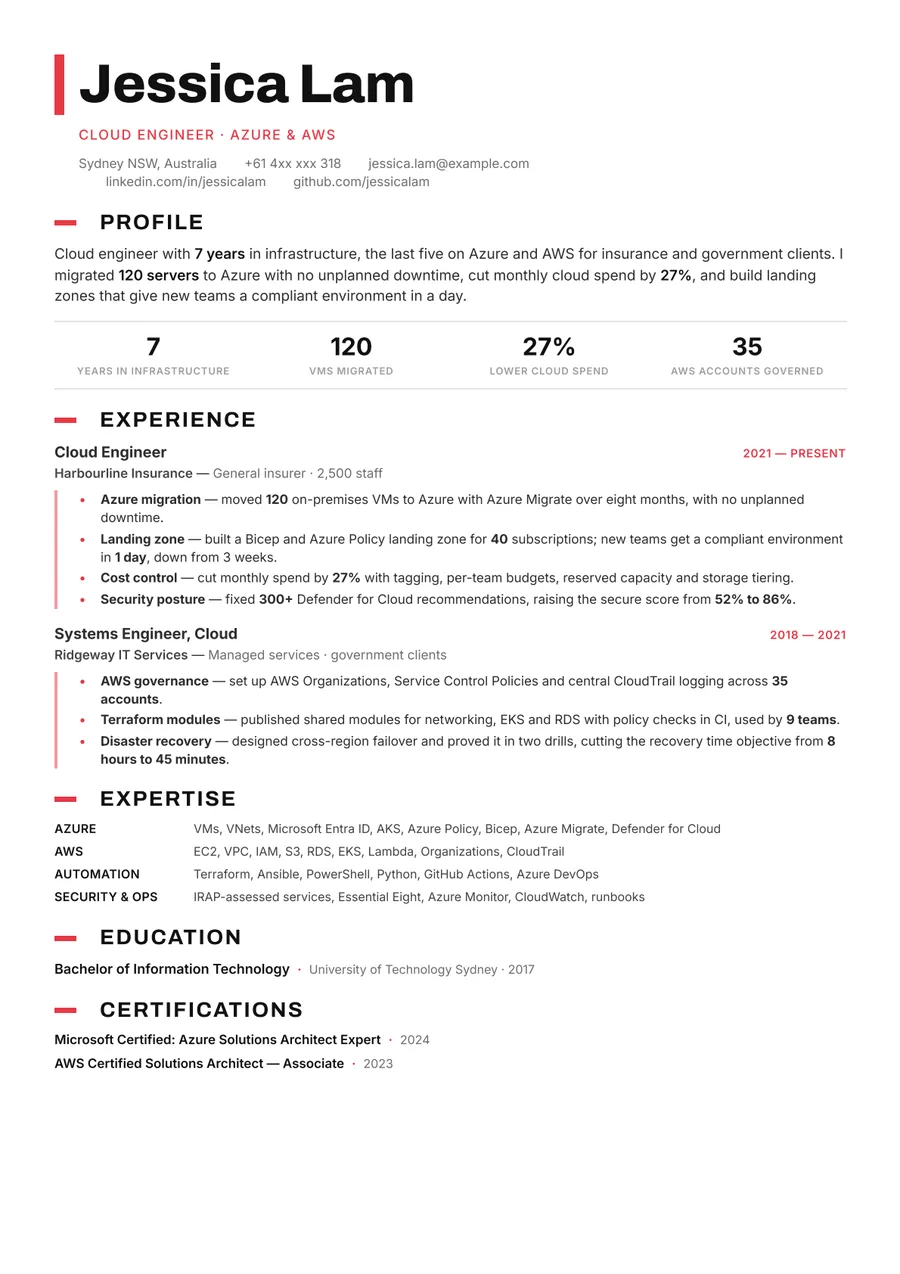
Best resume format for a cloud engineer
Use reverse-chronological order on one page for up to about five years in cloud. Two pages suit senior engineers and architects with several migrations or landing zones to describe. Because cloud ads filter on platforms and certifications, add a short certifications line right under the summary, not only at the end. If you hold several, list the most advanced first for each provider.
Order: summary, certifications, technical skills grouped by area (compute, networking, identity and security, infrastructure as code, observability), experience, education. Name the provider in bullets where it matters: "migrated 120 servers to Azure" is clearer than "migrated workloads to the cloud". Aim for bullets that fit on one or two lines.
ResumeInk's Stacked layout puts the expertise grid and education above experience, and Developer stack keeps technical skills prominent. If your work leans toward pipelines and releases, compare the DevOps engineer resume guide, which covers the overlap.
What to include in a cloud engineer resume
- Summary: main cloud, years, the type of environment (startup, enterprise, regulated) and one result in cost, reliability or delivery.
- Certifications: full official names and the year earned. Leave expired ones off or mark them.
- Skills: services by name (EC2, VPC, IAM, AKS, Cloud Run), infrastructure as code, containers, CI/CD, monitoring and scripting.
- Experience: migrations (how many workloads, how much downtime), landing zones and account structure, cost savings, security fixes, and automation that removed manual work.
- On-call and incidents: rotations you joined and incidents you led, with recovery times.
- Compliance: frameworks you worked within, such as ISO 27001, SOC 2, PCI DSS or a government standard.
- Education: degree or diploma. Career changers can add home-lab builds in a custom section such as Cloud projects, with a link to the code; see the career change resume guide.
Moving in from networking? The network engineer resume guide shows how to describe VPN, routing and firewall work that cloud teams need.
Cloud Engineer certifications and credentials by country
No licence is needed to work as a cloud engineer, but vendor certifications are a common filter, and the same ones count in every country:
- AWS: Cloud Practitioner (entry), Solutions Architect — Associate, Developer — Associate, then Solutions Architect — Professional and specialty exams such as Security.
- Microsoft Azure: Azure Fundamentals (AZ-900), Azure Administrator Associate (AZ-104), Azure Solutions Architect Expert (AZ-305).
- Google Cloud: Associate Cloud Engineer, Professional Cloud Architect.
- Platform-neutral: HashiCorp Terraform Associate, and the CKA for Kubernetes.
AWS certifications last three years and Microsoft's role-based ones need renewing every year, so show the year. The country differences are in the work. US federal roles mention FedRAMP and often a clearance. UK public sector buyers use the G-Cloud framework and NCSC cloud guidance. Australian government work asks for IRAP-assessed services and the Essential Eight. In India, banking and fintech roles involve RBI data-localisation rules, and in the UAE and Saudi Arabia, in-country data residency is common in regulated sectors.
Cloud Engineer resume summary examples
- Entry level: Cloud support engineer with two years in IT operations and the AWS Certified Solutions Architect — Associate. Automated user and backup tasks with Python and Bash, and built a three-tier practice environment on AWS with Terraform, CloudWatch alarms and least-privilege IAM.
- Mid level: Azure cloud engineer with six years in financial services, holding AZ-104 and AZ-305. Built the landing zone for 40 subscriptions with Bicep and Azure Policy, migrated 120 virtual machines with no unplanned downtime and cut monthly spend by 27%.
- Senior: Senior cloud engineer with 12 years in infrastructure, the last seven on AWS and Google Cloud. Leads a platform team of five supporting 300 developers, designed a multi-account AWS Organizations structure with central guardrails, and owns disaster recovery for a platform with a 99.95% uptime target.
Name the certification in the summary only if the ad asks for it; otherwise the certifications line does that job.
Cloud Engineer resume bullet point examples
- Migrated 120 on-premises virtual machines to Azure over eight months with Azure Migrate, with no unplanned downtime for business systems.
- Cut monthly cloud spend by 27% with a tagging policy, per-team budgets and alerts, reserved capacity for steady workloads and storage tiering for old data.
- Built a landing zone for 40 subscriptions with Bicep and Azure Policy, so new teams get a compliant environment in a day instead of three weeks.
- Published shared Terraform modules for networking, Kubernetes clusters and databases, with policy checks in CI, now used by 9 teams.
- Rolled out AWS Organizations with Service Control Policies, IAM Identity Center and central CloudTrail logging across 35 accounts.
- Designed cross-region backup and failover and proved it in two drills, cutting the recovery time objective from 8 hours to 45 minutes.
- Fixed 300+ Defender for Cloud recommendations, raising the Azure secure score from 52% to 86%.
- Moved 14 batch jobs from always-on VMs to Cloud Run and Cloud Scheduler on Google Cloud, cutting their compute cost by 60%.
Put the provider and service in each bullet; a recruiter searching for "Azure Migrate" or "EKS" should land on that line, not only on your skills list.
Skills & ATS keywords for cloud engineer resumes
Cloud ads are long lists of services, and recruiters search for the ones their platform runs on. Group yours by provider, then by job:
- AWS: EC2, VPC, IAM, S3, RDS, Lambda, EKS, ECS, CloudFormation, CloudWatch, Organizations, Control Tower
- Azure: virtual machines, VNets, Microsoft Entra ID, AKS, Azure Policy, Bicep, ARM templates, Azure Monitor, Azure Migrate
- Google Cloud: Compute Engine, GKE, Cloud Run, Cloud Storage, IAM, VPC, BigQuery
- Infrastructure as code and scripting: Terraform, Ansible, Python, Bash, PowerShell
- Containers and delivery: Docker, Kubernetes, Helm, GitHub Actions, Azure DevOps, GitLab CI
- Networking and security: DNS, load balancers, site-to-site VPN, Direct Connect or ExpressRoute, KMS, secrets management, zero trust
- Soft skills: cost conversations with finance, writing runbooks, working with security and application teams
Write services the way the ad does. Azure AD is now Microsoft Entra ID; if an ad uses the old name, include both. The ATS resume checker shows which terms you are missing, and how to make an ATS-friendly resume covers the layout side.
Common cloud engineer resume mistakes
- Certifications buried at the bottom. If the ad asks for AZ-104 or an AWS Associate, a reader should see it in the top third of the page.
- "Cloud" with no provider. Say AWS, Azure or Google Cloud, and name services. Generic cloud language matches fewer searches.
- Certificates without hands-on work. Three certifications and no projects reads as exam-only. Add one migration, build or lab project for each platform you claim.
- Savings without a baseline. "Reduced costs" needs a percentage or a before and after. If amounts are confidential, percentages are fine.
- One long paragraph of services. Sixty service names are hard to scan. Group them by area and keep the ones you have run in production.
- Missing the security side. Identity, encryption and logging are part of cloud work, not a separate job. Show at least one bullet on IAM, key management or audit logging.
Premium, ATS-friendly templates


Build your resume in minutes
Upload your current resume, edit anything, then preview and download it free.
Upload your resumeFrequently asked questions
Which certification is best for a cloud engineer resume?
The one for the cloud the employer uses. For a first cloud role, AWS Certified Solutions Architect Associate, Azure Administrator Associate (AZ-104) or Google Cloud Associate Cloud Engineer are the usual starting points.
How do I write a cloud engineer resume with no experience?
Lead with a certification and two or three projects you built yourself, such as a three-tier app deployed with Terraform, with a link to the code. Add IT support, networking or Linux work, since those are common routes into cloud roles.
Should I list expired cloud certifications?
Only with the year shown and only if the knowledge is still relevant; otherwise leave them off. Renewing the main certification for the platform you are targeting is usually worth the effort.
What is the difference between a cloud engineer and a DevOps engineer resume?
A cloud engineer resume leans toward infrastructure: networking, identity, landing zones, migrations and cost. A DevOps resume leans toward pipelines and release speed, and many roles overlap, so mirror the ad.
Should I put multi-cloud on my resume?
Only if you have run real workloads on more than one provider. Lead with your strongest platform and list the others with what you did on each, rather than claiming equal depth.