Free Cybersecurity Analyst Resume Template & Examples
A strong cybersecurity analyst resume shows that you can spot, triage and contain real threats, and that you hold the right certifications for your level. Hiring managers look for your SIEM and EDR tools, alert volumes, response times and the frameworks you work to. This page covers format, certifications by country with honest experience requirements, summary and bullet examples, keywords and the mistakes that hold analysts back. Upload your current resume as a PDF, Word file or photo, and ResumeInk rebuilds it in an ATS-readable design you can edit and tailor to each job.
Best resume format for a cybersecurity analyst
Use reverse-chronological order for most candidates. One page fits SOC analysts with up to five years of experience; two pages suit senior analysts, incident responders and threat hunters with certifications, clearances and larger programmes to describe.
A clear order: header, a three-line summary, certifications, technical skills, experience, projects or home lab, then education. Certifications sit high because many security postings screen for them, and some US government roles require specific ones.
Career changers from IT support, networking or the military can use ResumeInk's Skills-first layout, which puts a shaded block of grouped skills before experience; the skills-based resume template explains when that works. Experienced analysts usually do better with Classic or Compact header, which keep the work history front and centre and fit a lot on one page. Add a custom section with your own heading for a clearance or CTF results.
What to include in a cybersecurity analyst resume
- Header: name, city, phone, email, LinkedIn, and GitHub or a blog if it has write-ups. Leave out your full home address.
- Summary: your function (SOC, incident response, vulnerability management, GRC), your main tools and one measurable result.
- Certifications: full names and the year, with in progress and an exam date for any you are working on.
- Technical skills: SIEM, EDR, network and cloud security, scripting and frameworks.
- Experience: alert and incident volumes, time to detect or respond, vulnerabilities fixed, controls you introduced, audits you supported.
- Home lab and CTFs: vital at entry level: a lab with a SIEM you built, TryHackMe or Hack The Box ranks, CTF placings.
- Clearance: an active clearance by level only.
- Education: degree and year; cybersecurity, computer science and IT are typical, but many analysts come up through support.
Moving over from infrastructure? The network engineer and systems engineer pages show how to frame that background.
Cybersecurity analyst certifications and credentials by country
No country requires a licence to work as a security analyst, so certifications do much of the signalling. Know what each one demands:
- CompTIA Security+: the usual first certification, with no formal experience requirement. CySA+ is its analyst-level follow-on.
- CEH (EC-Council): you need two years of security work experience, or EC-Council's official training, to sit the exam. It is common in Indian and Gulf job ads.
- OSCP (OffSec): a hands-on, 24-hour penetration test exam with no experience prerequisite; it signals offensive skill rather than SOC work.
- CISSP (ISC2): five years of cumulative paid work in at least two of its eight domains, with one year waived for a relevant degree or approved credential. Pass without the experience and you are an Associate of ISC2 until you earn it.
- CISM (ISACA): five years of information security experience, including security management, so it suits leads and managers.
US: Department of Defense roles under DoD 8140 accept approved certifications such as Security+, and many need a Secret or Top Secret clearance. UK: SC or DV clearance, CREST exams and the UK Cyber Security Council's professional titles carry weight. Australia: the ASD Essential Eight and a Baseline, NV1 or NV2 clearance matter for government work. India: CEH, ISO 27001 Lead Auditor or Lead Implementer and familiarity with CERT-In directions appear often in ads.
Cybersecurity analyst resume summary examples
Function, tools, certification, one number. Adapt these:
- Entry level: CompTIA Security+ certified IT graduate with a home lab running Wazuh and Sysmon across six virtual machines and a top 3% TryHackMe ranking. Two years on a service desk handling phishing reports, account lockouts and endpoint rebuilds for 900 users.
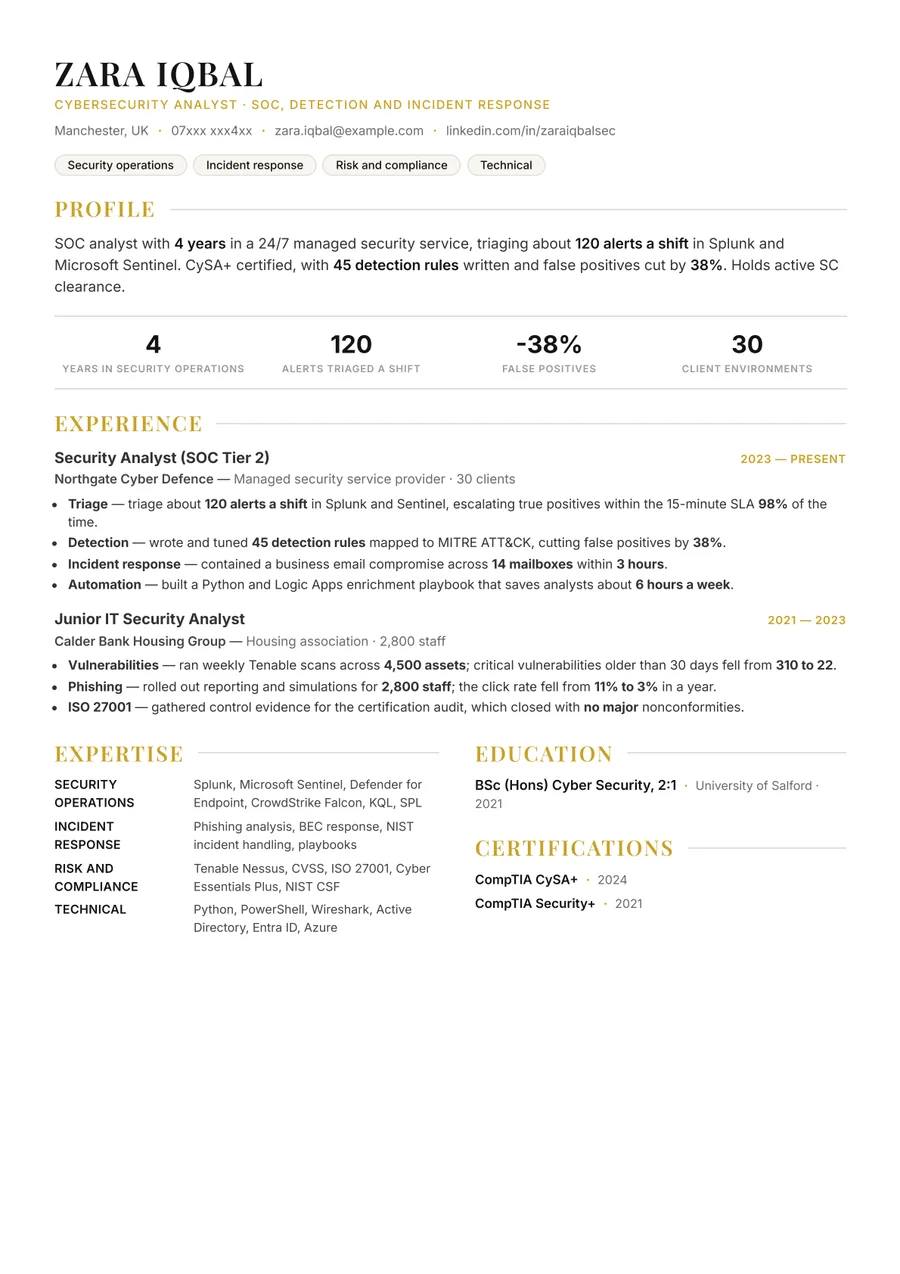
- Mid level: SOC analyst with four years in a 24/7 managed security service, triaging about 120 alerts a shift in Splunk and Microsoft Sentinel for 30 client environments. CySA+ certified; wrote 45 detection rules that cut false positives by 38%.
- Senior: Senior security analyst and incident response lead with 10 years in banking, holding CISSP and GCIH. Leads a team of six covering detection and response for 12,000 endpoints, and brought mean time to contain down from nine hours to two.
If the job ad names a certification you hold, put it in the first line of your summary as well as in the certifications section.
Cybersecurity analyst resume bullet point examples
Show volume, speed and the risk you removed:
- Triaged about 120 SIEM alerts a shift across Splunk and Sentinel, escalating true positives within the 15-minute SLA 98% of the time.
- Wrote and tuned 45 detection rules mapped to MITRE ATT&CK techniques, cutting false positives by 38% without missing any red team test cases.
- Contained a business email compromise across 14 mailboxes, revoking sessions and removing forwarding rules, with every account clean within three hours.
- Ran weekly Tenable scans across 4,500 assets and chased fixes with IT owners, reducing critical vulnerabilities older than 30 days from 310 to 22.
- Rolled out phishing reporting and simulations for 2,800 staff; the click rate fell from 11% to 3% in a year while reports rose fourfold.
- Automated IP and hash enrichment with a Python and SOAR playbook, saving analysts about six hours a week.
- Gathered control evidence against ISO 27001 Annex A for the certification audit, which closed with no major nonconformities.
- Raised a state agency's Essential Eight maturity from level one to level two in eight months by enforcing application control and MFA.
Skills & ATS keywords for cybersecurity analyst resumes
Match the ad's wording exactly, such as Microsoft Sentinel rather than Azure Sentinel. Terms that recur in analyst postings:
- Security operations: SIEM (Splunk, Microsoft Sentinel, QRadar, Elastic), EDR (CrowdStrike Falcon, Microsoft Defender for Endpoint, SentinelOne), SOAR, threat hunting, alert triage, log analysis.
- Incident response: the NIST incident handling lifecycle, digital forensics, phishing analysis, malware triage, playbooks.
- Vulnerability management: Tenable Nessus, Qualys, Rapid7, CVSS, patch prioritisation, Burp Suite and Nmap basics.
- Frameworks: MITRE ATT&CK, NIST CSF, ISO 27001, CIS Controls, ASD Essential Eight, Cyber Essentials, SOC 2, PCI DSS.
- Technical base: TCP/IP, Wireshark, firewalls, Active Directory, Entra ID, AWS and Azure security, Python, PowerShell, KQL, SPL.
- Soft skills: clear incident write-ups, calm under pressure, explaining risk to non-technical managers.
Tailor the list for SOC, GRC or penetration testing jobs, and check readability with the ATS resume checker.
Common cybersecurity analyst resume mistakes
- Certifications you do not hold yet. Listing CISSP without the experience is a red flag. Write Associate of ISC2 if that is your status, or in progress with an exam date.
- Tool lists with no volume. Say how many alerts, endpoints, assets or incidents you handled and how quickly.
- Oversharing. Never name breached clients, internal IP ranges, tool configurations or vetting details. Describe incidents by type and outcome.
- Ignoring the business side. Risk reduced, audits passed and downtime avoided matter to the managers who approve a hire.
- No proof behind entry-level claims. A home lab, write-ups or CTF results back up a junior resume; see how to write a resume with no experience.
- One resume for every job. SOC, GRC and penetration testing roles want different keywords, so tailor the summary and skills each time.
Premium, ATS-friendly templates


Build your resume in minutes
Upload your current resume, edit anything, then preview and download it free.
Upload your resumeFrequently asked questions
How do I write a cybersecurity analyst resume with no experience?
Lead with Security+ or a similar entry certification, then a home lab or project section showing a SIEM you set up, alerts you investigated and what you found. Add IT support, networking or help desk work, since triage, tickets and access management carry straight over.
Which certification should I get first for a cybersecurity analyst job?
CompTIA Security+ is the usual first choice, especially in the US, because it has no experience requirement and is accepted under DoD 8140. In India and the Gulf, CEH is also common in job ads, but it needs two years of security experience or official training.
Can I put CISSP on my resume without five years of experience?
Not as CISSP. If you pass the exam without the required experience you become an Associate of ISC2, and you can list exactly that until your experience is endorsed.
Should I list my security clearance on a cybersecurity resume?
Yes, list an active clearance by level, such as Secret in the US, SC or DV in the UK, or NV1 in Australia, and say that it is current. Give no other details of the vetting.
Should I include CTF results and TryHackMe or Hack The Box rankings?
Yes for entry-level and penetration testing roles, especially with a rank, a placing or a link to your write-ups. Once you have two or more years of security work, keep them to one line.