Free Web Developer Resume Template & Examples
Web developers are hired on what is live: sites that load fast, get found, convert and stay easy to update. A strong web developer resume names the platforms you build on, from hand-written HTML and JavaScript to WordPress, Shopify or a headless CMS, and backs each project with a result a client or manager cared about. Below are formats by career stage, the standards that count in each country, summaries, bullets and keywords. To start, upload your resume as a PDF, Word file or photo and ResumeInk lays it out in an editable, ATS-readable design.
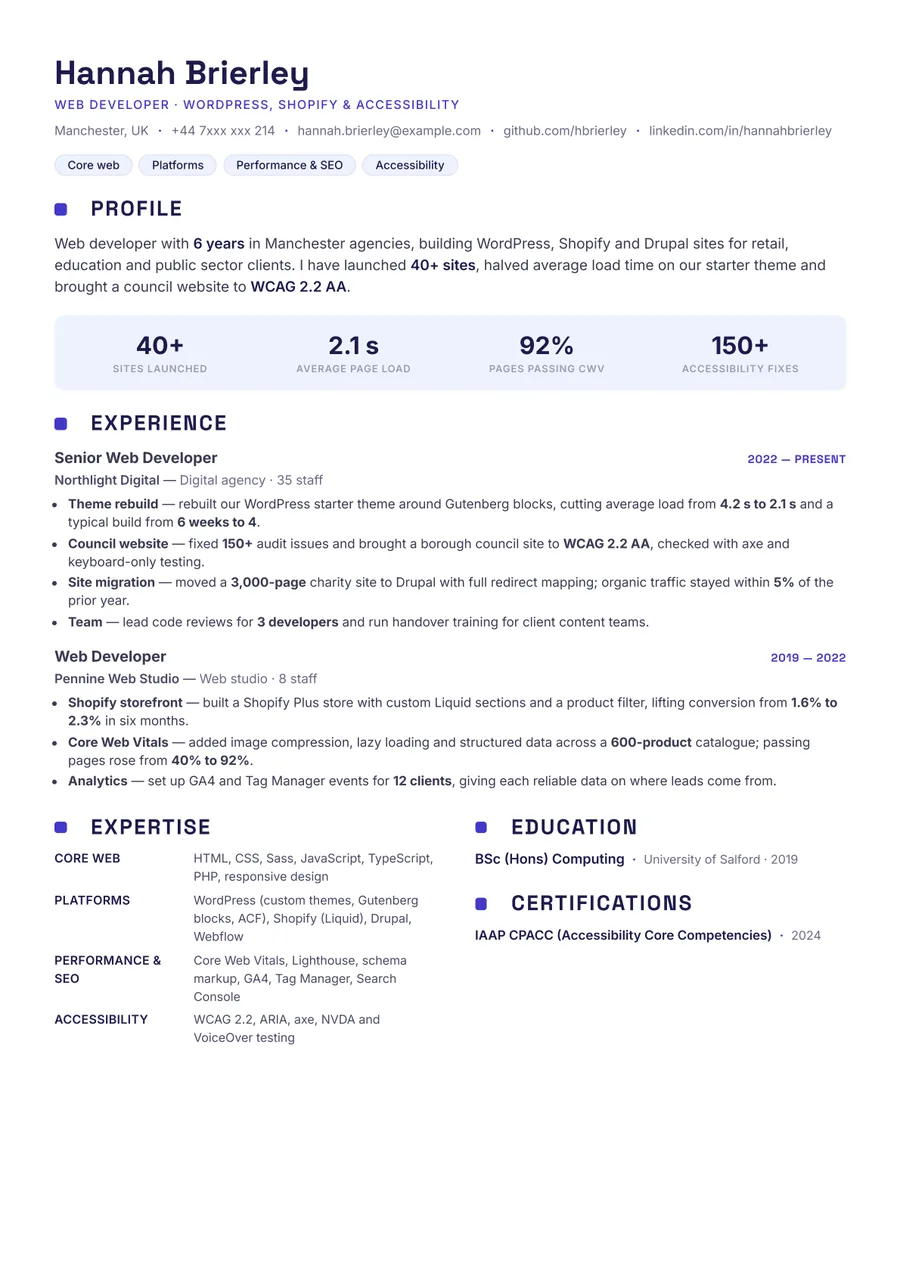
Best resume format for a web developer
Keep it to one page for most web developers, and use two only if you have led teams or long, complex builds. Use reverse-chronological order. If you have done years of client work on your own, list it as one role, such as Web Developer (self-employed), 2021 — Present, with your best three or four projects as bullets, rather than a dozen tiny entries.
Order: a header with your portfolio link, summary, skills, experience, selected sites, education. For each selected site give the URL, your part, the stack and one result. Live links matter more here than on most technical resumes, so open every one before you send.
A clean single column reads best. ResumeInk's Classic and Stacked layouts keep dates in a tidy left column, and Compact header fits a long platform list on one page. The one-page resume template shows how to trim.
What to include in a web developer resume
- Portfolio: one link in the header to a page with screenshots, dates and live URLs; name the client or sector where you are allowed to.
- Summary: the kind of sites you build (marketing, e-commerce, membership, public sector), your main platforms and one result.
- Skills: core web (HTML, CSS, JavaScript), CMS and platforms, any backend, plus SEO, accessibility and performance tools.
- Experience: sites launched, load times, search traffic, conversions, accessibility fixes, and hours saved for content editors.
- Client work: if you work for yourself, give the number of clients and how many came back; repeat business shows reliability.
- Hosting and handover: domains, DNS, SSL, hosting moves and backups, if you look after them for clients.
- Education: degree, diploma, bootcamp or self-taught.
In the ResumeInk editor you can add a custom section such as Selected sites for your best launches. If the ad leans toward app UI rather than whole sites, the frontend developer resume guide is the closer fit.
Web Developer certifications and credentials by country
No country licenses web developers, and most employers care more about your live work than certificates. Where countries differ is the standards a site must meet. If you have built to one, name it, because public sector and enterprise ads ask for it:
- US: Section 508 for federal sites, and WCAG conformance for accessibility work generally.
- UK: the public sector accessibility regulations, which point to WCAG, and the GOV.UK Design System for government services.
- India: the Guidelines for Indian Government Websites (GIGW) for central and state government portals.
- Australia: WCAG AA, which government websites are expected to meet.
Optional credentials that are recognised: IAAP's CPACC or Web Accessibility Specialist (WAS) for accessibility, the Google Analytics certification for tracking work, and HubSpot's CMS for Developers certification if you build on HubSpot. A degree or diploma helps with larger employers and many Indian companies; agencies and small businesses mostly judge your portfolio. Two relevant credentials beat six unrelated ones.
Web Developer resume summary examples
Name your platforms in the first sentence, so the reader knows at once what you build with.
- Entry level: Web developer with a diploma in IT and six live sites built in HTML, CSS, JavaScript and WordPress for local businesses. Every site scores 90+ for Lighthouse accessibility, and two clients have come back for a second project.
- Mid level: Web developer with five years at a digital agency, building WordPress, Shopify and headless sites for retail and education clients. Launched 40+ sites, rebuilt the agency's starter theme to halve average load time, and trains client teams to manage their own pages.
- Senior: Lead web developer with 10 years on public sector and charity websites, owning builds from discovery to launch. Led a team of four on a 3,000-page migration to Drupal, met WCAG 2.2 AA, and kept organic traffic steady through the move.
Skip openers like "passionate web developer"; your platforms and one result say more. Find other openings in our resume summary examples.
Web Developer resume bullet point examples
- Rebuilt a custom WordPress theme around Gutenberg blocks, cutting average page load from 4.2 s to 2.1 s and letting marketing publish pages without a developer.
- Launched 40+ client sites on WordPress, Shopify and Webflow over five years, hitting 90% of agreed launch dates.
- Migrated a 3,000-page site to Drupal with full redirect mapping; organic search traffic stayed within 5% of the previous year.
- Fixed 150+ issues from an accessibility audit and brought a council website to WCAG 2.2 AA, checked with axe and keyboard-only testing.
- Built a Shopify Plus storefront with custom Liquid sections and a product filter, lifting conversion rate from 1.6% to 2.3% in six months.
- Added structured data, image compression and lazy loading across a 600-product catalogue, raising pages that pass Core Web Vitals from 40% to 92%.
- Set up GA4 and Google Tag Manager events for forms and checkout, giving the client its first reliable data on where leads come from.
- Created a starter theme and launch checklist that cut a typical build from 6 weeks to 4.
Client names are optional. The sector, your part and the result matter more, and most agencies are happy for you to name public launches.
Skills & ATS keywords for web developer resumes
Web developer ads range from agency roles that want WordPress and SEO to product roles that read like frontend jobs. An agency ad will stress CMS, SEO and client skills; a product team will stress frameworks and testing. Mirror the ad's wording and group your skills:
- Core web: HTML5, CSS3, Sass, JavaScript, TypeScript, responsive design, cross-browser testing
- CMS and platforms: WordPress (custom themes, Gutenberg blocks, ACF), Shopify (Liquid), Webflow, Drupal, headless CMS such as Contentful or Strapi
- Backend: PHP, Laravel, Node.js, MySQL, REST APIs
- Performance and SEO: Core Web Vitals, Lighthouse, PageSpeed Insights, schema markup, Google Search Console, GA4, Google Tag Manager
- Accessibility: WCAG 2.2, ARIA, axe, screen-reader testing
- Tools: Git, Figma, cPanel, Cloudflare, Netlify or Vercel
- Soft skills: client communication, estimating, explaining technical choices in plain words
More on matching ads in resume keywords for ATS screening.
Common web developer resume mistakes
- Links to sites that have changed. Clients redesign. Keep screenshots and dates on your portfolio page as well as the live URL.
- Sites with no role. Say what you built: the theme, the integration, the migration. If a designer or wider team was involved, say which part was yours.
- A long list of one-line client entries. Group client work under one heading and pick the strongest projects.
- No results. Load time, traffic, conversions or editor time saved show value. "Built a website" does not.
- Designing the resume like a website. Icons, skill bars and text inside images can trip up an ATS. Keep the resume plain and let the portfolio do the showing; the ATS-friendly resume template page explains why.
- Leaving out the handover. Many web roles include training editors and documenting the build. If clients run their own sites after launch because of your handover, say so; it is a big reason agencies keep clients.
Premium, ATS-friendly templates


Build your resume in minutes
Upload your current resume, edit anything, then preview and download it free.
Upload your resumeFrequently asked questions
How do I put freelance web development on a resume?
List it as one role, such as Web Developer (self-employed), with dates and the number of clients, then three or four bullets on your strongest projects. Link a portfolio so the reader can see the sites.
What is the difference between a web developer and a frontend developer resume?
A web developer resume usually covers whole sites, often on a CMS such as WordPress or Shopify, plus SEO and hosting. A frontend developer resume focuses on application interfaces in frameworks such as React, so lean toward whichever the ad describes.
Do web developers need a degree?
Not for most roles. Agencies and small businesses hire on portfolio and experience, while larger employers and some Indian companies filter on a degree or diploma, so list yours if you have one.
Should I list WordPress on a web developer resume?
Yes, and be specific: custom themes, blocks or plugins are a developer skill, while installing themes is a lighter one. Describe your real level rather than just writing WordPress.
How many portfolio links should a web developer resume have?
One portfolio link in the header, plus a live link for each of two to four selected sites. Beyond that, readers rarely open them all.