Free Modeling Resume Template & Examples
A modeling resume is not a career history in the usual sense. It is a one-page booking summary that travels with your comp card and digitals: your stats, your agency, the work you have done and the skills a client might need on set. Agents, casting directors and brand clients use it to check that you are experienced, reliable and right for the brief. This guide covers the format, the photo, credits by type, the rules for minors and travel, examples and the mistakes to avoid.
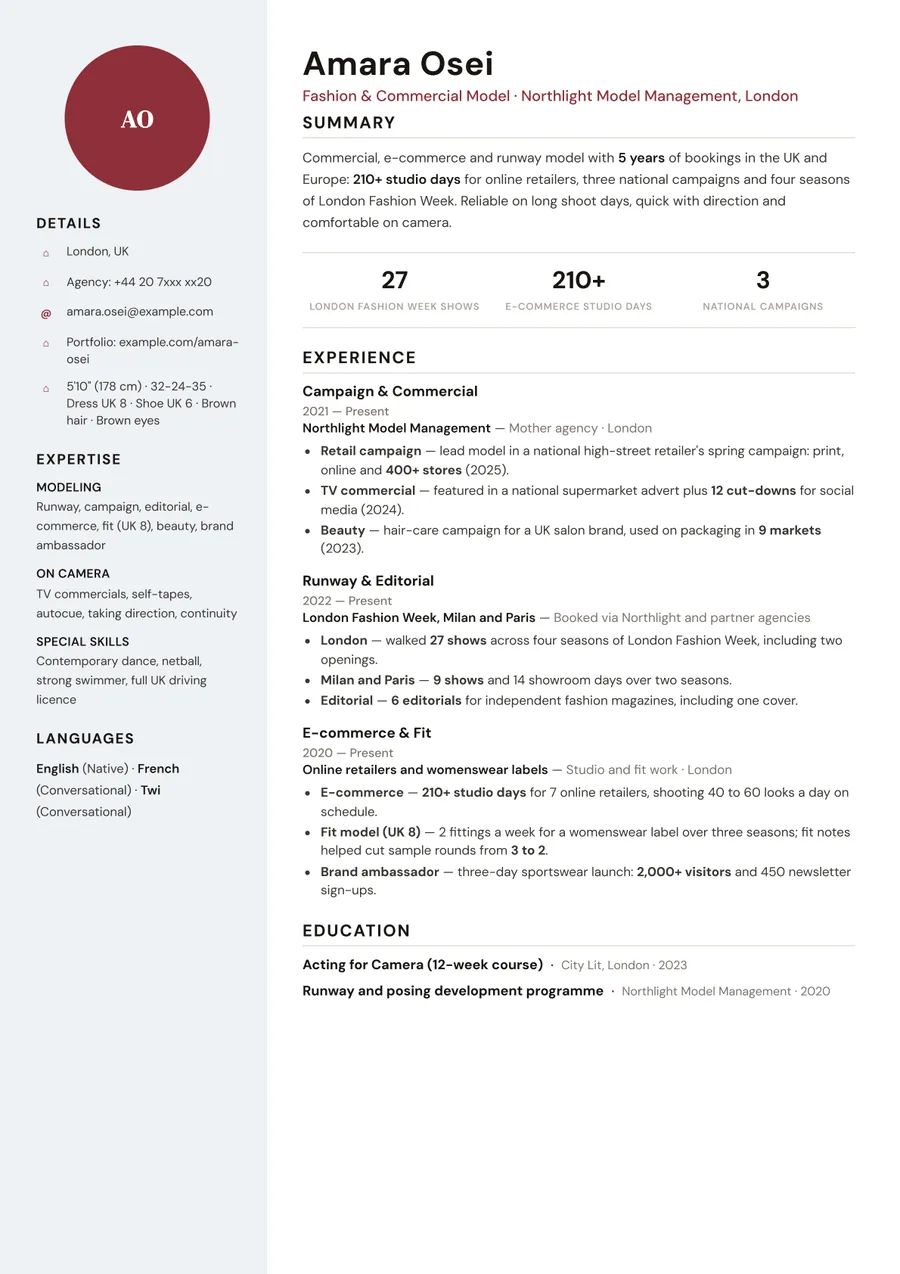
Best resume format for a model
Keep it to one page, always. Put a professional headshot and your name at the top, then a stats line, your agency, and credits grouped by type rather than by date: campaigns and commercial, editorial, runway, e-commerce and fit, then on-camera work. Finish with training and special skills.
Unlike most resumes, a photo is expected here. Use a recent, lightly retouched headshot in natural light, not a selfie or a heavily styled editorial shot. ResumeInk's Sidebar and Portrait layouts show it in a circle at the top of the side column, with room beside it for your stats and agency details; the Compact header and Timeline layouts place it in the header. The resume templates with a photo page shows how each one looks, and the creative resume templates add a little more personality.
Write measurements in the units of the market you are working in: inches and US sizes in the US, centimetres in Europe, India and Australia, and often both in the UK. Send the resume as a PDF with your comp card and a link to your portfolio.
What to include in a modeling resume
- Stats line: height, bust or chest, waist, hips, dress or suit size, shoe size, hair and eye colour. Men add inside leg and collar where clients ask for them.
- Agency representation: your mother agency and any other agencies by city, with the booker's contact details instead of your home address.
- Credits by type: client or brand, the kind of job (campaign, lookbook, catalogue, show, TV commercial), the market and the year. Add the photographer or director when that adds weight.
- Comp card and digitals: a link to your current comp card, recent unretouched digitals and your full portfolio.
- Training: runway coaching, posing workshops, acting for camera, presenting or dance.
- Special skills: sports, dance styles, languages, accents, swimming, driving, horse riding, and any parts work such as hands.
- Work rights and travel: passports held, visas, and whether you can travel at short notice.
Keep personal social media links only if they are professional and current.
Modeling certifications and credentials by country
There is no licence to work as a model in the US, UK, India or Australia, and a certificate from a modeling school carries little weight. What clients and agents look at instead:
- Agency representation: a recognised agency is the clearest sign that you are bookable. Name it near the top.
- Portfolio and digitals: current images that match how you look today matter more than any qualification.
- Work permits and visas: international bookings need the right to work in that country, usually arranged with the agency and client. The US has the H-1B route for fashion models of distinguished merit and the O-1 visa for extraordinary ability, and the UK has a Creative Worker visa for short engagements. List the passports and visas you already hold.
- Minors: in the UK, a child who models usually needs a child performance licence from their local council before the job, applied for by the client with the parent's help, and must be supervised by a parent or an approved chaperone. Some US states, including California and New York, require permits for child performers too.
- Unions: if you also act in commercials, add SAG-AFTRA (US) or Equity (UK) membership.
Modeling resume summary examples
A summary is optional on a modeling resume, but a two-line profile helps when you apply direct to brands or for promotional and fit modeling jobs. Three examples:
- Entry level: New face, 5'10" (178 cm), signed with a London agency in 2025. Completed runway and posing workshops and test shoots with six photographers, with digitals updated monthly; available for e-commerce, lookbook and commercial bookings with full UK work rights.
- Mid level: Commercial and e-commerce model with five years of bookings in the UK and Europe: 210+ studio days for online retailers, three national campaigns and four seasons of London Fashion Week. Reliable on long shoot days, quick with direction and comfortable on camera.
- Senior: Editorial and runway model with ten years' experience, represented in London, Paris and New York, with 40+ shows across four fashion week cities and campaigns for international beauty brands. Now adding brand ambassador and presenting work.
Modeling resume bullet point examples
On a modeling resume, credits do the work that results do elsewhere. Group them by type and add numbers where they exist:
- Lead model in a national high-street retailer's spring campaign, running in print, online and in 400+ stores (2025).
- Walked 27 shows across four seasons of London Fashion Week, including two openings.
- Booked 210+ e-commerce studio days for 7 online retailers, shooting 40 to 60 looks a day on schedule.
- Fit model (UK 8) for a womenswear label, attending 2 fittings a week for three seasons; fit notes helped cut sample rounds from three to two.
- Featured in a national TV commercial for a supermarket brand, plus 12 cut-down versions for social media.
- Shot 6 editorials for independent fashion magazines, including one cover.
- Brand ambassador at a three-day sportswear launch, talking to 2,000+ visitors and collecting 450 newsletter sign-ups.
- Grew a professional Instagram account from 8K to 42K followers in 18 months with behind-the-scenes content, leading to five brand partnerships.
Name real clients only when the work has been published; unreleased jobs can be described by category.
Skills & ATS keywords for modeling resumes
Agencies and casting directors rarely use applicant tracking systems, but brand ambassador, promotional, fit and e-commerce modeling jobs on job boards often do, and casting platforms let clients search by keyword. Useful terms:
- Work types: editorial, runway, commercial print, e-commerce, lookbook, catalogue, campaign, beauty, fitness, swimwear, fit model, parts model, promotional model, brand ambassador, TV commercial.
- Categories: petite, curve or plus-size, mature, tall, with your exact sizes for fit work.
- On-set skills: posing, runway walk, angles and expression, taking direction, continuity, quick changes, working to a shot list, self-tapes, autocue reading.
- Special skills: dance styles, sports, swimming, languages, accents, driving licence, horse riding.
- Professional habits: punctuality, stamina on long shoot days, adaptability, a calm presence with clients and crew, well-kept social media.
Building content skills alongside modeling? The social media manager resume guide covers content and audience work in more depth.
Common modeling resume mistakes
- Out-of-date stats or photos. Clients book from what they see. Update measurements and digitals whenever your look changes.
- A selfie or heavily filtered headshot. Use a clear professional photo, and save stylised images for the portfolio.
- Personal contact details everywhere. Your resume will be forwarded. Use your agency contact or a professional email, and never list a home address, especially for under-18s.
- Padding with test shoots. Tests are useful for beginners, but label them honestly and drop them once you have published work.
- A corporate-style layout. Paragraphs about goals waste space. Keep to credits, stats and skills on one page.
- No link to your book. Always include a portfolio link so the reader can see your range.
For keeping everything to a single sheet, see the one-page resume templates. Just starting? The guide to a resume with no experience helps you present training and tests.
Premium, ATS-friendly templates


Build your resume in minutes
Upload your current resume, edit anything, then preview and download it free.
Upload your resumeFrequently asked questions
What should a modeling resume include?
Your name, a professional headshot, a stats line with height and sizes, your agency, credits grouped by type, training and special skills. Add a portfolio link and send it with your comp card.
How do I make a modeling resume with no experience?
Use a headshot and stats, then list training, test shoots labelled as tests, school or charity shows and special skills such as dance or sport. Most new models approach agencies with simple digitals first, so keep those current too.
Should a modeling resume have a photo?
Yes. A recent professional headshot is expected, and clients also want a comp card and digitals, which are simple unretouched photos taken in natural light.
What is the difference between a comp card and a modeling resume?
A comp card is a printed or digital card with several photos and your stats, used to show your look. A modeling resume lists your agency, credits, training and skills, so the two work together.
Do models need a licence or permit?
Adults do not need a licence to model in the US, UK, India or Australia, but international bookings need the right visa or work permit. In the UK, children who model usually need a child performance licence from their local council, and some US states require permits for child performers.