Free Nurse Resume Template & Examples
A good nurse resume answers three questions fast: are you licensed or registered where the job is, what kind of unit have you worked on, and how safe and effective is your care? This page shows how to structure a nursing resume or CV, with summary and bullet examples, clinical keywords and the credentials employers check in the US, the UK, Australia and India. Upload your current resume as a PDF, Word file or photo, and ResumeInk rebuilds it in an ATS-readable design you can edit section by section.
Best resume format for a nurse
Reverse-chronological order works best, because employers want your most recent unit and level of responsibility first. One page fits new graduates and nurses with a few years on one unit. Two pages are fine once you have several specialties, charge or leadership duties, or advanced practice work; see one page vs two pages.
Order it as: contact details with a licence or registration line, summary, clinical experience, education, certifications, then skills. For each job, give the facility type, unit, bed count and usual patient ratio before your bullets; that context tells a nurse manager more than any adjective. New graduates should put clinical placements directly under education, with the unit, setting and hours.
Keep the layout simple. Hospital application systems need to read your licence and certifications as text, so never put them in images or badges. A clean single-column professional resume template works well.
What to include in a nurse resume
- US: your RN license with state and status (earned by passing the NCLEX-RN), a multistate compact license if you hold one, BLS and any ACLS, PALS or NRP, plus specialty certifications such as CCRN or CEN.
- UK: NMC registration with your PIN and field of practice (adult, children's, mental health or learning disabilities nursing), your current NHS band if relevant, and any practice supervisor or assessor experience.
- Australia: registration with the Nursing and Midwifery Board of Australia through AHPRA, as a registered or enrolled nurse, and any graduate program you completed.
- India: your State Nursing Council registration (RN/RM) and an INC-recognised qualification such as B.Sc Nursing, GNM or M.Sc Nursing. If you are applying abroad, add your OET or IELTS result and any overseas licensing exam you have passed.
- Everywhere: unit and specialty, patient ratios, EHR systems, clinical skills, education and the languages you use with patients.
Nurse resume summary examples
State your licence, specialty and years, then one result. Three starting points:
- Entry level: New graduate registered nurse (BSN, NCLEX-RN passed, BLS) with 600 clinical hours across medical-surgical, emergency and pediatric placements, including a 160-hour capstone on a 30-bed telemetry unit. Calm under pressure and confident charting in Epic.
- Mid-level: NMC-registered adult nurse with six years in acute medicine, the last two as a Band 6 senior staff nurse. Led a falls prevention project that cut inpatient falls on a 28-bed ward by a third in 12 months.
- Senior: Nurse unit manager with 15 years in intensive care, AHPRA registered with a postgraduate certificate in critical care. Runs a 24-bed ICU with about 120 nursing staff and led the unit's preparation for NSQHS Standards accreditation, with every action met.
Nurse resume bullet point examples
Give the setting and a number, not just the task:
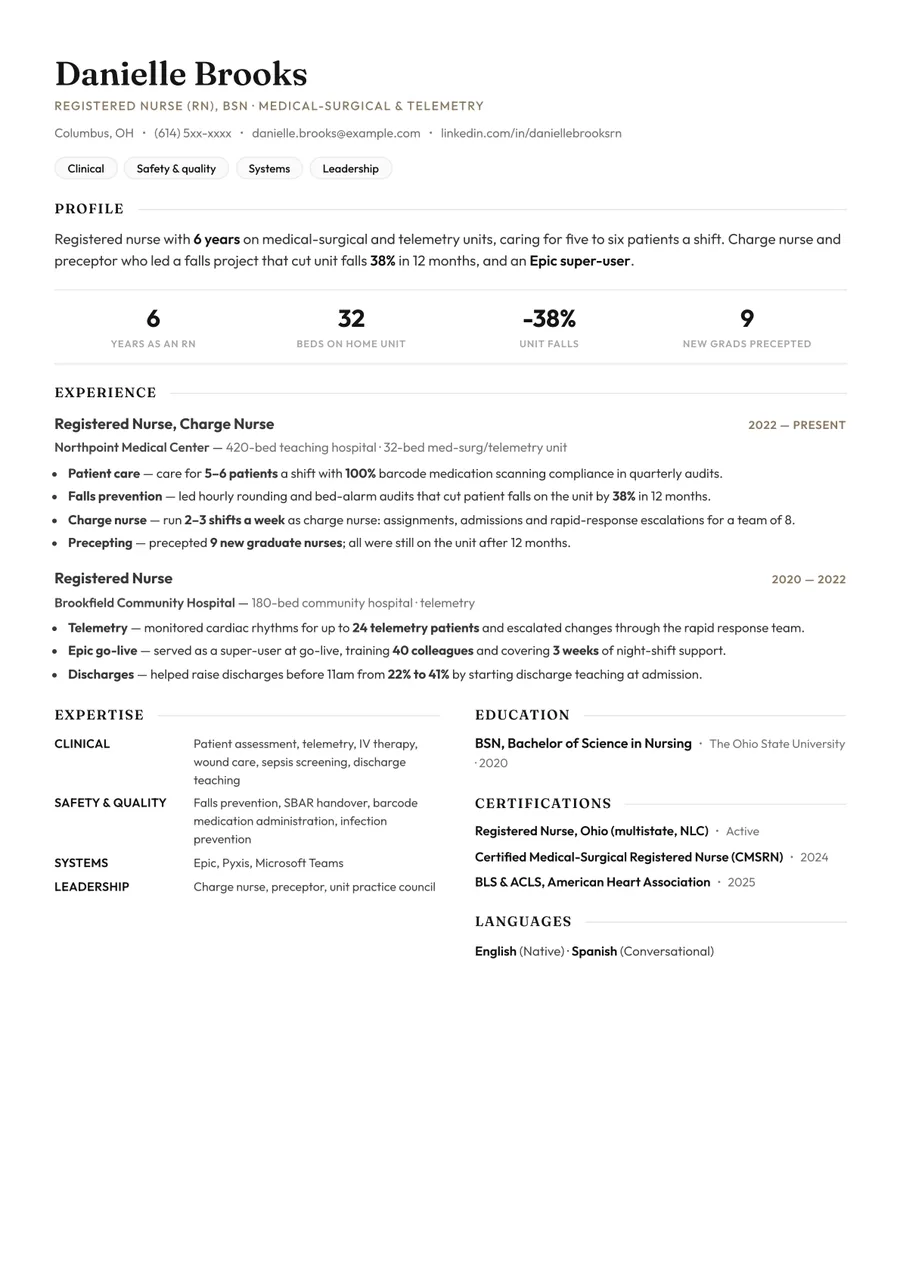
- Cared for five to six patients per shift on a 32-bed medical-surgical unit, with 100% barcode medication scanning compliance in quarterly audits.
- Led hourly rounding and bed-alarm audits that cut patient falls on the unit by 38% in 12 months.
- Triaged up to 45 patients a shift in a 40-bay emergency department using the Manchester Triage System, escalating deteriorating patients with NEWS2.
- Precepted nine new graduate nurses through orientation; all were still on the unit after 12 months.
- Served as an Epic super-user at go-live, training 40 colleagues and covering three weeks of night-shift support.
- Reached nine consecutive months with no hospital-acquired pressure injuries after introducing a two-hourly skin bundle and weekly audits.
- Raised discharges before 11am from 22% to 41% by starting discharge planning at admission with the multidisciplinary team.
- Worked as in-charge nurse on nights for a 20-bed cardiac step-down unit and helped the hospital through NABH reaccreditation with no non-conformities on the unit.
Never include patient names or details that could identify someone.
Skills & ATS keywords for nurse resumes
- Clinical skills: patient assessment, medication administration, IV therapy and cannulation, wound care, telemetry monitoring, infection prevention, care planning, patient and family education, discharge planning.
- Safety and quality: early warning scores (NEWS2 in the UK), falls prevention, sepsis screening, clinical handover with SBAR or ISBAR, evidence-based practice, and the NSQHS Standards in Australia or NABH standards in India.
- Systems: Epic, Oracle Health (Cerner), Meditech, Pyxis or Omnicell, and local e-prescribing systems.
- Certifications: BLS, ACLS, PALS, NRP, Immediate or Advanced Life Support, and specialty certifications.
- Soft skills: clinical judgement, communication, teamwork, cultural safety, resilience, time management.
Copy the specialty words in the advertisement exactly, such as med-surg, acute medicine or perioperative. Then check that your file reads cleanly with the ATS resume checker.
Common nurse resume mistakes
- Vague licence details. Licensed nurse is not enough. Give the licence type, state or regulator and status, and keep certification dates current.
- No setting. Bullets without the unit, bed count, acuity or ratio leave a manager guessing. Add one line of context under each job.
- Tasks every nurse does. Administered medications and monitored vitals adds little. Show what you improved, who you trained or the complex patients you managed.
- Skipping placements as a new graduate. Your clinical placements are your experience. List each with the unit, setting and hours.
- Patient details. Never include names, dates of birth or stories that could identify a patient.
- Local abbreviations. Hospital-specific shorthand confuses recruiters elsewhere. Spell it out once.
Then read it as a nurse manager would: after one quick pass, could they picture your unit, your patients and your level?
Premium, ATS-friendly templates


Build your resume in minutes
Upload your current resume, edit anything, then preview and download it free.
Upload your resumeFrequently asked questions
Should a nurse resume include licence numbers?
Always include the licence or registration type, the issuing body or state, and its status. Many nurses also add the number, such as an NMC PIN in the UK or an AHPRA registration number in Australia, because employers check public registers anyway; if you prefer not to, give it on the application form.
How do I write a new grad nurse resume with no experience?
Treat your clinical placements as experience: list each unit, setting and number of hours, with one or two bullets on what you did. Add your licence or exam status, BLS, any graduate program or preceptorship, and earlier work in care or customer-facing jobs.
What certifications should I put on a nursing resume?
List life support first, such as BLS, ACLS, PALS or Advanced Life Support, then specialty certifications like CCRN, CEN or a postgraduate certificate in your field. Include the expiry date for anything that lapses, and remove certificates that have expired.
Is a nursing CV different from a nursing resume?
Mostly in name. Nurses in the UK, India and Australia usually say CV, and NHS applications also ask for a supporting statement, so write that separately and keep the two consistent. In the US, a resume of one to two pages is the norm.