Free Pharmacist Resume Template & Examples
A pharmacist resume has to answer one question before any other: are you registered to practise where this job is? After that, employers look at your setting (community, hospital, clinical or industry), the volume and complexity you handle, the services you deliver and how safe your record is. This guide sets out the format by career stage, the licensing route in the US, UK, India, Australia and Canada, summary and bullet examples with realistic numbers, the keywords pharmacy ads repeat, and the mistakes to avoid.
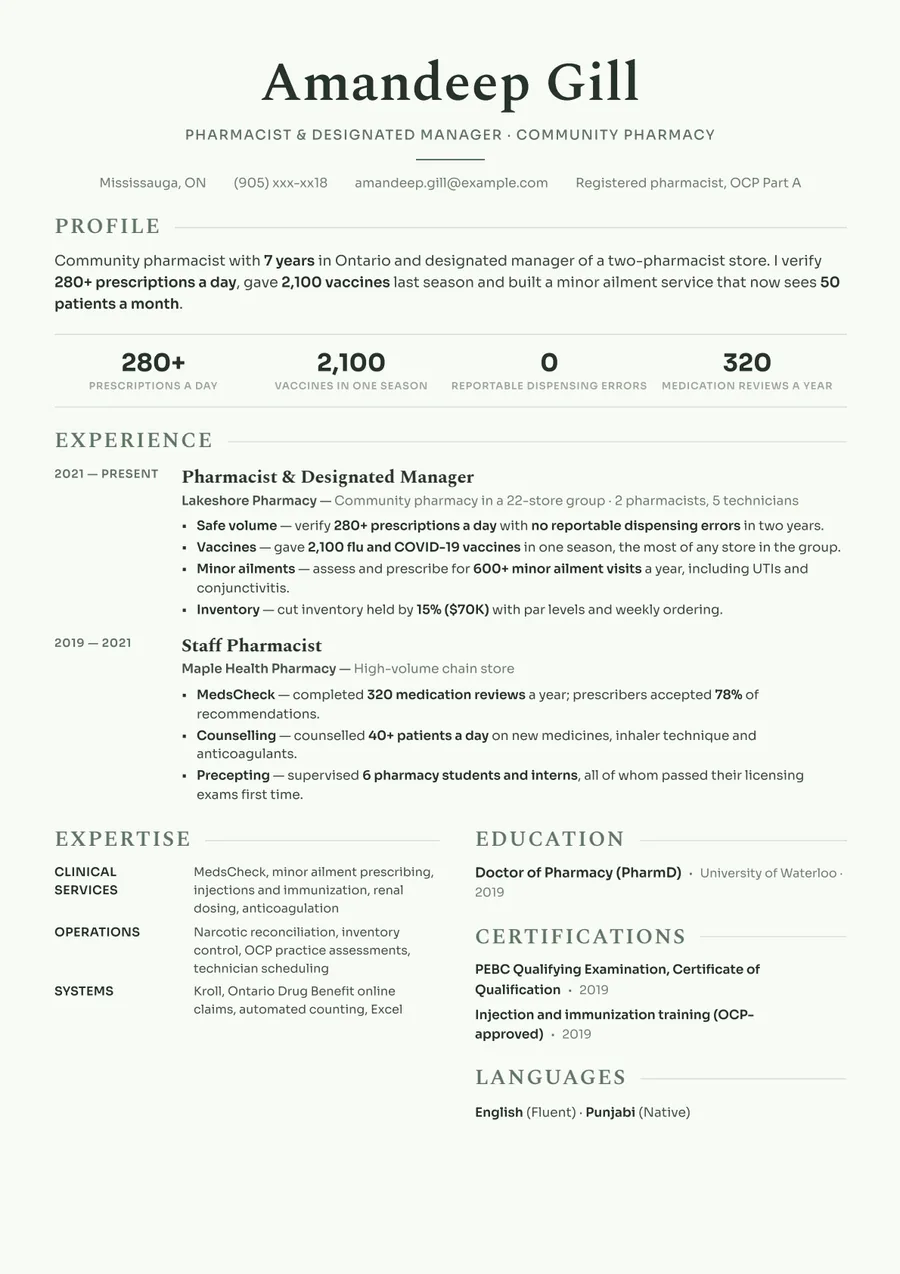
Best resume format for a pharmacist
Use reverse-chronological order with your registration near the top. New graduates and early-career pharmacists should fit everything onto one page. Two pages suits experienced community, hospital and clinical pharmacists, and pharmacists applying for residencies, research or teaching posts often need a fuller CV with publications and presentations.
A section order that works: a header with your degree and credentials after your name (for example PharmD, BCPS), licensure and registration, a short summary, experience, clinical skills and services, certifications, then education with rotations or placements. ResumeInk's standard section headings stay fixed, so add a custom section headed Licensure and Registration for your licence details.
A calm, single-column layout reads best. The Classic and Formal layouts suit most pharmacy roles; the Academic layout puts education first for new graduates and residency applicants, and the academic CV template guide covers publications. In the UK and India the document is usually called a CV, and the CV vs resume guide explains the difference.
What to include in a pharmacist resume
- Licence or registration: the regulator, state or province, status and year. Give the number where employers expect it, such as a GPhC registration number in the UK.
- Setting and scale: community, hospital, clinic, long-term care or industry, plus prescriptions a day, beds covered or sites supported.
- Clinical services: immunisations, medication reviews, medicines reconciliation, anticoagulation, minor ailment prescribing, smoking cessation or medication therapy management.
- Safety record: dispensing error rates, controlled drug audits, inspection outcomes and incidents you helped prevent.
- Systems: dispensing and hospital software by name, automation such as dispensing robots, and electronic prescribing.
- Leadership: technicians and assistants supervised, interns or trainees precepted, and the rotas or budgets you ran.
- Education: degree, residency or foundation training, and specialist credentials such as BPS board certification or independent prescribing.
Never include patient-identifying details, even in a case example. Other clinical roles follow a similar pattern; compare the nurse resume guide.
Pharmacist certifications and credentials by country
- US: a PharmD from an ACPE-accredited school, the NAPLEX, and the MPJE or the state's own law exam lead to a licence from each state board of pharmacy. List every state you are licensed in. BPS board certifications such as BCPS, BCACP or BCOP, PGY1 or PGY2 residencies and an immunisation certificate strengthen clinical applications.
- UK: an MPharm, a foundation training year and the registration assessment lead to registration with the General Pharmaceutical Council (GPhC) in Great Britain, or with the Pharmaceutical Society of Northern Ireland. Independent prescriber status is an annotation on the register; say if you hold it.
- India: a D.Pharm, B.Pharm or Pharm.D from a PCI-approved institution, then registration with your State Pharmacy Council as a registered pharmacist. Give the council and your registration number.
- Australia: an accredited degree, a supervised internship and the registration exams lead to general registration with the Pharmacy Board of Australia through AHPRA.
- Canada: the PEBC Qualifying Examination and a licence from the provincial regulator, such as the Ontario College of Pharmacists. Internationally trained pharmacists start with PEBC's evaluation process.
Pharmacist resume summary examples
Open with your registration and setting, then one result. Three examples to adapt:
- Entry level: Newly licensed pharmacist with a PharmD and rotations in community, internal medicine and ambulatory care. Counselled 400+ patients during rotations, completed 60 medication reviews under supervision and holds an immunisation certificate. Licensed in Ohio.
- Mid level: Community pharmacist and designated manager with seven years in Ontario, verifying 280+ prescriptions a day in a two-pharmacist store. Gave 2,100 vaccines last season and built a minor ailment service that now sees 50 patients a month.
- Senior: Lead clinical pharmacist and independent prescriber with 12 years in UK acute care. Runs the antimicrobial stewardship programme across 14 wards, cut broad-spectrum antibiotic use by 17% in a year and leads a team of nine pharmacists and technicians.
New graduates can borrow structure from the guide to a resume with no experience, then add rotation numbers in place of job results.
Pharmacist resume bullet point examples
- Verified and dispensed 280+ prescriptions a day in a high-volume community pharmacy with no reportable dispensing errors in two years.
- Gave 2,100 flu and COVID-19 vaccines in one season, the highest total in a group of 22 stores.
- Assessed and prescribed for 600+ minor ailment consultations a year, including urinary tract infections and conjunctivitis, referring 8% on to a doctor.
- Completed 320 medication reviews in a year, finding 410 drug therapy problems; prescribers accepted 78% of the recommendations.
- Led antimicrobial stewardship rounds on 3 medical wards, cutting broad-spectrum antibiotic days of therapy by 17% in 12 months.
- Kept the controlled drugs register at zero discrepancies across 4 inspections and introduced a weekly balance check.
- Cut inventory held by 15% (CAD 70K) through par levels and weekly ordering, while keeping back orders under 1% of prescriptions.
- Precepted 6 interns and foundation trainees; all passed their registration exams at the first attempt.
Each bullet gives the setting, a volume and an outcome a manager could check with a reference.
Skills & ATS keywords for pharmacist resumes
Pharmacy job ads are specific, so match their wording where it is true for you:
- Clinical: prescription verification, clinical screening, medication therapy management, medicines reconciliation, patient counselling, drug interactions, renal dosing, anticoagulation, antimicrobial stewardship, TPN, pharmacokinetics.
- Services: immunisations, minor ailment prescribing, medication reviews, smoking cessation, blood pressure checks, opioid substitution therapy, compliance packs.
- Compliance: controlled drugs, pharmacovigilance, USP 795 and 797 compounding, inspection readiness.
- Industry roles: GMP, CAPA, change control, stability studies, regulatory submissions and medical information, for moves into pharmaceutical companies.
- Systems: Epic Willow, Oracle Health (Cerner) PharmNet, PioneerRx, McKesson EnterpriseRx, Kroll in Canada, Fred Dispense or Z Dispense in Australia, ProScript Connect and PharmOutcomes in the UK, Marg ERP in India, dispensing robots.
- Soft skills: clear explanations for patients, calm prioritisation, teamwork with prescribers and nurses, attention to detail.
Run your file through the ATS resume checker to see how a hiring system reads it.
Common pharmacist resume mistakes
- Registration buried or missing. If an employer cannot see where you are licensed, they may not read further. Put it near the top with the state, province or regulator.
- Duties every pharmacist does. Dispensed medications and counselled patients describes the job, not you. Add volume, services and outcomes.
- No setting. Community, hospital and industry hiring managers look for different things. Make the setting obvious in every job title or scope line.
- One resume for every role. A hospital post wants clinical depth, a retail chain wants throughput, services and leadership, and industry wants GMP and documentation. Tailor the summary and skills.
- Expired certificates. Check immunisation, CPR or BLS dates before you list them.
- Patient details. Even an anonymised case can identify someone in a small community. Describe the problem type and the outcome only.
Before you send it, check that your degree, licence and certificate names match the wording on your registration exactly, because employers verify them against the public register.
Premium, ATS-friendly templates


Build your resume in minutes
Upload your current resume, edit anything, then preview and download it free.
Upload your resumeFrequently asked questions
How do I write a pharmacist resume with no experience?
Lead with your degree, licence or registration status and your rotations, placements or internship, giving numbers such as patients counselled or reviews completed. Add certificates like immunisation training and any pharmacy assistant or technician work you did while studying.
Should I include my licence number on a pharmacist resume?
Always state the regulator, state or province and that your registration is current. Many UK pharmacists add their GPhC number because employers check the public register; elsewhere you can keep the number for the application form.
How do I list PharmD and board certifications on a resume?
Put them after your name in the header, degree first, for example Jane Doe, PharmD, BCPS. Then list each certification with the issuing body and year in your certifications section.
Can I use the same resume for hospital and community pharmacy jobs?
Keep the same facts but change the emphasis. Hospital roles want clinical services, ward work and stewardship, while community roles want throughput, vaccinations, services and leadership, so rewrite your summary and reorder your bullets for each.
Is a pharmacist resume called a CV?
In the UK, India and Australia the word CV is common, and it usually runs to two pages. In the US and Canada a resume of one or two pages is normal, with a longer CV kept for residency, research or academic posts.