Free Receptionist Resume Template & Examples
A receptionist resume is often the first sample of your work an employer sees, so it has to be tidy, accurate and easy to read. Front desk hiring managers look for three things: how many people and calls you can handle, the booking and office systems you know, and a calm, professional manner. This guide works for corporate, medical, hotel and school receptionists, including first-time applicants, with the right format, country notes, summary and bullet examples, keywords and the mistakes to fix.
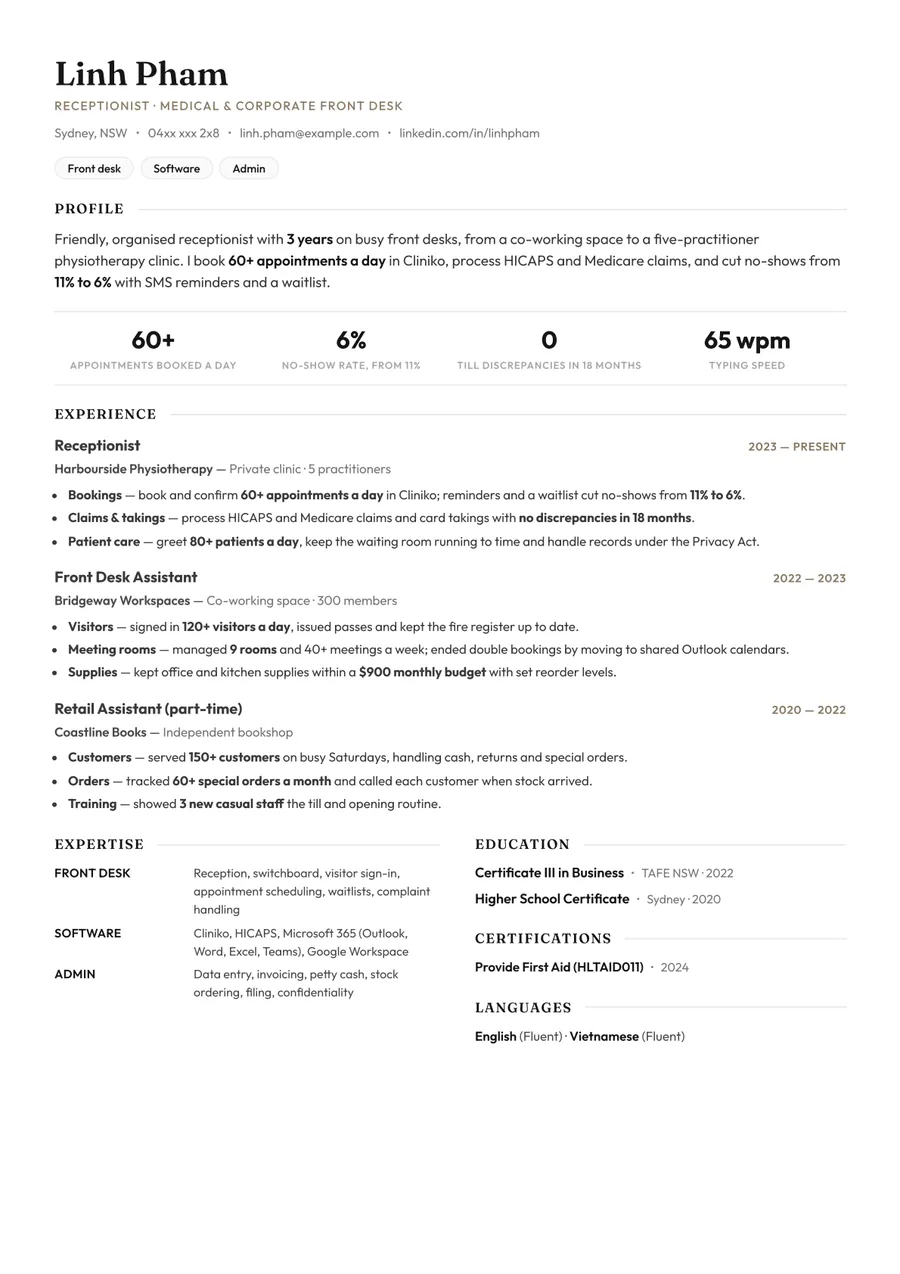
Best resume format for a receptionist
Keep it to one page. That is true for a first job and still true after ten years on a front desk; a receptionist resume that runs to two pages works against you, because organisation is the skill being judged. Use reverse-chronological order if you have front desk or office experience. If you are coming from retail, hospitality or school, a combination format with a skills section near the top lets you lead with what transfers.
A simple order: header, a two-line summary, key skills, experience, education and certificates. Add a line for languages if you speak more than one; at a busy desk that can decide the shortlist.
Choose a clean layout with real text. ResumeInk's Compact header layout fits a lot onto one page with your skills as small chips under your name, and the Skills-first layout suits career starters. More options sit in the one-page resume templates. On photos: leave one off in the UK, US, Canada and Australia, while hotel desks in India and the Gulf often expect one, which the resume templates with a photo handle neatly.
What to include in a receptionist resume
- Type of desk: corporate office, GP or dental practice, hotel, salon, school or law firm. Each has its own pace and systems.
- Volume: visitors or guests a day, calls a day, lines on the switchboard and the number of people whose diaries you managed.
- Systems: phone system, booking or practice software, visitor sign-in tools, Microsoft 365 or Google Workspace, and your typing speed if it is strong.
- Admin tasks: post and couriers, meeting rooms, supplies, petty cash, invoices or data entry.
- Security and confidentiality: visitor passes, key logs, fire registers, and handling patient or client data under GDPR, HIPAA or local privacy rules.
- Problems you solved: double bookings ended, waiting times cut, a filing backlog cleared.
- Checks and certificates: first aid, background checks for schools and healthcare, and any admin or hospitality qualification.
For desk roles that lean further into office support, see the administrative assistant resume guide.
Receptionist certifications and credentials by country
No country requires a licence to work as a receptionist. Employers look at experience, presentation, systems and references instead, and some sectors add checks or short qualifications.
- US: medical offices may ask for the Certified Medical Administrative Assistant (CMAA) credential from the NHA and for HIPAA training. Hotels value the AHLEI Certified Front Desk Representative, and a Microsoft Office Specialist certificate backs up software claims.
- UK: a Level 2 or 3 qualification or apprenticeship in business administration or customer service helps. GP surgeries may value AMSPAR qualifications, and schools, nurseries and healthcare settings carry out a DBS check.
- India: hotel front office roles favour a hotel management degree or a front office diploma; corporate desks look for a graduate with clear spoken English, Hindi or the local language, and MS Office.
- Australia: a Certificate III in Business, Hospitality or Health Administration is common, along with a current first aid certificate. Schools and childcare centres need a Working with Children Check.
List checks as current and give the year they were issued, but keep certificate and ID numbers off the page.
Receptionist resume summary examples
Two or three sentences: the desk you work on, the volume you handle and one thing you improved. Adapt one of these:
- Entry level: Friendly, organised school leaver with 18 months of weekend retail work, used to serving 200+ customers a shift and handling cash and returns accurately. Types 55 words a minute and is confident in Outlook, Word and Excel. Looking for a first front desk role in a busy office or clinic.
- Mid level: Medical receptionist with three years in a five-practitioner physiotherapy clinic, booking 60+ appointments a day in Cliniko and processing HICAPS and Medicare claims. Cut no-shows from 11% to 6% with SMS reminders and a waitlist.
- Senior: Front of house supervisor with nine years in corporate offices, leading a team of four across reception, switchboard and meeting rooms for 650 staff. Set up the visitor sign-in system and trained the team on fire and evacuation duties.
Starting out? The guide to a resume with no experience shows how to turn part-time work into evidence.
Receptionist resume bullet point examples
- Greeted and signed in 120+ visitors a day at a six-floor corporate office, issuing passes and keeping the visitor log ready for fire drills and audits.
- Answered a 12-line switchboard taking about 150 calls a day, routing callers to the right person first time and cutting abandoned calls by a third.
- Booked and confirmed 60+ patient appointments a day in Cliniko for a five-practitioner clinic; reminders and a waitlist cut no-shows from 11% to 6%.
- Checked in up to 90 guests a shift on Opera PMS and sold room upgrades worth about AED 18,000 a month.
- Managed bookings for 9 meeting rooms and 40+ meetings a week, ending double bookings after moving the office to shared Outlook room calendars.
- Balanced petty cash and card takings daily with no discrepancies in 18 months.
- Kept office and kitchen supplies within a GBP 900 monthly budget by setting reorder levels and switching two suppliers.
- Wrote a front desk handbook and trained 3 new receptionists, each running the desk alone within a week.
Numbers from a front desk are easy to find: count visitors, calls, bookings and the people you support, then add one before and after.
Skills & ATS keywords for receptionist resumes
Receptionist ads repeat a short list of terms. Use the ones that match your experience, in the same words:
- Front desk: reception, front of house, greeting visitors, visitor management, switchboard, multi-line phone system, call handling, mail and courier handling, meeting room booking.
- Admin: diary management, appointment scheduling, data entry, filing, petty cash, invoicing, stock ordering, minute taking.
- Software: Microsoft 365 (Outlook, Word, Excel, Teams), Google Workspace, Opera PMS or Cloudbeds for hotels, Cliniko, Dentrix, EMIS Web or SystmOne for medical practices, Envoy for visitor sign-in.
- Customer care: complaint handling, de-escalation, professional phone manner, confidentiality, GDPR or HIPAA awareness.
- Soft skills: calm under pressure, multitasking, accuracy, discretion, reliability, a friendly manner.
- Extras: typing speed in words per minute, languages, first aid.
There is more on choosing and wording skills in the skills to put on a resume guide.
Common receptionist resume mistakes
- An objective instead of a summary. Seeking a challenging role says nothing. Name the desk you want and what you bring to it.
- No volume. Answered phones could mean five calls or two hundred. Add the numbers.
- Missing software. If the ad names Opera, Cliniko or SystmOne and you have used it, it must appear by name.
- Typos and mixed formatting. For a job built on accuracy, one misspelt name or two date styles is a real risk. Read it aloud before sending.
- An unprofessional email address. Use a plain one built from your name.
- Too much on unrelated jobs. Keep old roles to one or two lines and spend the space on what shows you can run a desk.
Once the format is right, the customer service resume guide has more ways to describe handling people well.
Premium, ATS-friendly templates


Build your resume in minutes
Upload your current resume, edit anything, then preview and download it free.
Upload your resumeFrequently asked questions
How do I write a receptionist resume with no experience?
Lead with a short summary and a skills section, then show retail, hospitality, volunteering or school office work where you served people, handled cash or kept records. Give numbers such as customers served or calls answered, and keep it to one page.
What should a receptionist resume summary say?
Say what kind of desk you have worked on or want, the volume you can handle and one strength or result, in two or three sentences. Leave out general claims like hardworking unless a fact backs them up.
What skills should I put on a receptionist resume?
Combine front desk skills such as call handling, scheduling and visitor sign-in with the software you know, such as Outlook, Excel or a booking system. Add soft skills like staying calm under pressure and confidentiality, plus your typing speed and languages if they are strong.
Should a receptionist resume have a photo?
In the UK, US, Canada and Australia leave the photo off, because employers judge on skills and want to avoid bias. In India, the Gulf and parts of Asia, hotel and corporate front desk roles often expect a professional photo.
How is a medical receptionist resume different?
It should name the practice software you use, such as EMIS Web, SystmOne, Cliniko or Dentrix, and show that you handle patient data confidentially. Add any medical terminology training and how many patients or appointments you managed each day.