Free Lawyer Resume Template & Examples
A lawyer resume is read by people who edit for a living, so precision matters more than design. Partners, general counsel and legal recruiters look first for where you are admitted, then your practice area, the matters you worked on and the level of responsibility you carried. This guide covers the format for associates, in-house counsel and senior lawyers, how admission works in the US, UK, India and Australia, legal CV conventions, summary and bullet examples, and the mistakes that weaken strong candidates.
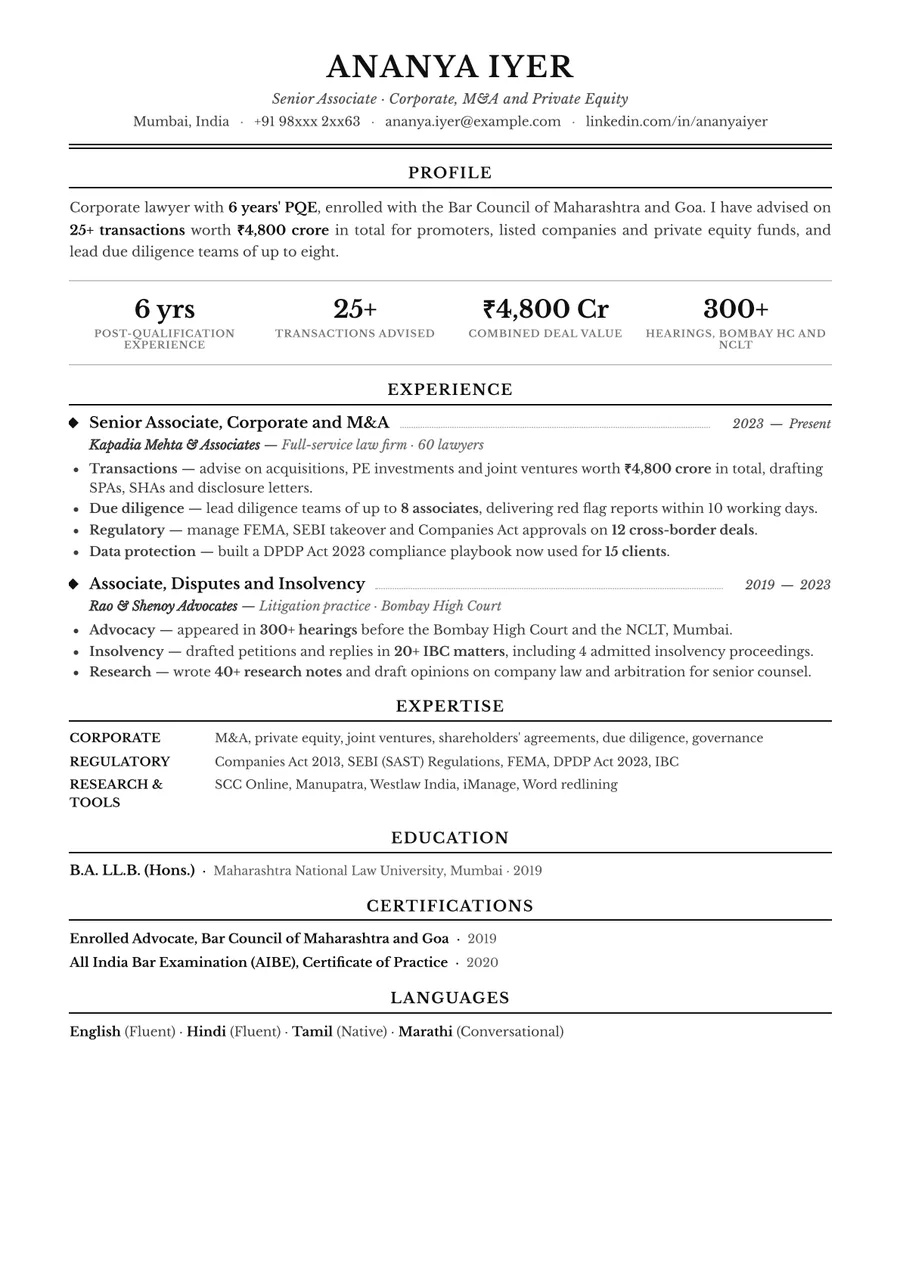
Best resume format for a lawyer
Length follows local convention. In the US, law students and junior associates keep to one page, and a senior attorney rarely goes past two, with a separate deal sheet or list of representative matters if needed. In the UK, India and Australia a legal CV of two pages is normal from the first job.
A section order that works: header, admissions, a short summary, experience, representative matters, education, then publications and pro bono. US law graduates usually put education first, with GPA, class rank, honours and law review or moot court; UK firms still read A-level and degree results closely. Group your work by practice area if you have moved between teams.
Choose a restrained, single-column design. ResumeInk's Formal and Traditional layouts suit law firms and chambers, and the Academic layout puts education first for students. Admissions sit well in a custom section headed Bar Admissions. See the traditional resume template for the look, and the one page vs two page guide if you are unsure about length.
What to include in a lawyer resume
- Admissions: every jurisdiction and court you are admitted to, with the year, and any admission pending.
- Practice area and seniority: corporate, disputes, employment, IP or regulatory, plus your post-qualification experience in years.
- Representative matters: deal type, value or claim size, sector, forum and your role, such as lead associate or second chair. Name a client only where the matter is public and your firm allows it.
- Advocacy: hearings, trials, arbitrations and motions you argued or drafted, and the outcome where you can share it.
- Commercial impact: contract turnaround, matters handled without outside counsel, lower spend on panel firms, or billable hours against target.
- Education and honours: degree and class or GPA, law review, moots, scholarships and clerkships.
- Pro bono, publications and languages: they show judgement and range, and a second language can decide cross-border roles.
In-house candidates should add the business context too: the sector, the size of the company and who you advised, from the board to sales teams.
Lawyer certifications and credentials by country
Admission is the credential that matters, and it is granted locally. State it exactly.
- US: bar admission is state by state, usually after a JD from an ABA-accredited law school, the bar exam (the UBE in many states) and the MPRE. List each state and year, plus federal courts, for example New York, 2020; S.D.N.Y., 2021. If results are pending, say so.
- UK: solicitors in England and Wales are admitted to the roll and regulated by the Solicitors Regulation Authority (SRA). New entrants qualify through SQE1, SQE2 and two years of qualifying work experience, while many current solicitors took the LPC and a training contract. Barristers are called to the Bar by an Inn of Court, complete pupillage and are regulated by the Bar Standards Board. Scotland and Northern Ireland have their own professions.
- India: after an LLB from a BCI-recognised college, advocates enrol with a State Bar Council and pass the All India Bar Examination (AIBE) for the Certificate of Practice. Give your enrolment number and year.
- Australia: a law degree and practical legal training lead to admission by the Supreme Court of a state or territory, then a practising certificate from the local regulator, often restricted during an initial period of supervised practice.
Lawyer resume summary examples
Summaries are optional for junior lawyers in the US, but useful for lateral moves and in-house roles. Keep them factual:
- Entry level: Recent JD graduate admitted in New York, with a judicial internship in the Southern District and two years on the law review. Drafted 15 bench memos and reached the national moot court quarter-finals; looking to join a commercial litigation team.
- Mid level: Corporate associate with six years' PQE, enrolled with the Bar Council of Maharashtra and Goa. Advised on 25+ acquisitions, private equity investments and joint ventures worth INR 4,800 crore in total, and leads due diligence teams of up to eight.
- Senior: Solicitor and head of legal for a UK software group, admitted in England and Wales in 2011. Built a three-lawyer team, cut outside counsel spend by 40% and negotiated the group's largest customer contract, worth GBP 22M over five years.
For in-house moves, the consultant resume guide has useful ideas on showing commercial impact.
Lawyer resume bullet point examples
- Advised on 25+ acquisitions and private equity investments worth INR 4,800 crore in total, leading diligence and drafting share purchase and shareholders' agreements.
- Led due diligence on a GBP 85M acquisition, coordinating 6 trainees and paralegals across 1,900 documents and delivering the red flag report in 10 days.
- Second-chaired a 5-day ICC arbitration, drafting the statement of claim and witness statements; the tribunal awarded the client USD 4.2M plus costs.
- Managed a docket of 45 active commercial cases in state and federal court and drafted 11 summary judgment motions, 9 of them granted in full or in part.
- Appeared in 300+ hearings before the Bombay High Court and the NCLT, Mumbai, in company law and insolvency matters.
- Cut contract turnaround from 18 to 10 days by building a playbook and templates for 120+ customer and supplier contracts a year.
- Ran a GDPR compliance programme for a 1,400-person group, closing 32 audit findings and training 600 staff.
- Represented 25 tenants pro bono in eviction proceedings; 19 kept their homes.
Describe each matter by type, size and your role. Exact client names can stay off the page.
Skills & ATS keywords for lawyer resumes
Large firms and in-house teams screen with applicant tracking systems, so use the practice terms from the ad:
- Core legal skills: legal research, drafting, negotiation, advocacy, due diligence, contract review, regulatory advice, case management, client counselling.
- Practice areas: mergers and acquisitions, private equity, capital markets, banking and finance, commercial litigation, arbitration, employment, intellectual property, real estate, insolvency and restructuring, data protection.
- Regulation by market: GDPR and UK GDPR, the DPDP Act 2023, the Companies Act 2013 and the IBC in India, and SEC or FCA rules for finance roles.
- Research and practice tools: Westlaw, Lexis+, Practical Law, SCC Online and Manupatra in India, iManage or NetDocuments, Relativity for e-discovery, Clio, DocuSign and contract lifecycle tools.
- Soft skills: judgement, clear writing, client management, working to deadlines, discretion.
The guide to ATS keywords explains how to mirror an ad without stuffing it.
Common lawyer resume mistakes
- Missing or vague admission. Licensed attorney says less than New York, 2020. Name every jurisdiction and the year.
- Naming confidential clients. It can breach duties to clients and worries the reader. Describe the sector and size instead, unless the matter is public.
- Practice areas with no matters. A list of fields is a claim; three representative matters with your role are evidence.
- Legalese and long paragraphs. Short, plain bullets show the clarity clients will rely on.
- Hiding grades where they are expected. US firms ask for GPA early in a career and UK firms for degree class; leaving them out invites questions.
- One version for private practice and in-house. Firms want billable work and technical depth; companies want commercial judgement and breadth. Tailor the summary and the order of bullets.
A short cover letter is still expected for many legal roles, and the cover letter guide shows how to write one.
Premium, ATS-friendly templates


Build your resume in minutes
Upload your current resume, edit anything, then preview and download it free.
Upload your resumeFrequently asked questions
Should a lawyer's resume list bar admission?
Yes, near the top, with every jurisdiction and the year of admission, plus federal or higher courts where relevant. If you have passed the exam but are not yet admitted, write admission pending and the expected date.
How long should a lawyer resume be?
In the US, one page for students and junior associates and up to two for senior lawyers, with a separate list of representative matters if needed. In the UK, India and Australia a two-page legal CV is normal.
How do I describe confidential matters on a legal resume?
Describe the matter by type, sector, value and your role, for example advised a listed pharmaceutical company on a USD 300M acquisition. Name the client only when the matter is public and your firm or former employer allows it.
How do I write a resume as a law student or new law graduate?
Put education first with grades, law review, moots and scholarships, then internships, clerkships, research work and pro bono clinics. Keep it to one page in the US and two in the UK or India, and add your admission status once you have it.
Is a legal CV different from a resume?
In the UK, India and Australia lawyers usually send a CV of about two pages with full academic results, while US lawyers use a shorter resume. Many UK training contracts and most pupillages are applied for through firm forms or the Pupillage Gateway instead of a CV.