Free Architect Resume Template & Examples
A good architect resume works alongside your portfolio. The portfolio shows what your buildings look like; the resume proves what you were responsible for. Practices want project types and sizes, the stages you led, your software and, above all, your registration status. This page covers format, licensure in the US, UK, India and Australia, summary and bullet examples, keywords and common mistakes, for graduates, project architects and associates. Upload your current resume as a PDF, Word file or photo, and ResumeInk rebuilds it in a clean, ATS-readable design.
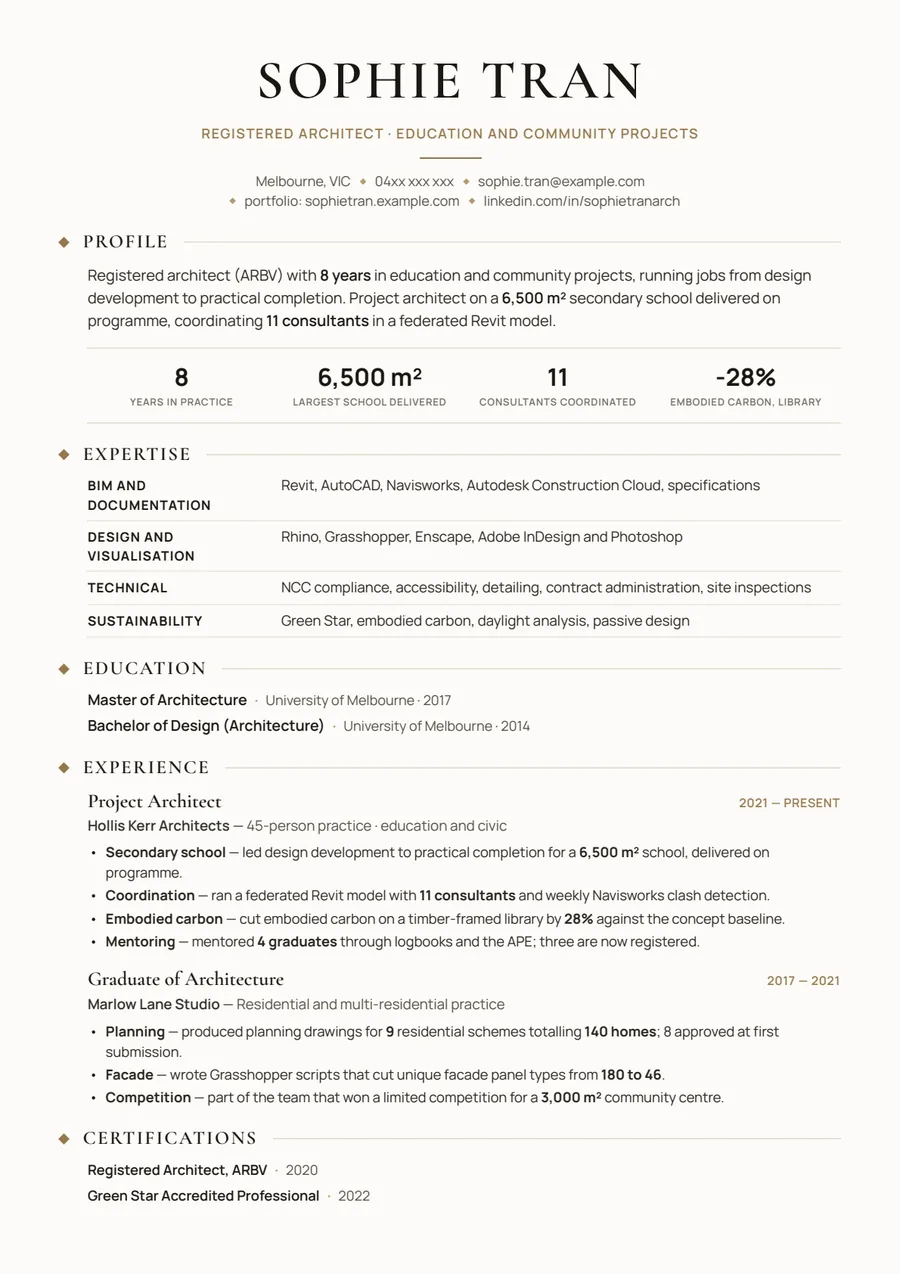
Best resume format for an architect
Use reverse-chronological order and keep the resume itself text-based. One page suits students, graduates and architectural assistants; two pages suit project architects and associates with a longer list of built work. Drawings and renders belong in a separate portfolio, a short PDF of your best projects or a website, linked from your header.
A practical order: header with portfolio link, a short summary with your registration status, experience with projects under each role, selected projects, software, education, registration and memberships, then awards and competitions. If a practice asks for one combined PDF, keep the CV pages text-based at the front and the images after them.
Layout tip: architects notice typography. ResumeInk's Atelier layout, with its centred editorial header and refined spacing, and the Letterpress layout give you that without hurting readability, since both keep real, selectable text; the elegant resume template page shows more. A photo is common in India and the Gulf but usually left off in the US, UK and Australia; if you want one, see the resume template with photo.
What to include in an architect resume
- Header: name, city, phone, email, LinkedIn and a portfolio link that opens without a login.
- Summary: registration status, years in practice, sectors (residential, healthcare, education, workplace, heritage) and one project result.
- Experience: for each practice, the projects you worked on with type and size, your role, and the stages you covered, using RIBA Plan of Work stages in the UK or schematic design through construction administration in the US.
- Selected projects: three to five with a short description, location, area, status and your contribution.
- Software: BIM and CAD, 3D and rendering, and graphics tools, grouped.
- Education: degree, school and year, plus your thesis project as a graduate.
- Registration and memberships: your licence, register entry or exam progress, and memberships such as the AIA, RIBA, the Indian Institute of Architects or the Australian Institute of Architects.
- Sustainability credentials: LEED AP, BREEAM, Certified Passivhaus Designer, IGBC AP or Green Star Accredited Professional, if you hold one.
Architect certifications and credentials by country
In each country below, architect is a protected title. Until you are registered or licensed, call yourself an architectural assistant, graduate of architecture or architectural designer, and show your progress instead.
- US: a licence from a state board, typically after a NAAB-accredited degree, the Architectural Experience Program (AXP) and every division of the Architect Registration Examination (ARE), both run by NCARB. List your state licence, and your NCARB Certificate if you hold one, since it eases licensing in other states.
- UK: registration with the Architects Registration Board (ARB), traditionally after qualifications known as Part 1, Part 2 and Part 3. RIBA chartered membership is separate and optional but widely recognised.
- India: registration with the Council of Architecture (CoA) under the Architects Act, 1972, after a recognised five-year B.Arch. Indian resumes often show the CoA registration number.
- Australia: registration with your state or territory board, such as the NSW Architects Registration Board or the Architects Registration Board of Victoria, after an accredited degree, logged practical experience and the AACA's Architectural Practice Examination.
- Canada: a licence from a provincial association, such as the OAA in Ontario, usually after the ExAC exam.
Architect resume summary examples
Status, sector, scale. Adapt these to your stage:
- Entry level: Part 1 architectural assistant with a BA (Hons) in Architecture and 12 months at a residential practice, producing planning drawings in Revit for nine housing schemes. Confident with Rhino, Enscape and the Adobe suite, and starting Part 2 study next year.
- Mid level: Registered architect (ARBV) with eight years in education and community projects, running jobs from design development to practical completion. Project architect on a 6,500 square metre secondary school delivered on programme, coordinating 11 consultants in a federated Revit model.
- Senior: Licensed architect (New York) and LEED AP with 16 years in healthcare design, now an associate leading a studio of 12. Took a 220-bed hospital expansion through construction administration and introduced design reviews that cut contractor RFIs by 30% on later projects.
Still studying? Read how to write a resume with no experience alongside these.
Architect resume bullet point examples
Give the project, its scale, your stage and the result:
- Led design development and construction documents for a 6,500 square metre secondary school, coordinating 11 consultants in a federated Revit model with weekly clash detection in Navisworks.
- Produced planning drawings for nine residential schemes totalling 140 homes; eight were approved at first submission.
- Ran construction administration for a 42,000 square foot office fit-out, answering 260 RFIs with an average turnaround of three working days.
- Reduced embodied carbon on a timber-framed library by 28% against the concept baseline through structural and material changes.
- Wrote Grasshopper scripts to rationalise a facade, cutting unique panel types from 180 to 46 and saving the fabricator weeks of shop drawings.
- Prepared the heritage statement and detailing for a Grade II listed warehouse conversion, securing listed building consent.
- Mentored four graduates through their logbooks and practice exams; three were registered within two years.
- Won a limited design competition for a 3,000 square metre community centre against five shortlisted practices.
Be precise about your share: led, coordinated and contributed to tell the reader three different things.
Skills & ATS keywords for architect resumes
Mirror the job ad and use the stage names your market uses, such as RIBA stages 2 to 6 in the UK or SD, DD, CD and CA in the US:
- BIM and CAD: Revit, ArchiCAD, AutoCAD, Navisworks, Autodesk Construction Cloud, BIM coordination to ISO 19650.
- Design and visualisation: Rhino, Grasshopper, SketchUp, Enscape, Lumion, V-Ray, Twinmotion, Adobe Photoshop, InDesign and Illustrator.
- Technical: construction documents, detailing, specifications, building codes (the IBC in the US, the Building Regulations in the UK, the National Building Code in India, the NCC in Australia), accessibility, fire strategy coordination.
- Process: concept design, design development, planning or permit applications, tender, contract administration, site inspections.
- Sustainability: energy modelling, daylight analysis, embodied carbon, passive design, green building ratings.
- Soft skills: client presentations, consultant coordination, hand sketching, team leadership, clear written communication.
Before you send it, check readability with the ATS resume checker.
Common architect resume mistakes
- Using the title too early. Calling yourself an architect before registration can break the law in the UK, US, India and Australia. Use architectural assistant or designer and state your exam progress.
- Images in the resume. Renders make the file heavy, and hiring software cannot read text inside them. Keep them in the portfolio.
- Project names with no role. A well-known project tells the reader little until you say which stages you worked on and what you produced.
- No scale. Give area, units, beds, value or programme length so a reader can judge the complexity.
- A portfolio link that fails. Test it on a phone and in a private browser window, and avoid links that expire or ask for sign-in.
- An overdesigned layout. Heavy graphics can break parsing. Show your design sense through clean typography instead, and keep the cover letter just as tidy; see how to write a cover letter.
Premium, ATS-friendly templates


Build your resume in minutes
Upload your current resume, edit anything, then preview and download it free.
Upload your resumeFrequently asked questions
Should an architect resume include images?
Keep the resume text-only and put drawings, renders and photos in a separate portfolio linked from your header. Images inside a resume make the file heavy, and applicant tracking systems cannot read text inside them.
Can I call myself an architect before I am licensed or registered?
No, the title is protected by law in the US, UK, India, Australia and Canada. Use architectural assistant, architectural designer or graduate of architecture, and state your exam or experience progress.
How do I write an architecture resume with no experience?
Lead with your degree, thesis and studio projects, plus any internships or placements, giving your role, the software you used and what you produced. Link a portfolio of your best three to five projects, and add competitions, workshops and model-making or fabrication skills.
How long should an architect resume be?
One page for students and graduates, and up to two pages for experienced architects with a project list. Your portfolio carries the visual detail, so the resume does not need to.
Which software should an architect list on a resume?
List the tools named in the job ad that you can use on a live project, usually Revit or ArchiCAD, AutoCAD, Rhino or SketchUp, a renderer such as Enscape or V-Ray, and the Adobe suite. Group them and be honest about your level, since some practices test software skills at interview.